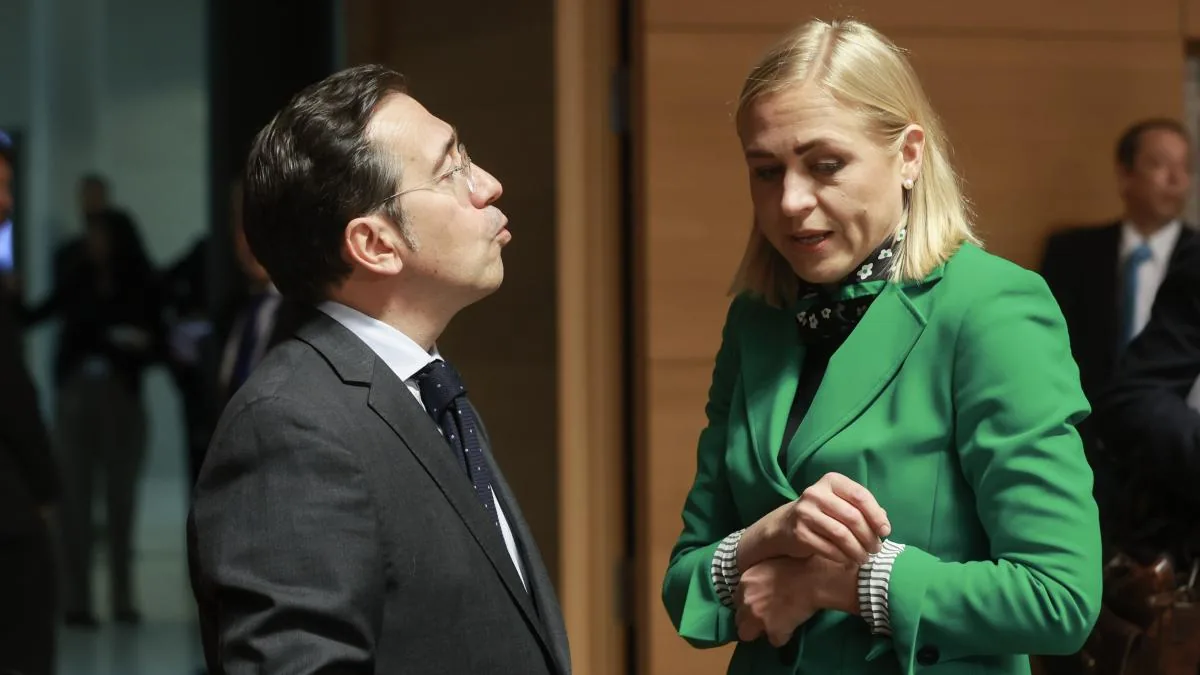
The European Union resists breaking with Israel and has once again ruled out the suspension of the Association Agreement. Not even partially. The issue, which had been formally requested by the Spanish Government, was the focus of this Tuesday’s meeting of Foreign Ministers in Luxembourg, but the Council rejected taking any decision on the matter due to the persistent division among the Twenty-Seven on an issue that remains too delicate for some capitals.
Read more Nestlé announces job cuts for 301 workers in Spain
Starting with Italy and Germany, which consider a European-level action against the government of Beniamin Netanyahu “inappropriate”. The EU High Representative for Foreign Affairs, Kaja Kallas, was clear in the final press conference, stating that she had not seen “a change of positions in the room regarding the suspension”. “Our debate will continue,” she concluded.
No response
Albares warns that Europe’s “credibility is at stake” in this matter, Kallas denies it
At the meeting, the heads of diplomacy of the Twenty-Seven were to share their views on this request from Spain, Slovenia, and Ireland, who last Friday sent a letter to the EU High Representative for Foreign Policy, Kaja Kallas, specifically requesting a review of the agreement at this Luxembourg meeting. In the communication, the ministers recalled that the pact, in force since 2000, is linked to the observance of human rights and international law, something that is currently not being fulfilled, with the bombings on Lebanon, the humanitarian situation in Gaza, or the new death penalty law.
“Today, Europe’s credibility is at stake,” Foreign Minister José Manuel Albares had warned, unsuccessfully, upon his arrival at the summit in Luxembourg. “Since our last meeting, Israel has enacted a new law that, in essence, introduces the death penalty, and that specifically penalizes and targets the Palestinian people. It is totally unacceptable,” agreed his Irish counterpart, Helen McEntee.
These three countries sought to follow up on the autumn proposals, when the European Commission had already taken a significant step by proposing to suspend the commercial part of the Association Agreement with Israel, sanction two extremist Israeli ministers and violent settlers, and halt the allocation of bilateral aid. However, the Community Executive only has its hands free for this last point regarding bilateral funds, a smaller amount. The rest were shelved.
Read also
In the case of sanctions against extremist ministers and violent settlers, unanimity of all Member States is required, as it is a matter of political nuance. Something still impossible to achieve due to Hungary’s blockade, awaiting the incorporation of Péter Magyar’s new Executive. For the rest, a qualified majority in the EU Council is sufficient, i.e., the favorable vote of at least 55% of the Member States —15 out of 27— representing at least 65% of the EU population. Suspending the agreement completely is a much more complicated undertaking, as it also requires unanimity.
Diplomats believed that now, however, a window of opportunity was opening for some kind of action at the European level with the result of the Hungarian elections and the new tone in Rome and Berlin with Tel Aviv. Lately, Germany has been hardening its criticism of Beniamin Netanyahu’s government, while in Italy, Giorgia Meloni has caused a noticeable cooling of relations by suspending the automatic renewal of the Defense Agreement with Israel.
Read more The Government approves the salary increase for teachers and the supplement for excursions
No impact
The shift in Rome with the suspension of the automatic renewal of the Defense Agreement has not materialized in Luxembourg
This has not materialized in the Luxembourg meeting. To begin with, because although the German Foreign Minister, Johann Wadephul, expressed his criticism of the death penalty and settler violence, he pointed out that Berlin remains committed to creating the conditions for a two-state solution, “but this must be done through critical and constructive dialogue with Israel.”
Italy also remains doubtful. “I don’t think blocking a trade agreement is a useful tool,” rejected Minister Antonio Tajani, arguing that “in the end, it affects the Israeli population in general, who often have nothing to do with the acts committed by the military and which are then attributed to the Government.”
His Belgian counterpart, Maxime Prevot, indicated that his country wants at least a partial suspension of the agreement, but at the same time stated that he was aware that a full suspension “is probably out of reach due to the positions of the different European countries.” France and Sweden, for their part, had proposed restricting trade at a European level with illegal settlements in the West Bank, something less complicated among the Twenty-Seven because it does not imply questioning the association agreement, something that some countries like Spain already do.
Although Spain advocated for a full suspension of the agreement as a “strong signal” against the government of Benjamin Netanyahu, yesterday Albares was open to accepting other measures, or only the commercial section. “I ask for one measure, just one. Since Israel launched this permanent war against all its neighbors in the Middle East, there has not been a single response from the EU,” lamented the minister.
Kallas’s response was clear. She reported that she would put the idea of France and Sweden on the table of the Commissioner for Trade, and also responded to Albares’s criticism about the EU’s “credibility.” “Yes, there is no total agreement on all these issues, but will the suspension of the Association Agreement stop the expansion in the West Bank?” she asked. And she added: “The proposals are there, but there is no agreement. So let’s focus on those issues where there is agreement, which are many.”