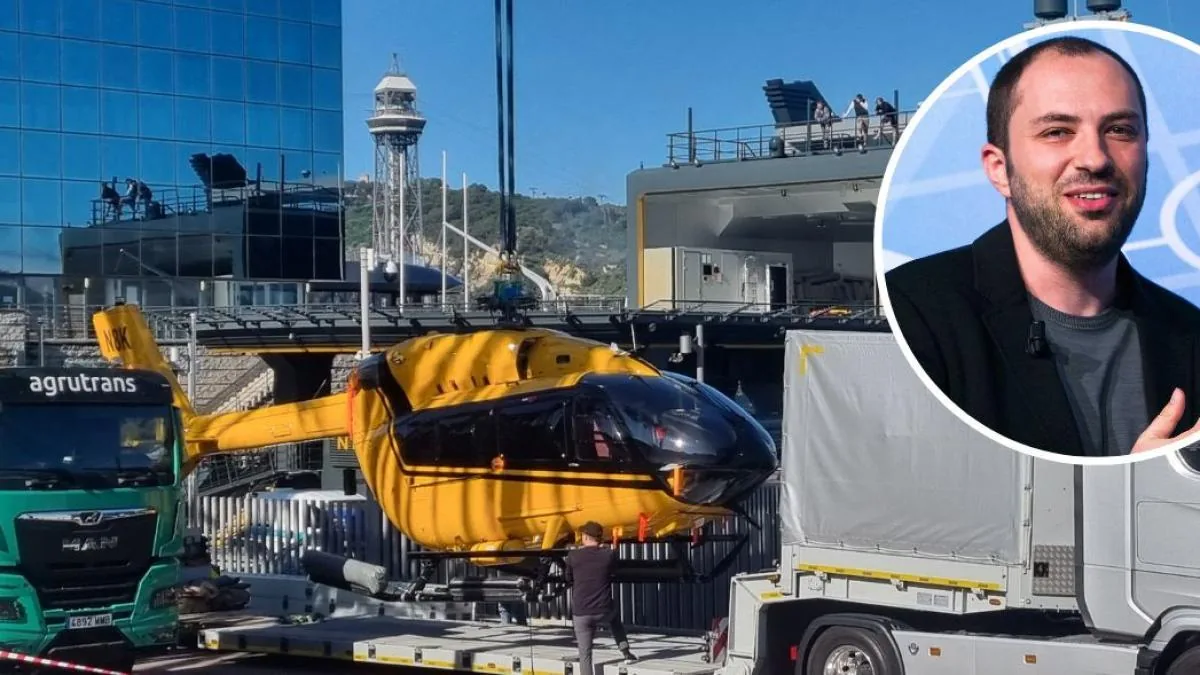
The Joan de Borbó promenade has a double life. On one side, La Barceloneta: that fishermen’s neighborhood transformed into a tourist attraction that, however, retains its usual pulse, with real residents. On the other, the port; Marina Port Vell, one of the most important marinas in the Mediterranean, specialized in large lengths where fifty meters is the minimum not to stand out.
Read more Match in Jódar interrupted due to smoke from Inter fans after winning the Coppa Italia
This morning, next to the Barceloneta restaurant and the control tower of that port area, the usual professional silence of that world was broken by a surgical precision aeronautical logistics operation: a huge crane was going to lift a helicopter worth several million euros into the air as if it were the most routine act in the world.
The Nebula: a support ship surpasses many yachts
The protagonist of the day was the Nebula, a 68-meter-long support catamaran of Spanish construction that has been moored in Barcelona for several weeks. At first glance, it could be mistaken for a recreational yacht, although its function is different: it is the mothership, the logistical assistant of an even larger ship. It carries several auxiliary boats, diving equipment, expedition material, and what makes it a rarity even within this market of excesses, a hangar with capacity for two aircraft.
In recent weeks, that hangar has housed a VIP version Airbus H145, the same twin-engine model that the Generalitat of Catalonia and other autonomous communities use as an air ambulance. Here, however, instead of stretchers, it carries leather upholstery and passengers who do not know what waiting is.
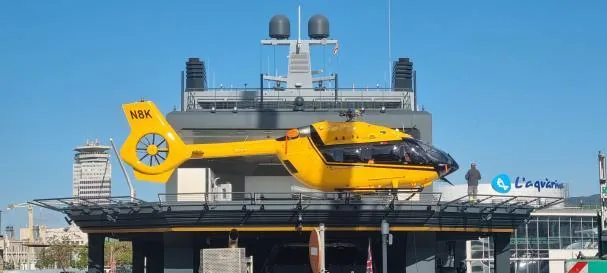
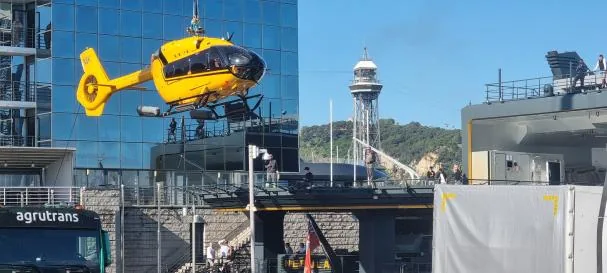
This morning, a very long-armed crane (of the type used in large civil works) positioned itself at the stern of the Nebula. Two heavy trucks waited on land. The helicopter, with the blades disassembled and the yellow fuselage shining under the Barcelona sun (the same Pantone as the ship’s name and its safety rings) was hoisted with calculated slowness. A few minutes later, it rested on the platform of a specialized aeronautical transport company’s gondola truck. Mission accomplished. No incidents, no press photos except those accompanying this text. Discretion in this sector is a professional skill as valued as seamanship.
Behind it all, an engineer who changed how we communicate
Marina Port Vell never publicly reveals who is behind each mooring. It is an unwritten (sometimes signed) rule of the sector: the privacy of the owners is sacred, even though their boats are perfectly visible from different points of Barceloneta or Moll d’Espanya, from the facilities of Club Natació Barcelona or from the port cable car. The names are on the hulls. The identities, supposedly, are not.
In this case, however, the owner’s identity is no secret to those who follow the superyacht market. The Nebula is the auxiliary ship of the yacht Moonrise, and both belong to Jan Koum, one of the founders of an application that, although sometimes it seems it has always existed, has been with us since 2009: WhatsApp.
Read more The Vatican threatens schism to the Lefebvrians if they ordain bishops
Koum, born in Kiev in 1976, emigrated young to the United States with his mother. He spent years working at Yahoo before partnering with Brian Acton to create WhatsApp, a proposal initially rejected by Facebook as a possible employer for both. The irony has a name and surname: in 2014, Facebook (now Meta) paid around 19 billion dollars to acquire the company. Koum and Acton went from being aspiring employees of Zuckerberg to briefly being his forced partners before leaving the company amid frictions over the privacy values they had founded in the app’s DNA.
Acton, in fact, invested 50 million dollars in Signal, the encrypted messaging app, in a gesture many read as a quite explicit message.
The Moonrise: a yacht that is already too small
The main yacht, the Moonrise, is almost 99 meters long, the symbolic barrier that separates the large superyachts from the rest. Built by the Dutch shipyard Feadship and delivered in 2020, it has capacity for sixteen guests attended by a crew of thirty-two people, features a deck pool, another certified helipad, and lounges designed by the French Rémi Tessier, a reference in so-called ‘silent luxury’. The recent asking price on the market: 325 million euros.
The reason for the sale? Koum has already commissioned a new Moonrise. This time 101 meters, again from Feadship, with integrated Starlink satellite system in the superstructure, gym, massage room, hair salon, private cinema, and improvements in propeller design to further reduce underwater noise. When the current yacht (the one that already has a helipad, hangar on its mothership, and thirty-two crew members) falls short, the scale of reference values shifts in a way that is difficult to process from the shore.
Barcelona, involuntary stage of the most discreet luxury
The most striking thing about this morning’s operation is not the logistics (impressive), but the normality with which it unfolded. The workers of these boats know this type of maneuver well. Marina Port Vell, like the MB92 shipyards in the port’s industrial area, operates under the same logic: what happens here is known: the boats are enormous, impossible to hide, but it is not said. Barcelona has been consolidating itself for years as a reference port for these lengths in the western Mediterranean, with infrastructure, technical services, and discretion sufficient to attract vessels that combine Monaco or Palma as their base of operations.
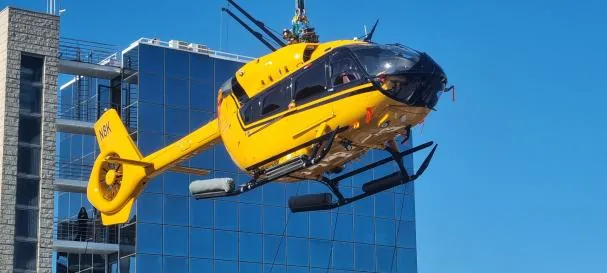
This morning, a yellow helicopter crossed the skies of Barcelona suspended from a crane, to the professional indifference of those operating it and the contained surprise of those going to swim. Few images better summarize the duality of that promenade that unites (and separates) two worlds on the shores of the same sea.
Read more The day actor José Lamuño stopped choosing the shortest path (and discovered something unexpected)