








At 30 kilometers into the race, the Frenchman hit the wall
Two hours, Ed Caesar
—————————————
Nike’s Breaking2 experiment in 2017 marked the turning point.
Eliud Kipchoge, Zersenay Tadese, and Lelisa Desisa, fabulous marathoners, laced up the Nike Vaporfly Elite, jumped onto the Monza circuit, and, surrounded by pacemakers, chased a milestone previously considered impossible: breaking two hours in the marathon.
Read more “Catalunya has a very solid biopharmaceutical ecosystem”
At that time, the official record was Dennis Kimetto’s 2h02m57s, and the experts predicted a long process.
They said:
–According to the logical evolution of the world record, no one will break two hours until 2035.
Or yes.
Or no.
The crazy race for two hours entangles Adidas and Nike in a fascinating experience for humanity
None of those three Breaking2 stars broke the barrier, but Kipchoge came close. He clocked 2h00m25s. And then, the experts believed yes. That perhaps the milestone was closer than anyone had dreamed. And that much of it was due to the shoes, the magic shoes.
–Until Breaking2, innovation had been driven by Adidas (and the infographics accompanying this information illustrate this) –says Raúl Fernández, who was marketing director for Nike Iberia between 2016 and 2021–. The Boost compound Adidas applied in the midsole offered maximum lightness, maximum ground contact, and maximum interaction between the shoe and the foot. It was understood that more contact meant more response. But, of course, those models were not suitable for flesh-and-blood people. The shoe was fast, like spikes on the track, although its cushioning was minimal. It served 10% of marathon participants.
Breaking2 changed the paradigm.
The Nike Vaporfly Elite designed for the project incorporated PEBA (Polyether Block Amide), a new generation foam that increased volume while reducing weight.
For the first time, the prototype’s weight went below 200 grams and the thickness soared to 36 millimeters (until then, it did not exceed 27 mm).
–Such height seemed eccentric. But with more foam and protection, the carbon plate could be incorporated. And thus propulsion was multiplied –says Raúl Fernández, who is also co-founder of the agency Pigeons Solutions and founder of the firm The Running Boy–. An efficiency improvement of 4% was calculated. This does not mean the shoe was 4% faster, but more efficient (less fatigue, less joint wear, more training capacity, better recovery from effort…).
In 2019, boosted by the Nike Alphafly, Kipchoge broke two hours (1h59m40s) in the Ineos project at Vienna’s Prater park, although that laboratory exercise was never homologated since Kipchoge ran without rivals and surrounded by 41 pacemakers who entered and exited the circuit, and the weather conditions were not incidental but analyzed and chosen to the millimeter.
In the following years, both the Nike Alphafly 2 (2022) and the Alphafly 3 (2023) indeed placed man on the threshold of two hours in an official race (see the infographic).
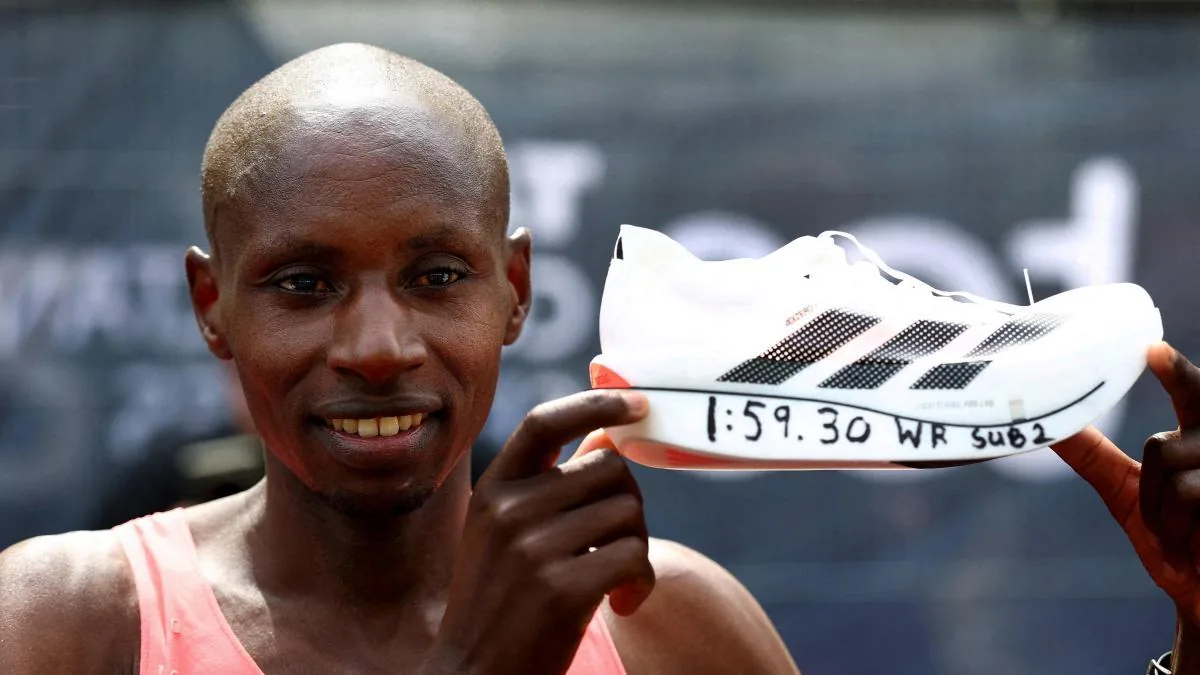
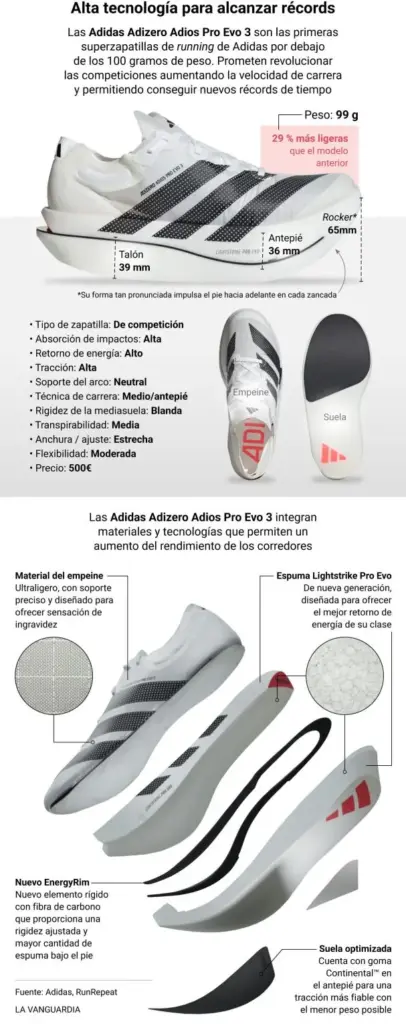
And then, last Sunday in London, Adidas exploded. It did so through its Adizero Adios Pro Evo3 and the feats of two of its treasures, Kenyan Sabastian Sawe (1h59m30s) and Ethiopian Yomif Kejelcha (1h59m41s).
Here we hear from Patrick Nava, general manager of Running Adidas, and Marc Makowski, its senior vice president of Innovation:
–During the last two years, we involved our athletes in the shoe design. We wanted to be the first to break two hours in an official marathon. Everyone came to our laboratory in Germany (Herzogenaurach) and we also visited them in Kenya and Ethiopia. We measured how the elements influenced their performance and ensured that product development adapted to their conditions.
–And how was that process?
–The Evo 1 came out at the end of 2023 and weighed around 130 grams. Then came the 2 and the 3, which is what led us to break two hours. Technologically, the leap was from the 2 to the 3. Weight is a key difference, I mean the 99 grams of the Evo 3. Although weight is a means, not an end. The goal was always to create a faster shoe. From Evo 2 to 3 we reduced running economy by 1.6%. It seems like a small figure, but over a marathon, it makes a difference.
–What are the changes?
–The outsole, extremely thin, made of Continental rubber. And the midsole foam is 50% lighter than that of the Evo 2 (by injecting nitrogen and CO2 into the midsole, the weight plummets). Also, the carbon plate is ring-shaped. This way we eliminated the plate in the three central toes, another factor in weight reduction. And for the upper, we were inspired by other sports, like kitesurfing: we use the same material as kite sails, light and resistant. Even the laces are shorter and more elastic, saving a couple of grams.
And they add:
–The first time we gave the Evo 3 to the athletes, they came in a box and the runners, upon picking up the box, said: “Hey, but there’s nothing here. Why are you giving me an empty box?” But when they opened it, oh surprise! Inside were the shoes.
Nacho Barranco, a journalist expert in athletics, goes beyond the magic shoes.
–Although there has been an improvement with the new models, in a way the shoes already existed before the London race.
In his opinion, the difference is mainly in nutrition, “in the bicarbonate that athletes took two hours before or in the hundred carbohydrates per hour that the marathoner absorbs and that brands like Maurten or Santa Madre design so that Sawe and Kejelcha, respectively, assimilate them immediately.”
–Actually, there were many factors: good weather, the shoes, the circuits, training methods, nutrition. But above all, talent. Kiptum, rest in peace (he died in a car accident in 2024, aged 24), would already have been capable of breaking two hours. The physiological exceptionality of these humans, like Sawe and Kejelcha, has brought us here.
Now, experts await Nike’s response and its franchise man, Jacob Kiplimo.
Read more Picasso Museum, let the music not stop