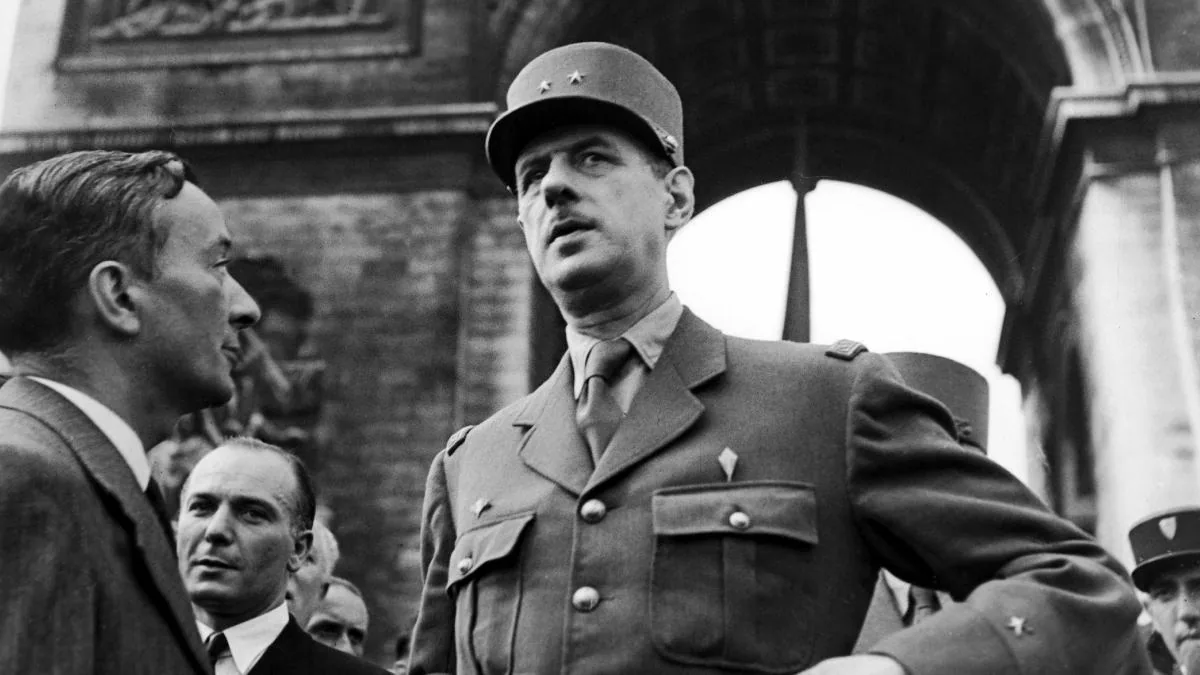
Charles de Gaulle did not trust the Americans. The leader of the French resistance against the German occupation in World War II, and future founder of the Fifth Republic, was perfectly aware that the Allied victory over Hitler owed everything to the United States (even though he publicly tried to downplay its importance). But after the liberation, he soon distanced himself from Washington, whose desire for tutelage he feared. “I am not anti-American just because I am not always on the side of the U.S.,” he declared in a television interview in 1965, during the escalation of the Vietnam War. He would not be, but he did become a symbol of a certain French anti-Americanism.
Read more More than 3,000 immigrants remain on the streets in Ceuta after a tense relocation
Independent and proud, a year after those statements, in 1966, waving the flag of national sovereignty, the old general ordered the closure of the thirty or so military bases that the U.S. maintained in France since the end of the war and withdrew his country from NATO’s integrated military command, which was forced to move its original headquarters from Paris to Brussels (France would not return until 2009, under Nicolas Sarkozy). The earthquake caused by that decision, which is now 60 years old, was more than considerable.
A biopic to the greater glory of De Gaulle has swept this summer in cinemas across France
The figure of De Gaulle has regained its former shine this summer and ignited patriotic spirit in France thanks to the two-part biopic The Battle of Gaulle (by Antonin Baudry), which has swept the cinemas with more than 5.6 million viewers, second only to Oppenheimer by Christopher Nolan. At a moment of confusion in a world where the strongest seek to impose themselves on others, De Gaulle’s resistance to giving in and obeying any external dictate, no matter how old-fashioned the era may seem, undoubtedly evokes parallels with the current troubles caused by Donald Trump’s U.S.
If De Gaulle could glimpse, from his austere tomb in Colombey-les-Deux-Églises, the current European debate on transatlantic relations and the need for Europe to have genuine strategic autonomy in defense matters, he would surely feel vindicated. For decades, De Gaulle’s insistence and that of his successors in the Élysée on this point always clashed with the resistance of the main EU members—mainly Germany and, until 2020, the United Kingdom—against any initiative that could question or weaken NATO as the axis of the Western alliance. Trump’s return to the White House and his internal undermining of the Atlantic Alliance—more dead than alive—has radically changed the scenario.
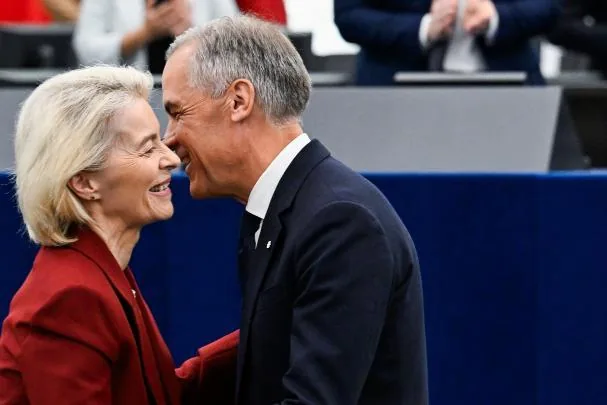
It is in this context that the President of the European Commission, Ursula von der Leyen, took advantage of her State of the Union speech (SOTEU, in community jargon) on Wednesday to launch the proposal to create a European Security Council in which, besides EU members, other allied countries such as Canada, Norway, the United Kingdom, or Ukraine could participate. A mini-NATO as some have called it? In any case, its vocation would be to have mechanisms similar to Article 4 of the Alliance, which provides for a common response—not automatic nor necessarily military—if any member country sees its “territorial integrity, political independence or security” threatened. The EU already has such a clause in its treaty—Article 42.7—and what it would be about is articulating a clear mechanism or protocol of action for when a member country invokes it.
The European Parliament session in Strasbourg also served to stage the mutual rapprochement between the EU and Canada, with whom Trump’s U.S. seems determined to break its historic alliance. If on Wednesday Von der Leyen proposed incorporating Canada into the EU as an “associated member,” on Thursday the Canadian Prime Minister, Mark Carney—one of the most listened to and respected voices on the international stage—picked up the glove and advocated building together with Europe the “next world order, which is fair, stable, and prosperous.” The opposite of the law of the jungle.
It is not clear what incorporating Canada as an associated member means, but it has great strength
Neither the Security Council outlined by Von der Leyen nor the EU “associated member” status (an idea that until now had been considered for Ukraine as a way to accelerate its access to the Union before full entry) have very precise contours. It is also unclear whether such initiatives, or the way they are proposed, will garner broad consensus among the 27. But their symbolic and political strength is undeniable.
European enthusiasm evaporated on the other side of the Atlantic. “This is a partnership [with Canada] that is not against anyone, but in favor of our common strength,” Von der Leyen was careful to warn in the European Parliament, without explicitly mentioning the U.S. But Donald Trump was not fooled and hurried to label the initiative “hostile,” while threatening once again to take reprisals in the form of new trade tariffs. His problem is that his ultimatums have lost their intimidating power and today neither Russia nor Ukraine, nor China nor Iran, nor Israel nor Canada, nor the Federal Reserve nor the U.S. Supreme Court pay attention to him.
The Ceuta crisis. In her speech to the European Parliament, Von der Leyen referred to the Ceuta crisis to underline the European commitment to the Spanish enclave—“The border of Ceuta is a European border (…) and Europe will be there to help you,” she said—and proposed a “new European framework for emergency response” to migration that would include “temporarily relaxing” (that is, lowering the requirements of) expulsion procedures. Solidarity with Ceuta and Spain has so far been rather scarce—recall the letter of the 22 taking advantage of the situation to settle scores with the Spanish president, Pedro Sánchez—and the issue has been used to question Madrid’s extraordinary regularization policy. This confrontation was again experienced in the plenary of the European Parliament, where the pro-European alliance broke once more and the EPP managed to impose its theses with the support of the far right.
Also read
Social networks and minors. In another part of her speech, the Commission President also announced a European initiative to protect minors from abuses on social networks—a “large-scale capture,” she described. The initiative, presented the next day in Brussels, will prohibit access to social networks for children under 13, between 13 and 15 they will only be able to access “mini-accounts” supervised by parents or guardians, and from 15 to 18 providers must ensure a safe design. The regulation (EU Kids Act) provides, among other things, to prohibit infinite scrolling and defines “core sleeping hours” as a period of eight consecutive hours between 10 p.m. and 8 a.m. during which automatic notifications are prohibited. It also bans exposing minors to variable reward systems in video games.
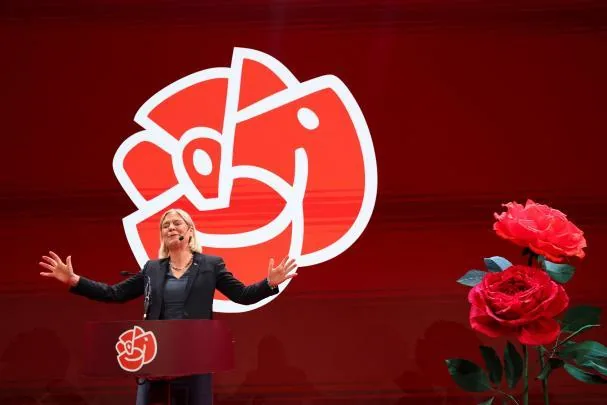
Sweden, against the tide. The legislative elections held in Sweden last Sunday have marked a turning point compared to the majority voting trends in recent times in Europe. Although divided into two blocs, in Sweden the center-left camp—led by Social Democrat Magdalena Andersson, now a candidate for prime minister—ended up prevailing over the right-wing camp, which had been governing until now, according to the final results announced on Thursday. One of the most striking results, by contrast, is the decline of the far right: the Sweden Democrats (SD) received 17.5% of the votes, three points less than in the previous 2022 elections, where they garnered 20.5%, and have gone from being the country’s second political force—and the first on the right—to third place.
Read more The therapist asked her assistant to point out to Jonathan Andic the «dangerous points» of the route