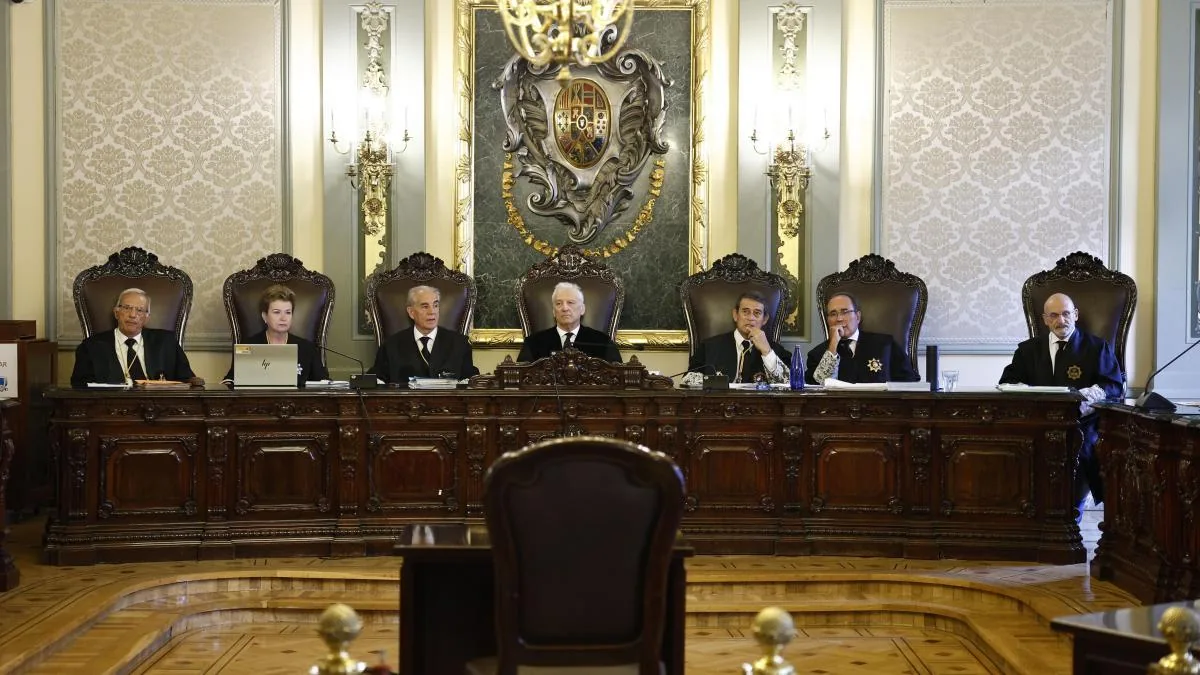
The association Judges for Democracy and the Progressive Association of Prosecutors reminded the Supreme Court this Saturday that its own case law establishes that a large number of people can only be deprived of a fundamental right, such as the right to vote, in cases of “clear legal evidence,” which is not present in the controversy over the so-called ‘grandchildren’s law,’ given the debate established on the matter.
These judicial associations issued a joint statement in which they set out their objections to the precautionary suspension of the right to vote for Spaniards residing abroad who have obtained nationality by being direct descendants of exiles from Francoism, as made possible by the eighth additional provision of the 2022 Democratic Memory Law.
The Minister of Justice, Félix Bolaños, has echoed the statement of the progressive judges and prosecutors and has described the ruling as “very legally debatable.” Furthermore, he requests that the Supreme Court “resolve this issue before the 2027 elections.” “The electoral roll cannot be altered without a solid legal basis.”
The Supreme Court decided this week, responding to an appeal from the Vox and Iustitia Europea parties, to suspend registration in the CERA and therefore the right to vote for beneficiaries who do not prove that they are truly descendants of exiles for political, ideological, or sexual orientation reasons. An instruction from the Ministry of Justice following the approval of the Memory Law in Parliament ordered to consider by default all Spaniards who left the country during Francoism as such.
The progressive associations, in their statement, which they acknowledge largely coincides with the dissenting opinion to the Supreme Court resolution issued by Judge María Alicia Millán, share the ruling’s objective of guaranteeing “the correct formation of the electoral roll and the transparency of electoral processes” and clarifying “the criteria for assigning the municipality of registration for voters residing abroad.”
However, they argue, on the one hand, that the Supreme Court’s resolution affects the aforementioned Justice instruction and that this is “unrelated to the main appeal” of Vox and Iustitia Europea, which targeted the law itself, while the instruction “in this procedure has not been challenged directly or indirectly.”
Read more Artificial intelligence accelerates the transformation of the professional office
No individualized examination
Secondly, JJpD and the APF denounce that, with the Supreme Court’s decision, recognized Spaniards are deprived of a constitutional right “without having been part of the process and without an individualized examination of their situation having been carried out,” and that the accreditation as descendants of political exiles “depends on a certification that they themselves cannot request,” thus generating “a difference in treatment” with other citizens.
Furthermore, they warn that the risk of alteration of the electoral roll cited by the Supreme Court as the reason for its decision “projects onto future and not yet called electoral processes, while the harm caused by the suspension is, on the contrary, immediate and concrete.”
Finally, they recall that “when a precautionary measure limits fundamental rights of a very large number of people, it is necessary that the balancing be carried out with especially intense rigor.” In this regard, they emphasize that “the Supreme Court’s own case law reserves this criterion for cases of clear legal evidence,” while in this case there is a “legitimate interpretative controversy,” which “must be resolved in the substantive judgment, with full contradiction and all guarantees.”
The statement also invokes the principle of legal certainty, recognized in article 9.3 of the Constitution, in which Spaniards who applied for nationality as descendants of exiles placed their trust; a trust that is considered necessary to protect.
For all these reasons, Judges for Democracy and the Progressive Union of Prosecutors trust that the procedure “will be resolved as quickly as possible and, in any case, before any electoral process can be called,” that doubts about the Ministry’s instruction will be resolved through the established channel and not as a response to the appeal by Vox and Iustitia Europea, and they make “a call for the public debate on this issue to be conducted calmly, without turning the electoral roll or the affected persons into objects of partisan confrontation.”
Read more Más Madrid and PSOE attack Ayuso over the penthouse and mock the president’s new residence