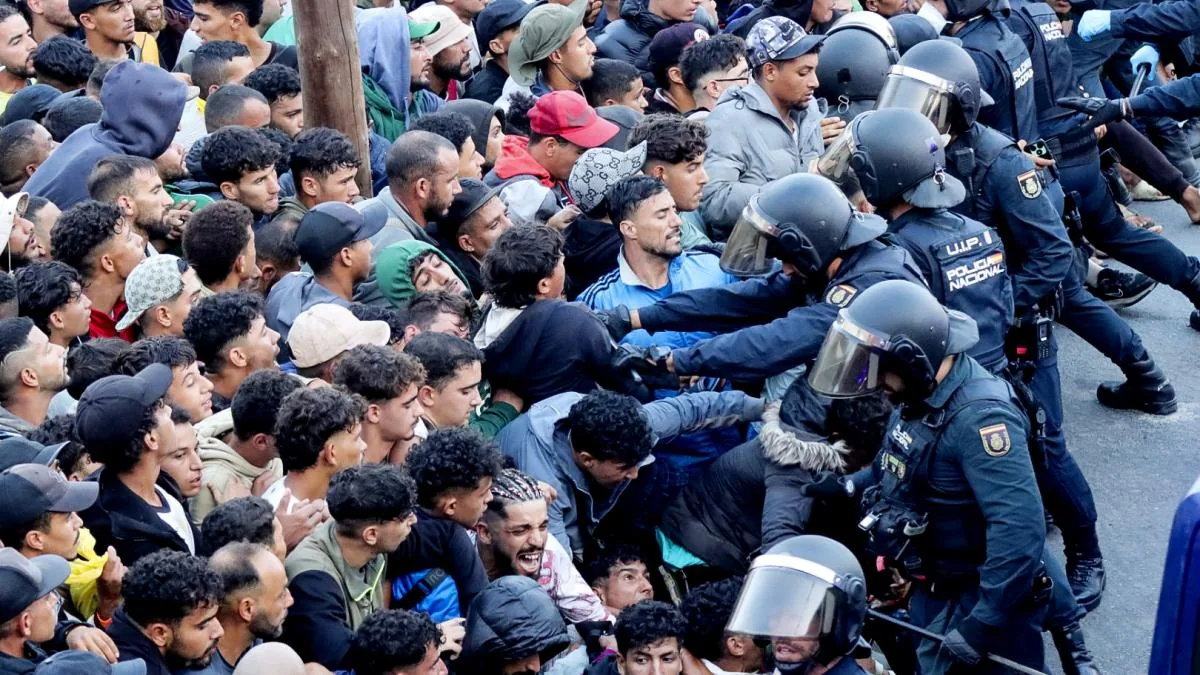
Almost 40 days after the Ceuta incident, the three stages of crisis management – alert, response, and reconstruction – are being reordered. In the “alert” phase, Pedro Sánchez has announced the order to publish and declassify a dossier with all the situation and alert reports prepared between July 1 and August 1 by the CNI, the Police, and military intelligence. This reduces any kind of future or past pressure, such as the leak of the CENIF report that indicated signs of Moroccan permissiveness. A successful move in an aggressive and unprecedented transparency measure to show that the Government does not want to hide anything.
Read more The drama of the Ceuta Diving Board, the beach you would never step on
In the “response” phase, there is also a clear shift in tone in his speech, which will surely increase, towards greater determination against Morocco, as hinted in his appearance in Congress with expressive darts like “this Government is not afraid to confront other foreign powers.” Even abandoning the staunch defense of the uncomfortable neighbor by introducing suspicion about their behavior: “We know that on July 30 the gendarmerie allowed the border crossing. And that afterwards they controlled it.” Moncloa cannot lightly confirm intellectual authorship, but it should never be ruled out. Here too he corrected, balanced, and succeeded.
Spaniards understand the loyalty to the State that the PSOE demonstrated during the ‘procés’ and that the PP ignores
And in the “reconstruction” phase, besides continuing to provide all necessary means to return Ceuta to Ceuta – a herculean task – he succeeds by abandoning the status quo and beginning to write a new model for the two autonomous cities at the international level. Exercising a position of strength in community institutions to Europeanize the border. Unequivocally stating that cooperation with Morocco “has to be different” after what happened, as well as announcing that he will try to secure the permanent presence of Frontex, along with a specific Interpol mission, and the legal consideration of Ceuta and Melilla as outermost regions of the EU.
The State is regaining ground. At this point, it would be an absolute success if King Felipe VI went to Ceuta before the High-Level Week of the United Nations General Assembly from September 21 to 25. This would send an unequivocal message of maximum institutional firmness. Spain would attend the UN with an unbeatable symbolic position of strength and show the whole world that sovereignty over the autonomous cities is an unquestionable State consensus, backed by the Head of State. The King’s presence would also be a historic support for the Ceutan population and their local institutions just before the president presents the border crisis to world leaders, reinforcing the idea that Ceuta “is Spain and Europe at the border”. This is an ideal and natural moment for the president to speak with the opposition leader, Alberto Núñez Feijóo, and establish permanent contact on this crisis.
Read more At least five dead after an Amazon plane crashes near Miami airport

We have been debating for almost 40 days about “who is responsible?”. We will continue doing so, but the question is also another: “Who takes advantage?”. Spaniards are aware of the mistakes that have been made. The Government lacked reflexes, self-criticism, and empathy. Not anymore. Now it is the opposition’s turn. Spain, a fascinating country, deserves a State-level response. And it is an absolute lack of seriousness to appeal to the “treason” of article 102 of the Constitution or to a Supreme Court pirouette against the prime minister in the face of an attack on the country’s territorial integrity in which everyone must be “united”. This is a point of no return. Do not be mistaken. Spaniards understand loyalty to the State. This is how the PSOE behaved, even though it was very painful and without sharing the response, when it practiced a state opposition during the procés and after October 1 (the undersigned was there), before a Government that made a resounding error in its analysis and needed their support. That exemplary attitude, which the PP forgets (José María Aznar is wrong in his thesis of “toughness” with Ceuta), decisively influenced Sánchez’s arrival at La Moncloa only 9 months later.
Next week
The alternative
When short-term tactics or ideological debate are prioritized over State unity, the consequences are profound for the alternative. Border security in Spain has always been treated as a consensus that transcends party lines. The breakdown of this agreement weakens the country’s position externally (Morocco, the EU, and potential aggressors), which may perceive internal division as a vulnerability, continue pressuring with new hybrid attacks, or obtain concessions. The opposition must know that Spaniards take note.
The hawk eye
Whoever can stop, should stop
Fluid cooperation among all administrations is indispensable to manage logistical, humanitarian, and national security emergencies like Ceuta’s. When the relationship is strained by political or personal dynamics, decision-making and coordination become slower and more complex. In cities like Ceuta, with a very diverse demographic composition, raising levels of institutional tension is precisely what causes the conflict to spill into the streets, undermining coexistence. Whoever can stop, should stop.
Read more A disturbing future