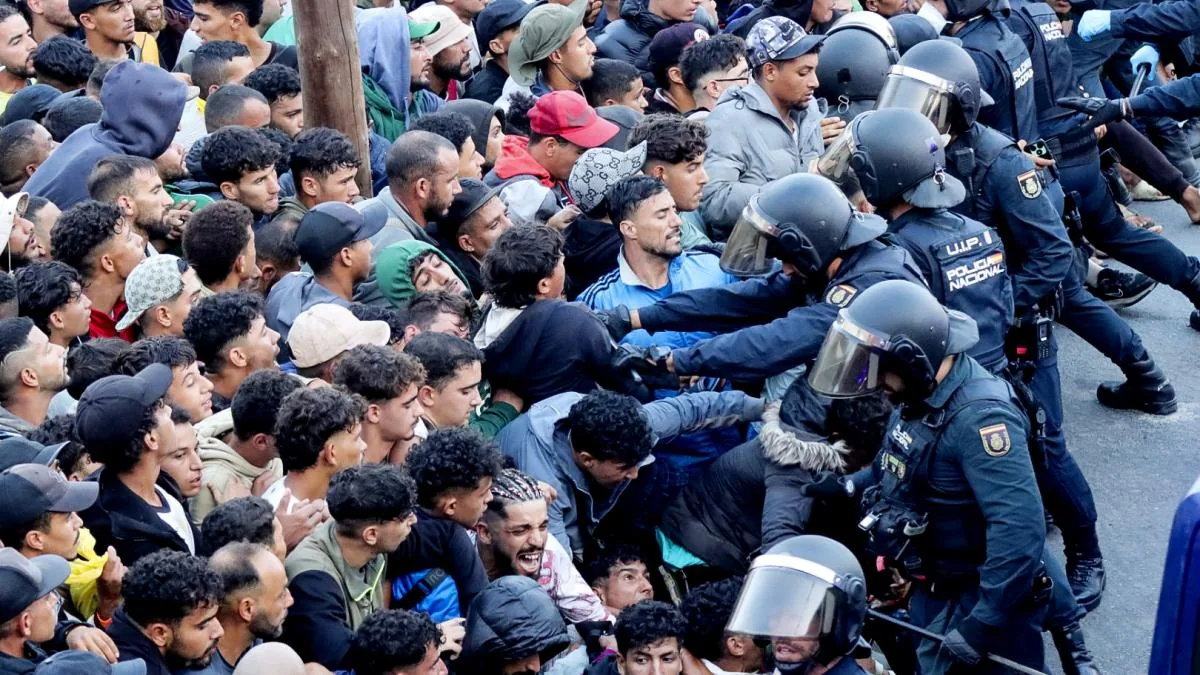
The last plenary session of Congress is one of the most high-voltage parliamentary sessions that have taken place in Spain in recent years. The Prime Minister appeared, at his own request, to report on the situation in the autonomous city of Ceuta. The opposition was waiting to accuse him of “treason,” and none of his parliamentary allies, whether close or more distant, was willing to give him full support. The day before, numerous demonstrations had taken place in the main municipalities of Spain in solidarity with Ceuta. Convened by the Popular Party and Vox, these demonstrations became a cry of protest against the Government.
Harsh, tough, tense, it was an interesting parliamentary debate, at least for one reason: all positions were expressed clearly and bluntly. No one can say that the pulse of society does not reach the Spanish Parliament. Everyone inside. No relevant position is excluded from the parliamentary game today. Pedro Sánchez has been left alone in the Ceuta crisis because his caution with Morocco is not aligned with the majority feeling of society.
The right accuses him of “treason” (Vox) or of acting under Morocco’s blackmail (PP). His parliamentary allies — both permanent and circumstantial — reproach him for too much condescension towards the Moroccan regime. They are a minority who give him the benefit of the doubt or publicly admit that caution is today the best recipe not to worsen things in Ceuta and throughout Spain, since Morocco is a key country for controlling migratory flows, as Libya and Tunisia are for Italy, as Turkey and Egypt are for Greece.
Also read
At ten in the morning on Thursday, when the head of the Executive was finishing his initial intervention, an urgent news appeared on mobile phones: a drifting boat had been located near the Canary Islands, from which eighty of its initial 120 occupants had died during a twenty-six-day journey from Gambia. This small Atlantic nation is located south of Senegal, not far from Mauritania, the “buffer” country that is currently collaborating with Spain, for payment, to prevent a massive arrival of African immigrants to the Canary Islands by sea. The boat left Gambia at the beginning of August, got lost at sea, and only forty of its occupants were rescued alive by Maritime Rescue services. Eighty dead, including several children. This figure represents more than half of the people who died on July 30 and 31 when trying to swim to Ceuta from Morocco. Two hundred and twenty dead between one episode and the other. These dead occupy an almost invisible place today in the heated Spanish public debate. They are hardly talked about, but they are testimony to a dramatic reality, very difficult to solve.
Millions of people want to leave Africa in search of a better future, and in Europe more and more people are getting nervous about the growth of the immigrant population. The government of the world’s leading power, the United States, stokes that fear and tells Europeans that their civilization could disappear. Statistics, however, show that irregular immigrant arrivals are decreasing in the European Union so far this year, except for the recent Ceuta event, undoubtedly provoked.
Irregular border crossings into the EU fell by 40% in the first four months of the year compared to the same previous period, according to data from the European agency Frontex. The route that has decreased the most is the Canary Islands, with a 78% decrease. Let us imagine for a moment that the current Ceuta crisis coincided with a massive arrival of small boats to the Canary Islands.
Let us imagine that the Ceuta crisis coincided right now with a massive arrival of small boats to the Canary Islands
Morocco also influences the Atlantic route: it can contribute to control or relax it; it can tighten surveillance on the coasts of Western Sahara or reduce it; it can influence Mauritania; it can influence Senegal, it can influence Gambia… With the support of the United States and Israel, Morocco is on its way to becoming one of the most powerful countries in North Africa, with growing influence on the Atlantic coast and in the Sahel strip, a region from which France has been expelled in recent years and where Russia has increased its military presence through mercenaries.
You have to look at the map to understand it better. Inherited from a distant past, Spain retains two cities within the territorial framework of a North African country that is on its way to becoming a key force on the very populated Atlantic coast and a possible guardian of the Sahel region. The income difference between Morocco and Spain is 1 to 8, if we compare nominal GDP per capita. It is a country with many internal contradictions, a country with social tension, but with very strong potential that the United States and Israel are overseeing. Reading these days on social networks and in some media certain characters who fantasize about a war between Spain and Morocco over Ceuta and Melilla causes astonishment. They do not know what they are saying. They do not know what world they live in. Let’s say it all: it is not easy nowadays to know what world we live in.
The parliamentary debate was not kind to Morocco, but it was not a declaration of war either. Public opinion is agitated and there are anti-Moroccan impulses in Spanish society that come from long ago and go from right to left. The wars of yesteryear, the trauma of Western Sahara in 1976, the crisis of the Perejil islet, the shift regarding the Sahara in 2022. Even today about 3,000 Sahrawi children travel to Spain every summer invited by Spanish families.
Sánchez’s pragmatism has been left alone among those emotional currents with a historical basis. If to that pragmatism we add the feeling of indolence conveyed by his insistence on not suspending his vacation, although he was permanently in communication with his ministers, we are facing his worst political moment in eight years; worse than the Ábalos, Cerdán, Leire Díez and Zapatero moments, which is saying something.
Read more Shadow here shadow there
Also read
“The news of my death is somewhat premature,” said writer Mark Twain in 1897, while in London, when rumors about his death began to circulate in the United States. We can be sure that the two main opposition parties in Spain do not consider Sánchez dead at this time. So much so that both would like the judges to deliver the final blow. They expressed this with crystal clarity in Thursday’s debate. Vox aspires for the president to be prosecuted by the Supreme Court for “high treason” under article 102 of the Constitution, which regulates the criminal responsibility of members of the Executive. The PP foresees another path from the National Court.
The aforementioned article 102 states the following: “1) The criminal responsibility of the President and other members of the Government shall be enforceable, if applicable, before the Criminal Chamber of the Supreme Court. 2) If the accusation is for treason or any crime against the security of the State in the exercise of their functions, it may only be brought by initiative of one quarter of the members of Congress, and with the approval of the absolute majority of the same. 3) The royal prerogative of pardon shall not be applicable to any of the cases of this article.”
88 deputies are needed to raise the issue. Vox currently has only 32 seats. It would need support from the Popular Party to be able to present the initiative, and the PP currently does not consider that path. An absolute majority of the chamber would be necessary to transfer the accusation to the Supreme Court, whose Second Chamber should open an investigation and put the president on trial if it saw signs of guilt. With the current parliamentary arithmetic, that majority could only be reached with the favorable vote of Junts per Catalunya. Carles Puigdemont (‘Puigdemont to prison!’), would hold the key to the most serious accusation against Sánchez. We will agree that the current legislature is rich in delirious paradoxes. It is a very difficult path, but Vox proposes it to gain political visibility. The banner is eye-catching and allows placing the PP in a bind: you support it or you don’t.
The article 102 route, however, is not a Vox discovery. The hypothesis of a Spanish-style impeachment was raised in a press article last June by jurist Pedro Cruz Vilallón, who was president of the Constitutional Court between 1998 and 2001, coinciding with the mandate of José María Aznar. The idea had an echo in opinion circuits in Madrid and ended up in Vox’s hands.
Abascal considers that Sánchez has committed “high treason” because he would have had prior knowledge of a massive human avalanche at the Ceuta border without giving orders to prevent or try to stop it. The Government, as is known, maintains that it had no reports warning of a massive and accelerated avalanche. Sánchez committed on Thursday to publish in the coming days a dossier with all the reports received in the previous days. That publication will very likely take place next week. There is tension in the Ministry of Defense over the documents from the National Intelligence Center that may appear in that public dossier. On Thursday, the Minister of Defense, Margarita Robles, remained seated on the government’s blue bench, while the other ministers stood up to applaud the initiative announced by the head of the Executive.
No one talks about a motion of censure, PP and Vox focus on the judicial path to end the legislature
Alberto Núñez Feijóo knew that Santiago Abascal was going to propose activating article 102, since Vox had been adopting the suggestion of magistrate Cruz Villalón for weeks. The leader of the opposition made a veiled mention of the Supreme Court in his speech. He said the following, looking at Sánchez: “Look at me, you will pay for it, at the polls and before justice.” And he added: “Yes, judicial responsibility will be resolved during the case that is already open in the National Court, and in which my party has already appeared and will probably escalate to the Supreme Court.”
That is, the Popular Party trusts that the investigation initiated by judge María Tardón in the National Court will pass to the Supreme Court and reach the head of the Executive. (Judge María Tardón was a Popular Party councilor in the Madrid City Council between 1999 and 2003, a period in which she was on leave from the judicial career. She later joined the National Court).
The Supreme Court’s Second Chamber would prosecute Sánchez and put an end to the legislature, as no one dares to present a motion of censure. No one talks about a motion of censure these days, amid extremely serious accusations against the head of the Executive. We will agree that Thursday’s plenary was very instructive.
Read more Towards a happy world