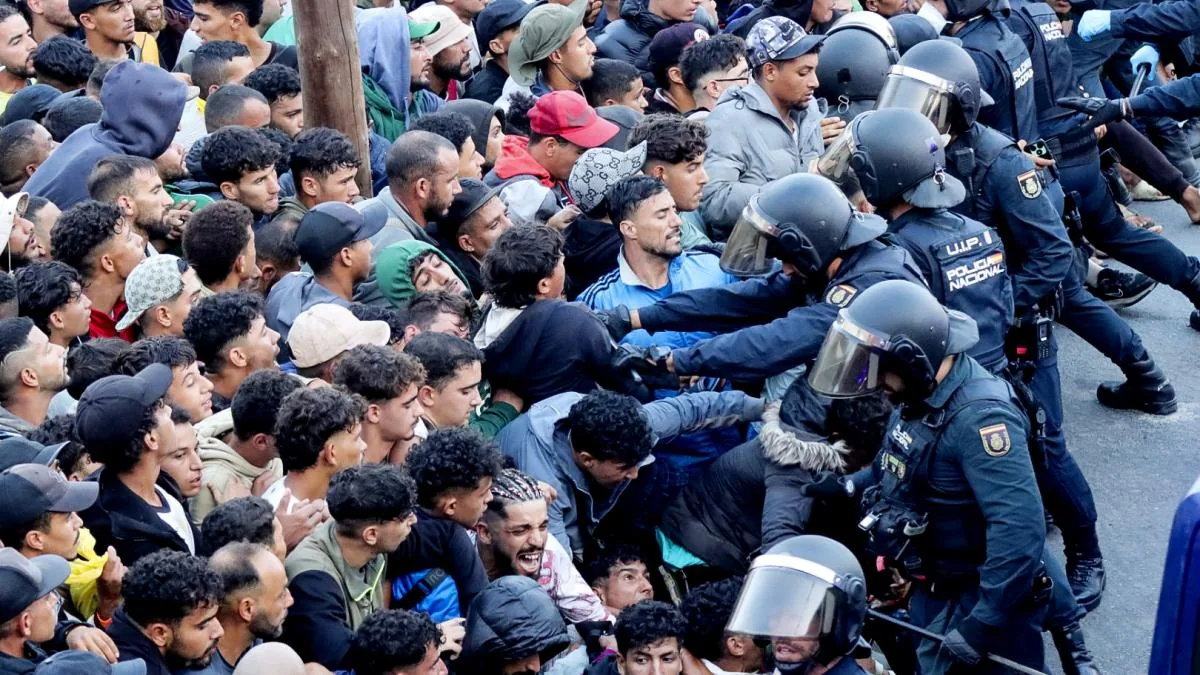
The appearance of Pedro Sánchez in the Congress to give explanations about the Ceuta crisis has confirmed that the Government was wrong throughout August in considering that the incident was almost resolved with the immediate Moroccan decision to reabsorb the people who had arrived swimming to Ceuta. Many returned to Morocco, the vast majority, but not all. Just under 10% remain in Ceuta, minors whom no one claims and mostly sub-Saharan immigrants.
Read more Treasury plans to approve the reform of regional financing despite Madrid’s boycott
Sánchez did not properly assess Juan Jesús Vivas, president of the autonomous city since 2001. He has been in office for twenty-five years, in the French style: long-serving mayors who know the terrain very well. A French style mayor in North Africa. An old-school politician, Vivas is not one of those sycophants who now appear on television, but just because he does not charge does not mean he is weak. Without Vivas, this crisis is impossible to manage. A parade of ministers through the city is useless without the consent or complicity of the mayor-president of Ceuta, a member of the mahogany sector of the Popular Party. In this crisis, Vivas has more authority than Alberto Núñez Feijóo.
Second mistake: not properly gauging the reverberation of the Ceuta event in the different strata of Spanish society. For the older generation, whether they vote Popular or Socialist, the Barranco del Lobo and the Annual Disaster have returned, the two great setbacks of the Spanish army in North Africa in the 1920s, echoes of the past, memories of the Rif War, which brought down the Restoration parties, General Primo de Rivera, and finally the Alfonsine monarchy. Memories of Franco’s Moorish Guard. More recent memories of the humiliating Spanish exit from Western Sahara in 1976, of Sahrawi children spending holidays in democratic Spain, and of Sánchez’s recent turn in 2021, that farewell to the Polisario Front, never debated in Parliament, which Podemos accepted to avoid breaking the coalition government.

All this political-sentimental burden exploded in Sánchez’s hands this summer, while he believed he had the situation under control because the Moroccan Minister of Foreign Affairs, the powerful Nasser Bourita, directly connected to King Mohammed VI, promised Juan Manuel Albares that Morocco would reabsorb all its nationals who had crossed the border, swearing to the Spanish side that the Moroccan government did not provoke the stampede. That may be true, which does not mean that the Moroccan State has nothing to do with what happened.
It is possible that those who instigated it are now surprised by the magnitude of the event, since that avalanche of more than 80,000 people reveals the deep unrest of Moroccan youth, which was already evident a year ago with the protest of the so-called Generation Z, demonstrations that lasted several months and ended badly. They demanded better public services, less corruption, and less waste on football stadiums. Three dead, hundreds injured, and 1,400 prosecuted. Without that wave of protests, started a year ago, what happened at the end of July is probably not understood.
Bourita offered a quick reabsorption of the hematoma, but that promise, largely fulfilled, did not close the trauma. The Barranco del Lobo has returned this summer to a confused and uncertain Spanish society about the future. A quick, cold, and painless solution to a huge crisis was not possible, which magnate Elon Musk immediately viralized with a series of messages on X, the network he owns, with images of wild zombies jumping the wall of a fortified city. “This is what will happen in the United States if the Democrats win again,” said Musk’s message, always at Donald Trump’s service. Draw your conclusions. Sánchez opted for an attitude also inscribed in the Spanish tradition: impassive demeanor. Mistake. This morning’s parliamentary session revolved around that mistake.
Sánchez is a very resilient politician – today he demonstrated it again in Congress – but not a Homeric titan from a Christopher Nolan movie. Those titans only exist in literature. The current Prime Minister’s resilience rests on a mental cooling system that allows him to cool down and distance himself from the tensions around him. Some people have strong mental shielding. Sánchez is one of them. However, that cooling mechanism is incompatible with the “dramatic sense of history.” People with a very sensitive thermostat, with great evocative capacity, usually suffer and are generally incompatible with professional politics.
Read more A Moroccan diabetic minor dies in a reception center in Ceuta
Sánchez is a very resilient politician but not a Homeric titan from a Christopher Nolan movie
There is no capacity for resilience without a certain insensitivity. To solve that, there are counselors and advisors. It is possible that Sánchez’s advisors failed him this summer. Right-wing Spain wanted to recall the Barranco del Lobo, and left-wing Spain, the Green March of Hassan II, with Henry Kissinger behind it, and the subsequent humiliation of the Sahrawi people, now abandoned by almost everyone. Sánchez has been caught between both seismic movements, isolated for the first time. In this circumstance, of strong political significance, some police instances have again felt the call of the forest. Sectors of the State apparatus that operate autonomously in a situation of serious political crisis. It happened in October/November 2017, following the Catalan spasm, and it is happening again now, with the Moroccan spasm. One of Sánchez’s mistakes has been not activating the state scenography with all the trumpets, to discipline and invoke order. Order, the great theme of our time. Liturgical acts discipline.
These have been the axes of this morning’s debate in Congress. Surely aware of the mistakes made last Monday before the microphones of the Ser radio station, the Prime Minister has hardened the tone a bit on Morocco – only a bit -, has toned down references to Russia and Israel, still does not mention the United States – pay attention to this fact – has announced that the King will travel to Ceuta in the coming weeks (no date yet), has promised to publish a dossier with all the police and intelligence reports received by the Executive during the days and hours before the crisis, and has offered maximum support to the city of Ceuta, with an emotional message directly addressed to the people of Ceuta. Emotion is another of Sánchez’s weak points, for the reasons we mentioned earlier.
He began his speech by recalling that the bronze lions on the Congress steps were cast with the cannons seized from the Moroccans in the Battle of Wad-Ras in 1860, the final point of the first African war. After that battle, the limits of the cities of Ceuta and Melilla were expanded, and Spain took possession of Sidi-Ifni, south of Agadir, returned to Morocco in 1969. Fifteen days ago, Sánchez would not have even joked about starting a speech in Congress evoking the Battle of Wad-Ras.
Political victory for the Spanish right, which today has expressed two convergent strategies, with separate points. Vox wants to activate Article 102 of the Constitution so that the Supreme Court tries Sánchez for high treason. This accusation should be presented by 25% of the deputies (Vox does not have them) and approved by an absolute majority of Congress, that is, it would need the votes of Junts. If approved, the Supreme Court should investigate and decide on opening a trial. If convicted, the accused could not be pardoned. That article of the Constitution has never been activated in Spain. The 102 route was publicly suggested last May by jurist Pedro Cruz Villalón, former magistrate of the Constitutional Court, in an article published by El Pais, a thesis later supported by journalist José Antonio Zarzalejos in El Confidencial. Today it is Vox’s banner.
In a harsh and relentless intervention, Núñez Feijóo also referred to the Supreme Court, but that does not mean that the PP will give its votes to Vox to bring the activation of Article 102 to the full Congress. No, for now. The PP trusts in the progression of the investigation opened by Judge María Tardón of the National Court, and contemplates the possibility that the matter jumps to the Supreme Court, with the consequent entry of the Second Chamber, the breakwater of all political cataclysms in Spain.
Conclusion of the debate. Sánchez begins to reconfigure his discourse, the PP doubles down on the judicial route, and Vox directs the ideological battle from the depths of the Barranco del Lobo. The Prime Minister has been labeled a traitor, sold out to Mohamed VI, the object of relentless blackmail by Morocco, but no one has spoken of a motion of censure. The judges are called to close the legislature.
Read more The president of the CGPJ warns Marlaska to have the “utmost respect” for Judge Tardón