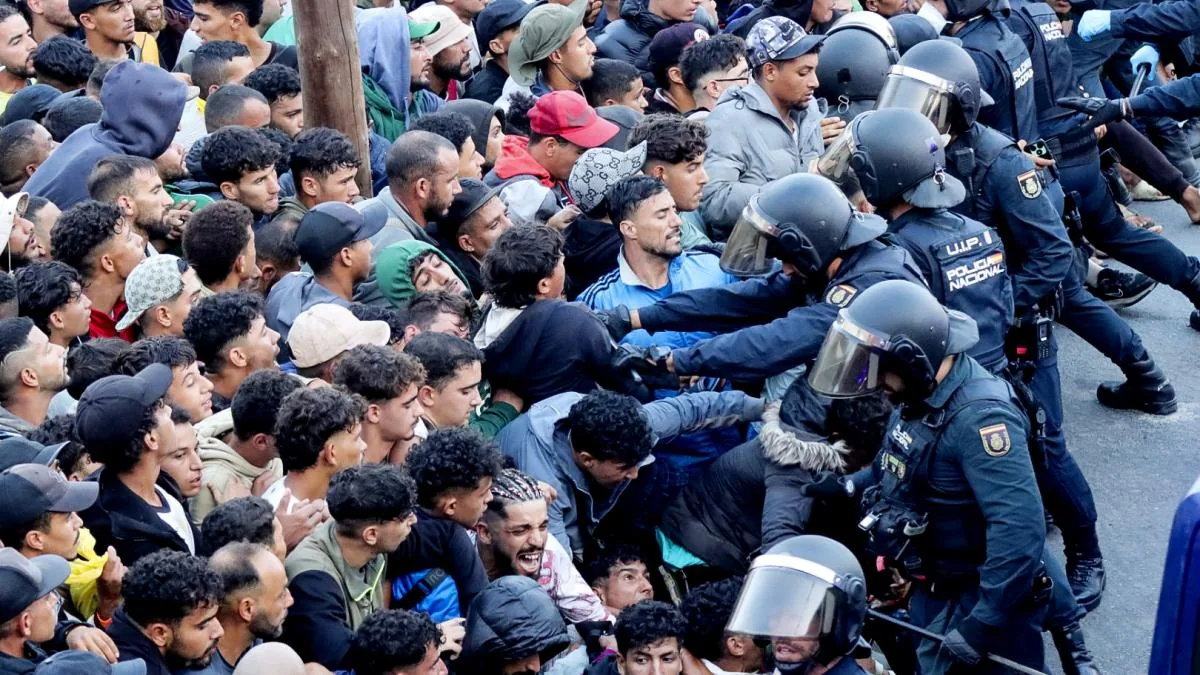
Brussels has no evidence of an alleged Russian involvement in a disinformation campaign that would have caused the migration crisis in Ceuta, as claimed by Pedro Sánchez’s government, but it does believe that Russia is trying to “take advantage” of the complicated situation in which the autonomous city finds itself after the massive crossing it experienced at the end of July.
Read more Andy Burnham blames Brexit for the slow economic growth of the last decade
“In the case of Ceuta, we have seen attempts by Russia to exploit the crisis online,” a community spokesperson told La Vanguardia, one day after the Prime Minister, Pedro Sánchez, stated in an interview on Cadena Ser that Spain’s “brave” foreign policy may have motivated moves by countries such as Russia or Israel to destabilize migration movements through hoaxes and disinformation.
EEAS has detected “significant” activity on social networks to fuel divisions through migration
According to the same source, the EU External Action Service (EEAS) has long seen “significant” disinformation activity on social networks seeking to exploit a topic as sensitive throughout Europe as migration. These campaigns aim to fuel divisions and increase polarization.
However, Brussels says it does not have “conclusive evidence suggesting that the crisis itself was caused by disinformation from foreign state actors.” The EEAS also recalls that, as a service to member states, it “provides periodic assessments of the information environment around specific crises or political events that are important for the collective interests and political objectives of the EU,” and also regularly shares its information with each of the member states when their interests are affected.
Also read
This is a response similar to that given by community spokesperson Guillaume Mercier in early August, when he said that Ursula von der Leyen’s European Commission had already detected some channels, especially from Russia, that were trying to amplify the massive influx of migrants on social networks. This phenomenon occurred, he reported then, after July 30, with no suspicious prior activity observed beforehand.
Read more The U.S. attacks military targets in Iran again in retaliation for its blockade in Hormuz
The European message points to Russia, but the Commission avoids responding to another of Sánchez’s accusations, the one related to Israel. In Europe, the Spanish government is one of the most pressing to punish Tel Aviv for its repression against Gaza, something that, so far, has not borne fruit due to the resistance of several countries, starting with Germany, to confront Israel.
In the initial interview, Sánchez referred to an alleged EEAS report, which has not been made public, to argue that in this crisis a series of hoaxes spread through social networks “associated both with Russia and Israel and an ultra-right international” that always resorts to migration, not only to attack Spain but also Europe.”
Sánchez’s accusations have not been well received in the Kremlin. The spokesperson for the Russian Foreign Ministry, Maria Zakharova, has demanded “concrete facts” from Spain to prove the alleged Russian involvement in a disinformation campaign and warned that only after verification could such an accusation be taken seriously. The government, however, has not changed its position. Investigations in this area, explained from Moncloa, affect national security and much of them are confidential, so the corresponding parliamentary committee, behind closed doors, is expected to be the channel “to report on them and not in a press conference.”