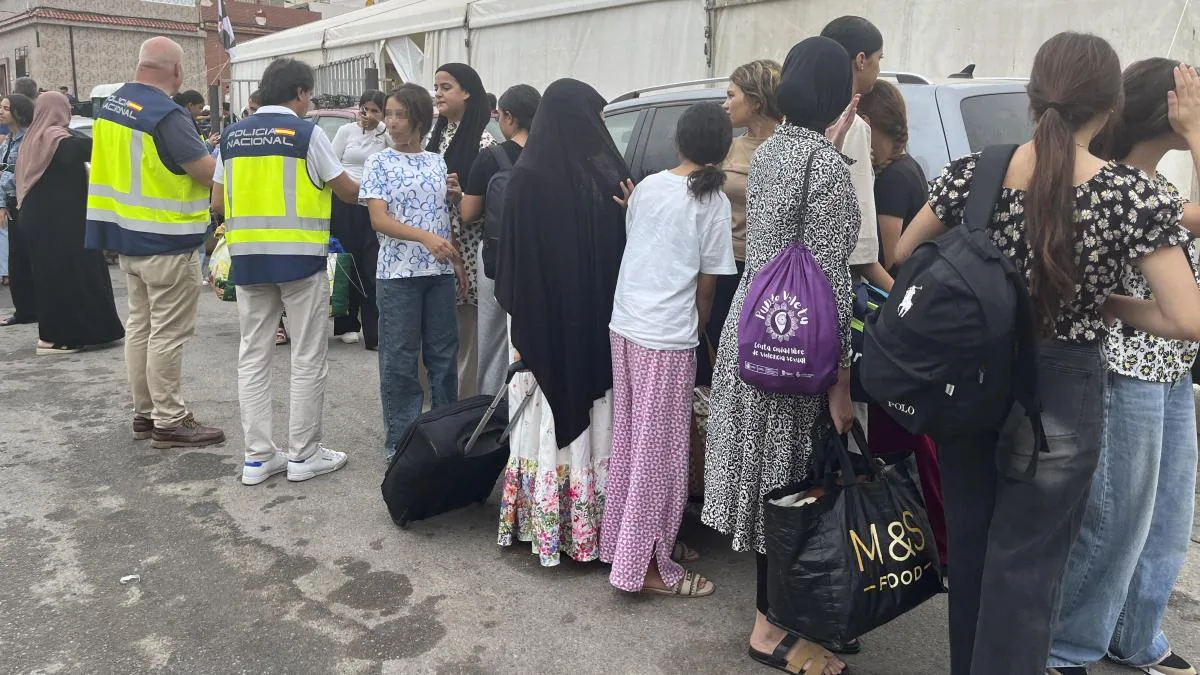
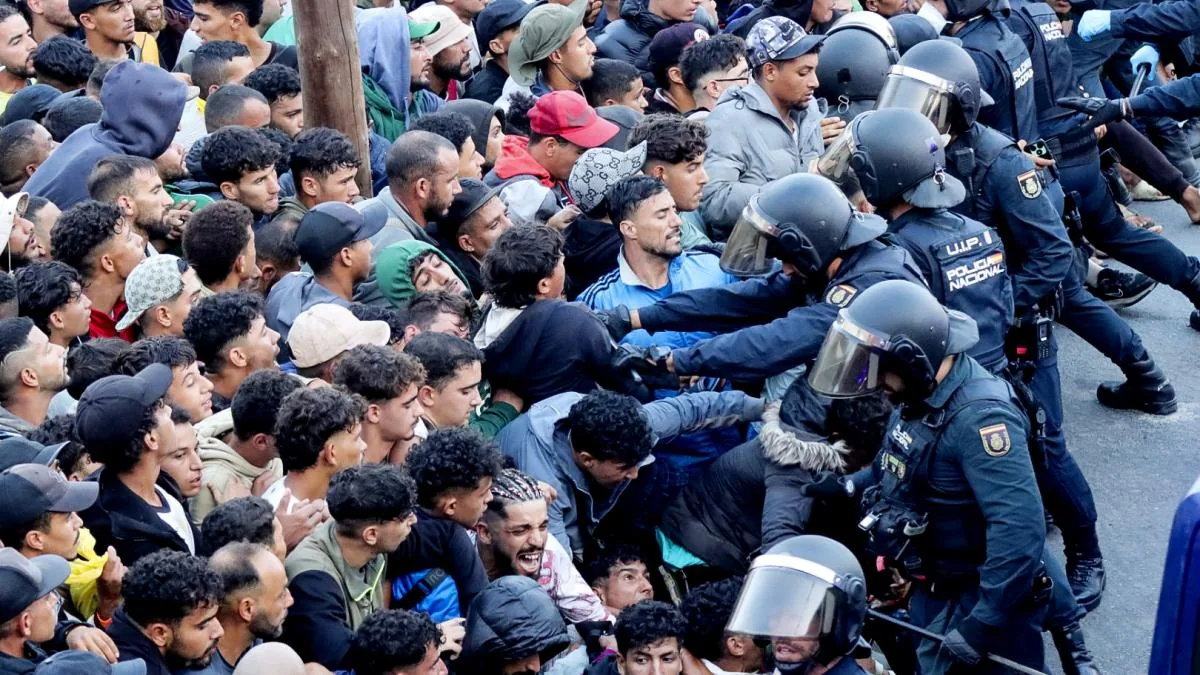
The spark that puts Ceuta on the brink of social explosion began to ignite yesterday. Literally. After days in which tension was starting to overflow the autonomous city, Benítez beach became the image that portrays the state of the autonomous city almost a month after the massive entry of more than 80,000 people. A cordon of riot police separates two realities: in front of the police, hundreds of Ceutans increasingly fed up shout for the immediate expulsion of the “invaders”; behind the officers, also hundreds of immigrants, defiant, show their intention to resist, not to return to their country. The smoke, like a pressure cooker about to blow up, envelops the beach. The smoke comes from the huts of the camp that a group of neighbors set on fire, after destroying it. Neither side is willing to give in anymore. The protesters leave, the police deploy, the Maghrebis rebuild the settlement.
Read more The City Council approves another urban ‘windfall’ of 360 million for Florentino Pérez’s Madrid
The call for calm from the central government, through the single command in the crisis, Ángel Víctor Torres, fell on deaf ears. The Minister of Territorial Policy was honest: “I cannot promise returns tomorrow.” And that is where the heart of the matter lies. The Ceutans understand that after weeks of promises that do not materialize, there is no other way than “the expulsion of all” those who arrived irregularly from Morocco. The same goal pursued by the Executive – with the exception of minors and asylum seekers – but the time frame given by the Ceutans and that handled by Moncloa does not match. The patience of the former has run out. Hence the episode of the burning of part of the immigrant camp was, for now, the latest in the spiral of violence into which the anger of the locals has descended.
A patrol detains twelve immigrants for participating in an ambush against a military vehicle
After a night in which immigrant hunts by ultras were recorded, a group of Moroccans set a planned ambush on a military vehicle, whose front part ended up destroyed. According to police sources, around 5:30 a.m., between 30 and 40 people who were crouched around the surveillance post established in the Bezú neighborhood surrounded the armed forces transport with sticks and large stones. The violence of the attackers caused the four soldiers of the Regulars Group number 54 who were in the vehicle to flee on foot. While trying to get to safety, according to the same sources, they were hit by stones, which caused them minor injuries for which they had to be treated. The National Police who came to the aid of the uniformed officers managed to detain 12 of the alleged attackers. Images of the vehicle with broken windows spread like wildfire among groups of neighbors on WhatsApp, causing great outrage.
As did the viral call to prevent more food from being distributed among immigrants at Trampolín Beach. About a hundred neighbors responded to the call, staging a sit-in in the middle of the avenue that caused the Red Cross convoy to turn back. Under the banner “Ceuta is not for sale, Ceuta is defended,” the protesters considered that “if they continue feeding” the people who entered irregularly “they will never return to their country.” Immediate expulsion or suffocation. Finally, the food (and water) could be distributed, as every afternoon, thanks to another strong police deployment at the Trampolín access points. And when all eyes were on the Red Cross vehicles, the assault on Benítez Beach came, where the huts were reduced to ashes.
A group of neighbors blocks a Red Cross truck to prevent it from delivering food in the settlements
The escalation of tension has had as a turning point the possible use of Ceuta’s sports centers as immigrant reception centers. The government listed them, one by one, in the Official State Gazette, although they would only be used in cases of extreme necessity. But this was seen by the neighbors as the last straw.
Read more A fire forces the evacuation of the town of El Saler (València) and the beach campsites
With this situation, the government stepped on the accelerator yesterday in its plan to “speed up” the procedures that allow managing returns – or asylum. The problem, as Torres admitted, is that it will not be immediate. But the Ministry of the Interior ordered to reinforce the device in charge of carrying out the ‘triage’ of the migrants who remain in Ceuta with the opening of new police work lines in the provisional Temporary Foreigners Reception Center (CATE). Until now, the identification and registration of migrants were being carried out at the Ceuta Superior Headquarters and at the border post, but minors were being prioritized.
Interior reinforces the ‘triage’ device to “speed up” migrant asylum or returns
Now it is the adults’ turn. There are 1,800 beds occupied, but more are needed. Many more. The government plan is to accommodate them in new enabled spaces: for humanitarian reasons, but also to have them close, located. For when their files are resolved.
It is a matter of time. It remains to be seen if the fuse allows time before burning out completely.
The city buries the last victims of El Tarajal
In the Muslim cemetery of the Sidi Embarek mosque rest the bodies of the 88 victims that the Civil Guard managed to recover from the sea after the massive entry of immigrants that began last July 30. Yesterday, late in the afternoon, about a hundred people witnessed the burial of 12 people who died around the Tarajal breakwater. Among them, the only woman without life located by the Armed Institute.
The identified bodies do not reach a dozen. For those who have been named, Morocco has refused to repatriate them. Due to the state of decomposition of the bodies, they were buried in a site that had to be expanded urgently, with concrete niches built in a hurry. Until then, the corpses had been guarded in an improvised morgue on the grounds of the old Military Hospital in refrigerated trucks. The unidentified bodies have been buried in white bags with digits, in case in the future some relative looks for their loved ones. / J. Vera
Read more Yayoi Kusama dies, the parachutist of the polka dots