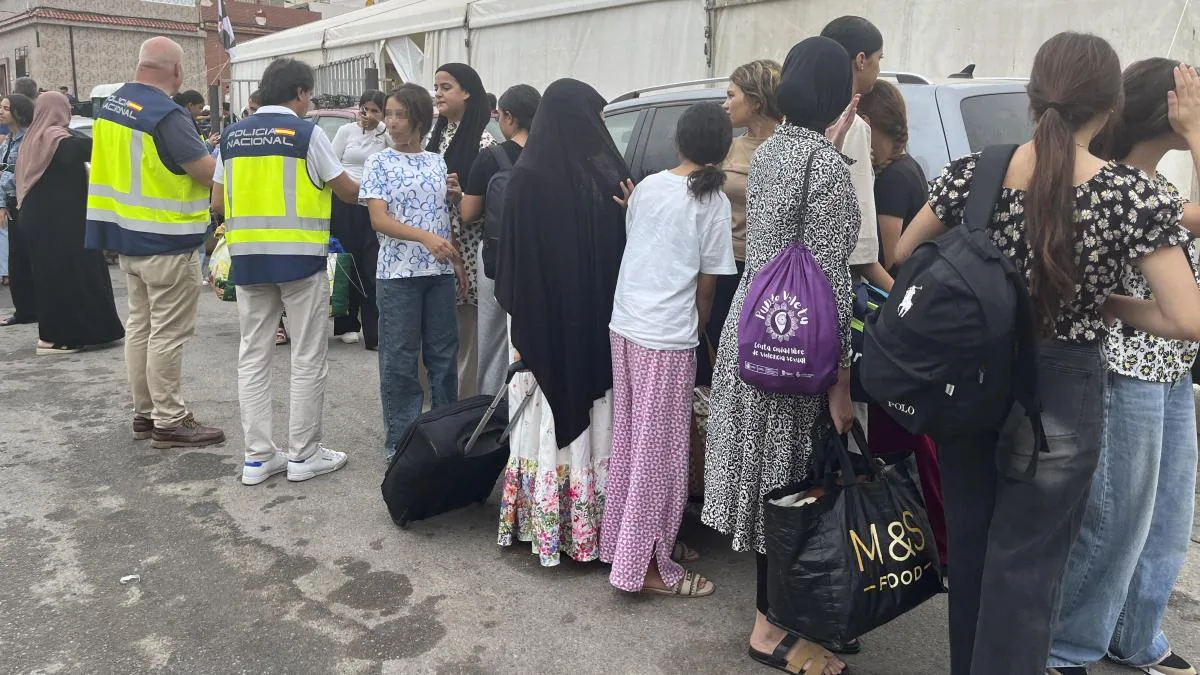
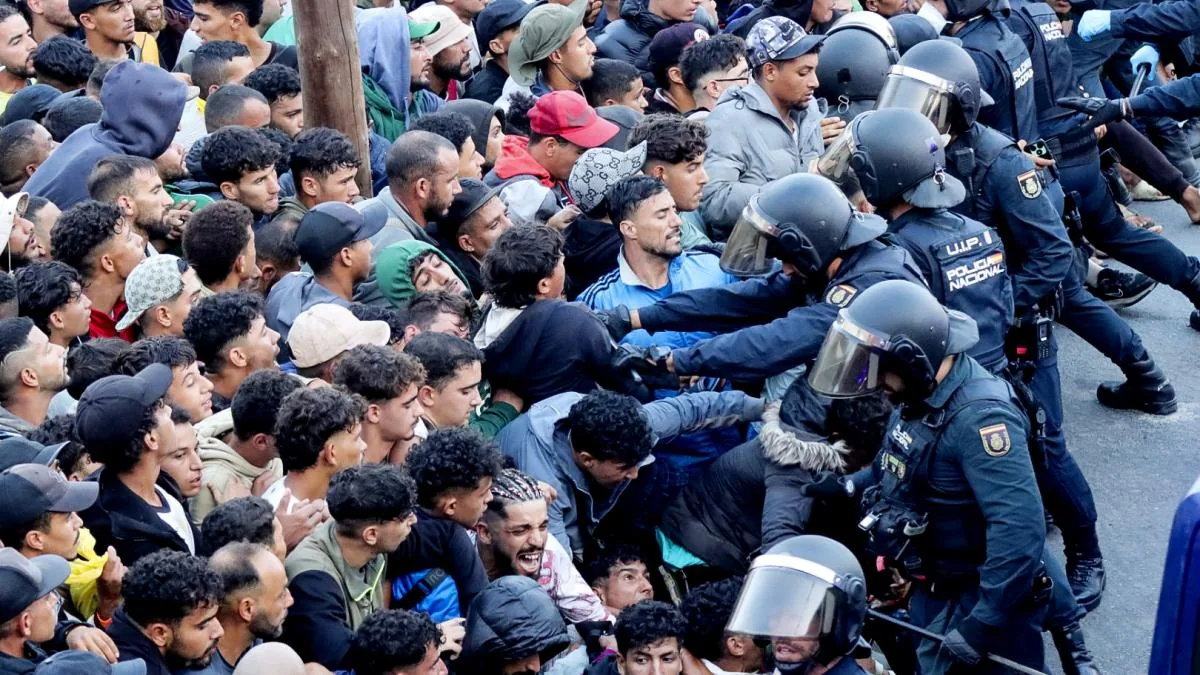
The Government enters a new phase in managing the Ceuta crisis, where humanitarian attention to the people who entered irregularly in a rush becomes a priority over the threat at the border, once Morocco has shown its firm control of the line.
Read more The Iran war diminishes the U.S. military capability in the Pacific
From the same podium where a week earlier the Foreign Minister, José Manuel Albares, promised that “all” immigrants would be expelled to their countries – knowing it is impossible – yesterday the Migration Minister, Elma Saiz, announced an immediate device to enable four spaces that will provide shelter to migrants who still sleep outdoors.

The spokesperson assures that asylum legality will be complied with after Albares announced the expulsion of “all”
Seventeen days after the massive crossing, these locations in non-central areas of the autonomous city will initially have 1,500 beds. After the announcement, the press asked Saiz a direct question: Is Moncloa’s plan now to expel or to host? The spokesperson assured that the Government strictly complies with current legislation. The same legislation that does not allow the immediate return of unaccompanied migrant minors nor of international protection applicants. And there are thousands of both in the city.
Ceuta has ceded one of the spaces to Migration, the Embolsamiento parking lot in Loma Colmenar, on one side of the road leading to the El Tarajal border, where at least 141 people died. It is a huge parking area designed to organize, hold, and regulate the traffic intending to cross to Morocco; to avoid massive traffic jams in the city. At the peaks of the Operation Paso del Estrecho (OPE), up to 1,000 vehicles can accumulate on its asphalt. By mid-afternoon yesterday, with hardly any engine noise, the military had set up two tents in less than an hour. Today they will erect another 26 in parking lots three and four, according to sources familiar with the operation. Inside, bunk beds will be placed. The showers to be installed will add to the bathrooms already available in the mega parking lot, which also has a large tent with tables for eating.
Ceuta cedes two parking lots on the outskirts of the center to set up about thirty military tents
The other three spaces, of a “temporary and extraordinary” nature, will be located on the sports courts of the Cavalry barracks, the vacant lot in front of the old guano factory (at the end of Playa del Trampolín, where showers and portable toilets have already been placed), and the equestrian center: all owned by the Government. The latter, the Hípica, was a hive of activity yesterday. Its workers, as those who preferred to remain anonymous explained, had received orders to tidy up the sand of one of the three horse tracks, on which the camp will be set up. A member, at war against the arrival of immigrants, claimed that horse owners are studying invoking the Animal Protection Law to prevent the arrival of irregulars.
The gates of the equestrian center face the Temporary Stay Center for Immigrants (CETI), which remains full. They are surrounded by wooded slopes where the count of huts still hiding immigrants is lost. They go up and down to Playa del Trampolín, which increasingly resembles a pressure cooker about to explode. Tensions are high.
Read more Rodri lands in Barcelona with a strong message: “I come to win everything that comes my way”
A center will be set up on a horse track, although members will try to stop the decision
Moroccans are not only a minority compared to sub-Saharans, but the latter are increasingly aware that their expulsion may come soon. About a hundred, with banners bearing the word asylum, announced they were starting a hunger strike. Bial Eljary, 26 years old, wondered why his “friends” from Tunisia, Sudan, or Yemen on the beach “could” apply for asylum and he could not. “I just want to work to have a good life,” while making clear, again and again, that he is not looking for “trouble.”
The Migration Minister did not specify yesterday how many people have places in the CETI, nor an estimate of the settlement at Trampolín, although she pointed out that enabling the new spaces would ease the streets, which continue with the same pattern: a bustling urban center where normality prevails versus hot spots on the outskirts where neighbors are increasingly fed up.
Saiz does not specify the number of people still on the street in a city that seems like a pressure cooker
Focusing on the humanitarian emergency, the Government wants to set the pace in managing the crisis: from the massive assault that compromised territorial integrity to a response that protects the vulnerable. “That is the way, a coherent policy that puts human rights at the center and scrupulously complies with current asylum legislation and all regulations that affect and have an impact on migration policy,” Saiz assured, who will continue in Ceuta this Tuesday awaiting the new centers to welcome migrants. “Refugees welcome.”
Vivas considers taking the situation to the Judiciary
The president of Ceuta, the Popular Party’s Juan Jesús Vivas, reiterated his criticisms of the Government yesterday, accusing it of “absolute passivity” and “whitewashing the reality” that the autonomous city lives, and threatened to go to “other State instances,” including the judiciary, if the Executive does not resolve the crisis in 30 days. “We will resort to other State instances, we have the obligation to do so, to the General Courts, to the judiciary, to the Autonomous Communities, to the Federation of Municipalities and Provinces, to business organizations, to unions, to whoever is necessary, because we will not give up and of course to Europe,” Vivas said in a statement after convening his government council. He added that he intends to convey the situation to the president of the Supreme Court and the president of the Constitutional Court “simply to say that Ceuta is in danger.” The president denounced a “lack of adequate response” from the Government towards “a part of Spain that has been attacked in its territorial integrity” and recalled that the Prime Minister himself, Pedro Sánchez, described Ceuta as a territory in a situation of “high risk.”
Read more Barcelona contains the price of student apartments while it soars in Madrid