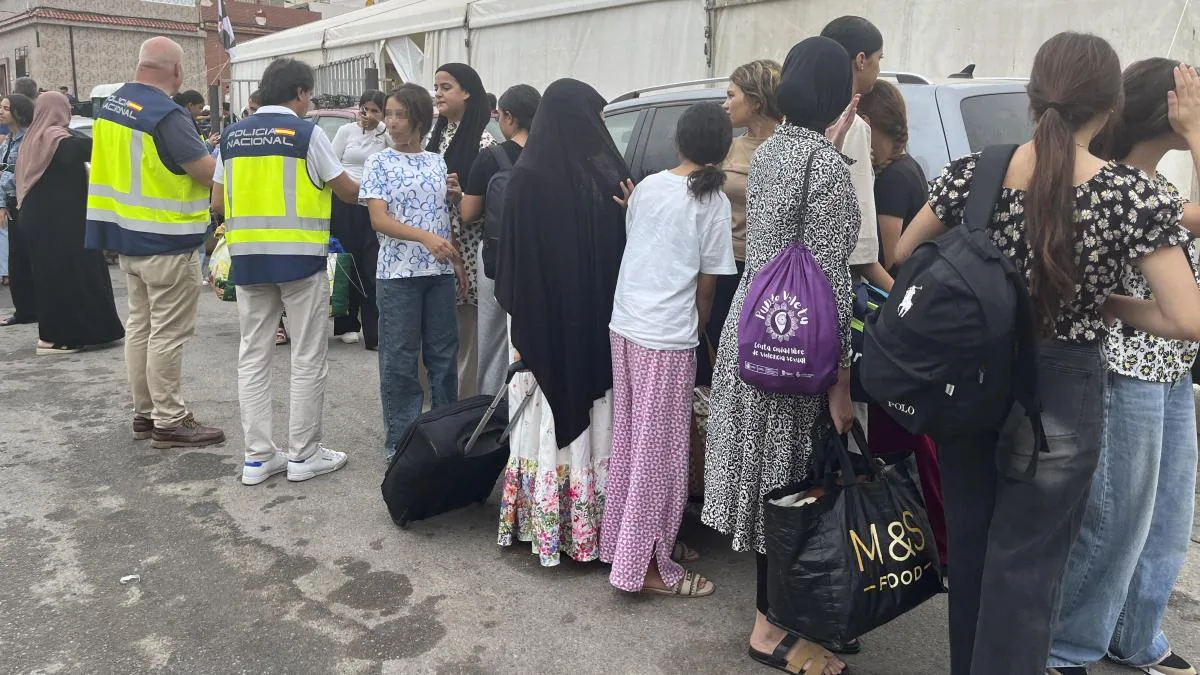
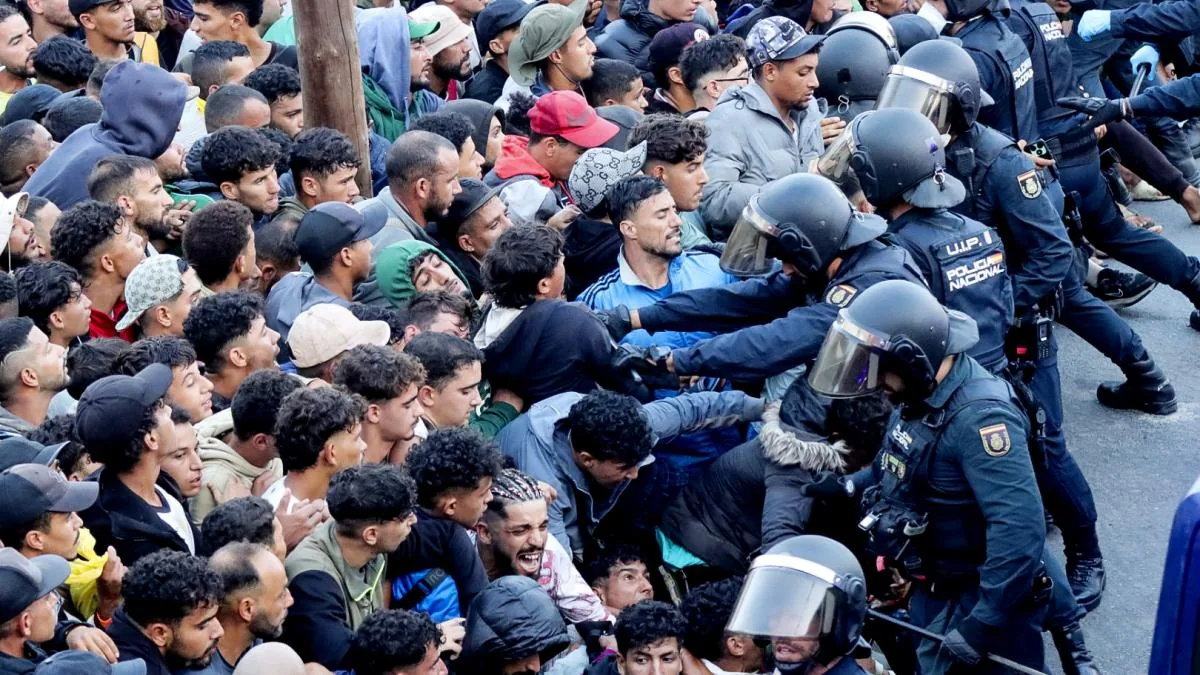
The Alaouite kingdom has demonstrated this Saturday its control over the border that separates Morocco and Spain in Ceuta. After intensifying surveillance near the El Tarajal breakwater, where just over half a month ago at least 141 people drowned or were crushed, according to humanitarian organizations, a strong deployment has blocked the passage of hundreds of sub-Saharan Africans who intended to irregularly reach the autonomous city. The thousands of gendarmes, with the help of speedboats, helicopters, drones, and dogs, have charged against the immigrants, even using tear gas. While the people of Ceuta held their breath for fear of a new avalanche, Morocco reported, by the dozens, the people it was arresting for trying to cross into Spain: 111 migrants at 2:30 p.m.; 148 an hour later; nearly 300 after 6:00 p.m…
Read more Spain wins the world gold and secures the ticket to Los Angeles ’28
Police unions celebrate Morocco’s action but warn that Spain must be “prepared”
The caballas, the colloquial demonym with which the people of Ceuta feel comfortable, call the taró the thick fog that forms on their beaches with the Levante wind in the Strait. The taró greatly reduces visibility on the coast, creating perfect conditions for immigrants who intend to swim across to the city without being seen by the Civil Guard. Today’s day – and also the early morning – has been taró , which could have encouraged the so-called new massive entry, which had been spreading on social networks for days. However, the residents of Ceuta, who woke up to an unprecedented police reinforcement in the city, explain that it is not the thick mist that marks the porosity of their border, but the neighboring country. And judging by what they had seen in the media – how, this time yes, Morocco had militarized its side of the border – “little was going to happen.” The caballas, some visionaries.
It was not until almost noon that the news reached Ceuta, which had experienced the morning with absolute normality. At the border crossing, through which immigrants who have accepted that Spain will not welcome them continue to leave voluntarily, riot vans, Civil Guard vehicles, and military trucks were stationed. A larger deployment than usual, but without movement. The calm was not interrupted even by a siren.
Calm in the city due to the unprecedented deployment that prevented migrants from approaching the border
Moroccan security sources decided to act three kilometers from El Tarajal, on a hill on the outskirts of Fnideq (Castillejos), blocking the passage of hundreds of sub-Saharan Africans. Among them, unlike the more than 70,000 who crossed to Ceuta on July 30 and 31, there was only a Moroccan minority. One of the keys to understanding the hard police hand against black migrants.
Rabat announces it has detained nearly 300 people who wanted to cross and another 61 for inciting migration
Unofficial sources from Rabat have reported that their security forces have detained 294 people, who have been loaded in groups onto buses. Humanitarian organizations have been denouncing for years that the detained sub-Saharan Africans are transferred hundreds of kilometers away, to remote places in the country. Another 61 have been arrested on suspicion of “inciting and promoting” irregular migration on social networks, although they have not specified when or where this occurred. In addition, they have announced that from now on and permanently, they will carry out “informative surveillance” operations in order to “detain all those involved in digital incitement to mass migration.”
Read more Meteocat issues a violent weather warning this Saturday afternoon in parts of Catalonia
The gendarmes have also expelled the teams from the EFE agency and TVE who were covering the day in Fnideq. According to reports, the hotels where the journalists were staying informed them that they had received orders from local authorities to leave the establishments immediately.
The Interior Ministry has had all eyes on Ceuta, although not losing sight of Melilla, where there was also police reinforcement due to the possibility of irregular entries. Police unions such as the SUP have celebrated the frustrated crossing thanks to the deployed device, but warn that, although “Morocco has prevented it,” “Spain must be prepared for when it does not.”
On the other side of the fence, in the peripheral neighborhoods of Ceuta, time seemed to stand still due to the August 15 holiday. On Trampolín beach, migrants continue in their more than 80 improvised cane huts waiting for a place in the Temporary Stay Center for Immigrants (CETI). And the camp, with plastic roofs, improvised by neighbors of El Príncipe to protect underage girls, is not easing. The central government has announced that a “large team” from the Ministry of Inclusion, Social Security, and Migration will travel to Ceuta to urgently address the implementation of several provisional reception centers intended for the thousands of migrants who still remain scattered throughout the city. The government’s intention is to begin gradually putting into operation several devices with the aim that at least two of them, with a combined capacity close to a thousand people, can be operational during the next week. The biggest problem, according to the Ministry? Finding space: due to the rejection generated among neighbors by the possible locations.
Read more Former Cambridge professor accused of plagiarism found dead in a context of racism