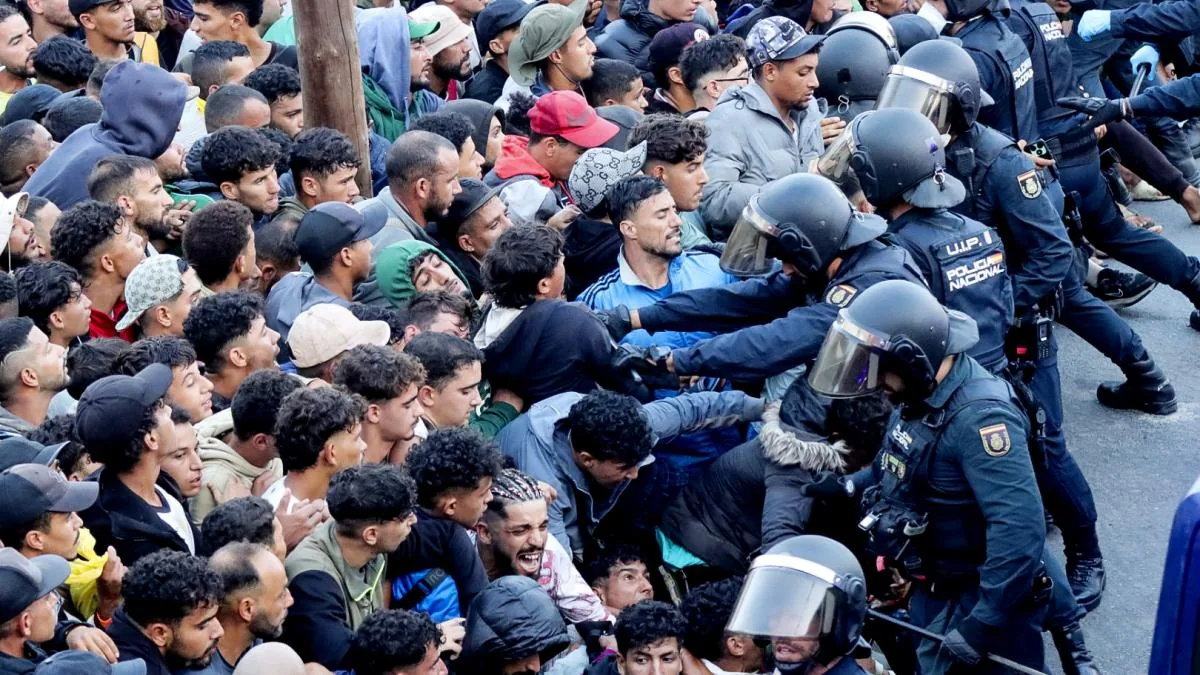
The messages coming from Rabat, through its Minister of Justice, Abdellatif Ouahbi, either about the possibility of breaking the bilateral extradition treaty that operates between Spain and Morocco, or casting doubt on the Spanish sovereignty of Ceuta and Melilla, an issue he says he repeatedly raises in meetings with the Spanish Government, do not alter the position of Pedro Sánchez’s Executive, which tries to cool down any kind of clash with the neighboring country and to avoid a diplomatic confrontation, with the migration and sovereignty crisis as a backdrop.
Read more The INE raises the inflation rebound in July to 3.6% due to electricity and gasoline
The Government insists on highlighting the collaboration with the Alaouite Kingdom and does not consider under any circumstances that the treaty could be broken, a position that contrasts with that of the main opposition party, which already openly points to Rabat as responsible for the crisis after the caution of the first days, and even with the interpretation made of all these issues by one of PSOE’s partners in Moncloa, United Left.
IU, Government partner, points to the Alaouite Kingdom as a “danger” to Spain’s sovereignty
“I cannot foresee any issue related to what they are telling me,” Interior Minister Fernando Grande-Marlaska concluded this Thursday when asked about this matter. “Cooperation and coordination on extraditions with the Kingdom of Morocco, as well as judicial cooperation, has always been, is, and will be extraordinary and exceptional,” Marlaska added from Ceuta, before meeting with the city’s president, Juan Jesús Vivas, who in recent days has labeled Rabat as a disloyal and unreliable partner. The Interior Minister, however, emphasized that bilateral relations in all areas “are absolutely close and based on loyalty.”
The Popular Party, in turn, has demanded from Barcelona that the Executive call the Moroccan ambassador for consultations, both because of the migratory avalanche and because of Ouahbi’s words in which he “called into question the Spanishness of Ceuta and Melilla.” “We would like to know why they still have not called him for consultations,” said Jaime de los Santos, who recalled that with Italy it was done immediately when the Schengen area with Spain was suspended.
Also read
In addition, the Popular group in Congress registered this Thursday a series of questions addressed to the Minister of Justice, Félix Bolaños, to urgently explain the contacts with his Moroccan counterpart following his messages in recent days.
Read more Five days of settlers besieging a family in the West Bank
“What kind of coordination have you had with your Moroccan counterpart? Do you have any response regarding the legal tools to return the 11,000 Moroccan citizens who continue to roam the city of Ceuta?” the Popular leader questioned at a press conference accompanied by the secretary general of the Catalan PP, Juan Fernández, and its leader in the Barcelona City Council, Daniel Sirera. Likewise, De los Santos called it “unacceptable” that, in his view, only the Minister of Defense, Margarita Robles, has defended Spain’s integrity.
The position of IU is also significant, since it is a Government partner and does directly point to Rabat. Its general coordinator, Antonio Maíllo, referred to the neighboring country as a “danger” to Spanish sovereignty. “Now the dictatorship raises the stakes, maintains the threat, and claims Ceuta and Melilla,” he pointed out in a message on the social network X in response to Ouahbi’s words. “Does anyone still doubt where the danger to our sovereignty lies?” added the IU leader.
For his part, Enrique Santiago, IU leader and spokesperson for Sumar in the Justice and Interior commissions, criticized Morocco for using migrants “to attack Spain, while collecting from the European Union.”
Read more Strong protest from Japan over Putin’s first visit to the Kuril Islands