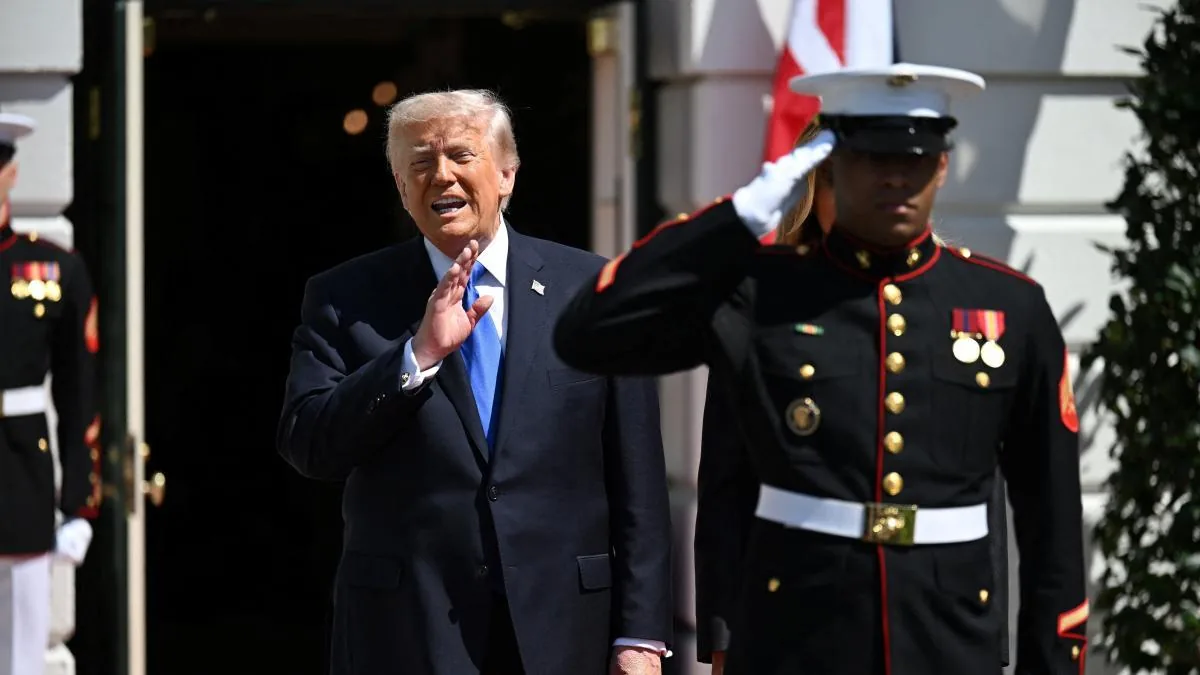
When the European NATO members decided not to come to Donald Trump’s rescue when he asked for help to reopen the Strait of Hormuz, the president said it no longer mattered, that the United States did not depend on the oil coming from the Gulf and that its blockade by Iran would have no consequences in Washington. “I have a suggestion for you: buy it from the U.S., we have plenty, and muster the courage you lack, go to the strait and simply take the oil,” he urged the United Kingdom, Germany, France, and other European allies.
Read more The ERC-Junts struggle: from political to personal
This Thursday, Brent crude surpassed $126 early in the morning and the gallon of gasoline in the U.S. now averages around $4.5, highs not seen since 2022. U.S. inflation soared in March to 3.5% year-on-year and Federal Reserve analyses foresee that energy pressure will further increase the cost of living in the coming months.
Tehran says enemy ships that “do evil” in the Strait of Hormuz will end “at the bottom of the sea”
Apparently, the strangulation of the global energy supply caused by the U.S. and Israel’s war in Iran, which closed Hormuz two months ago (through which 20% of the world’s oil passed), has indeed had effects on the U.S. economy. The subsequent American naval blockade of Iranian ports, overlapping with the strait’s closure and which Trump now wants to maintain indefinitely, has not yet yielded strategic results, while it has further worsened the outlook.
The situation has led the White House to propose, again, an international coalition aimed at reopening the Strait of Hormuz, according to a State Department cable obtained by Reuters. The plan invites allied countries to join a coalition called the Maritime Freedom Construct (MFC) to allow ships to navigate the strait.
“The MFC constitutes a fundamental first step in establishing a post-conflict maritime security architecture for the Middle East,” the cable said, which according to Reuters was to be communicated orally to partner countries before May 1. France, the United Kingdom, and other countries have held talks about their possible participation in this coalition but have indicated they would only be willing to help open the strait once the conflict ends.
But their resolution is at a standstill. The fragile ceasefire, in effect since April 8, has so far not led to honest negotiations between both parties to achieve lasting peace. The current phase of the war, in which Pakistan is working intensively as a mediator, has become a war of attrition. Trump trusts that his indefinite blockade of Hormuz will end up breaking the Iranian regime, as it has cut off its main economic support. For its part, Tehran hopes that the prolongation of the war will politically damage the White House and lead it to seek a quick end to the war.
Also read
In a defiant statement, Iran’s Supreme Leader, Mojtaba Jamenei, has declared that the Islamic Republic will guarantee security in the Persian Gulf and eliminate “the enemy’s abuses” in Hormuz, where Tehran is writing “a new chapter.” Foreign powers that “do evil” in the strait will end “at the bottom of the sea,” he said, referring to the U.S. and countries joining its coalition.
Read more The workforce at the Gurb plant is wary of the deal between Pascual and Casa Tarradellas
In his message, Jamenei, who has yet to make any public appearance to dispel rumors about his health following his father’s assassination, allows himself the luxury of rejoicing in the American humiliation. “Today, two months after the largest military concentration and aggression by the world’s bullies in the region and the shameful defeat of the U.S., a new chapter is being written,” he said in the statement, released by state media on the occasion of Persian Gulf Day. “By the power and strength of God, the bright future of the Persian Gulf region will be a future without the U.S.,” he concluded.
However, Iran’s president, Masud Pezeshkian, took a more conciliatory tone this Thursday, showing his “willingness to continue the diplomatic process” with the U.S., but only if Washington stops its “excessive and provocative actions.” Among them, he cited Trump’s repeated threats since the war began, including the threat of genocide, when he said an “entire civilization” in Iran was going to “die.”
The president eventually withdrew that threat and extended the deadline of his ultimatum, something he has done repeatedly throughout the conflict. The costly daily bombings, in a war that the Pentagon confirmed yesterday has already cost more than $25 billion (independent organizations estimate $60 billion), gave way to the naval blockade, which has already forced 37 ships to retreat, according to the most recent update from Central Command.
Trump claimed on Sunday that his naval blockade would “blow up” Iranian pipelines in “two or three days”; four days later, there is no evidence that this has happened
Trump maintains that, by not being able to export oil, “all of Iran’s oil infrastructure is going to explode.” He said on Sunday on Fox News that Iranian pipelines, “both mechanically and underground, will explode from within.” “They say they only have about three days left before that happens. And when it explodes, it can never be rebuilt as before,” he added. But four days have passed and that has not happened, and according to experts told to The Washington Post, it would still take months for that unlikely scenario.
Alongside the naval blockade, Trump was scheduled to receive a report from Central Command this Thursday with possible plans for a new series of military attacks against Iran, Axios reported last night. Among them is taking control of parts of the Strait of Hormuz, including the strategic Kharg Island, essential for Iranian exports, in a strategy seeking Tehran’s concession in possible future negotiations.
Trump promised he would not enter any conflict and would solve the inflation problem by “unleashing” the U.S. energy potential and “freeing” gasoline, which would reach “never-before-seen lows.” The war in Iran has not only made him break all those promises, but he has also failed to achieve any of his strategic objectives: the ayatollah regime remains standing and inflexible in the face of Washington’s demand that it give up its enriched uranium, Hormuz remains closed, and proxy militias continue to receive financial and logistical support from Tehran.
Read more The Finnish group Sanoma acquires the publishing house Vicens Vives