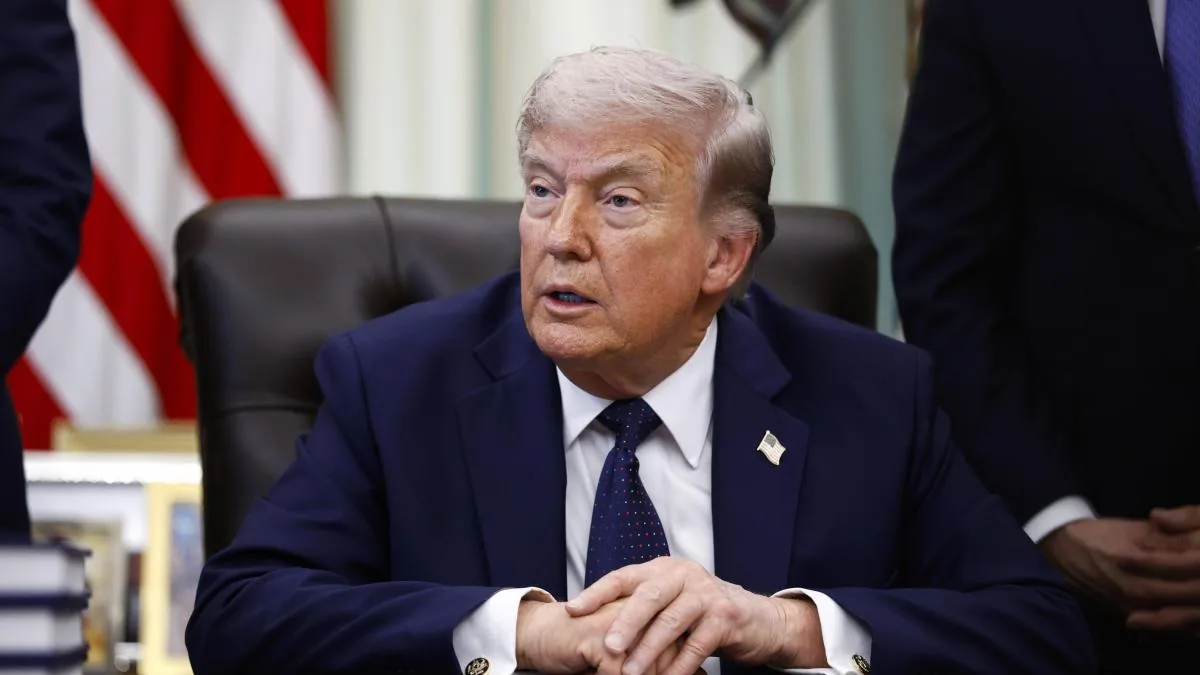
Donald Trump has announced that the United States and Iran have reached a preliminary peace agreement, renewing optimism about the end of two months of war in the Middle East. At the same time, the president has threatened Tehran with the largest bombings since the start of the offensive if it does not comply with the conditions of the supposed pact.
Despite his optimism, Iran has not publicly confirmed any agreement, although, according to the American portal Axios, it would be “evaluating” a one-page memorandum proposed by Washington, which would declare the end of the conflict and open a 30-day process to negotiate a definitive peace.
Also read
“Assuming Iran agrees to deliver what has been agreed — which may be a big assumption — the already legendary Epic Fury will come to an end, and the highly effective blockade will allow the Strait of Hormuz to be open to all, including Iran,” Trump announced on his platform, Truth Social, referring to the campaign of massive bombings along with Israel. “If they do not accept, the bombings will begin, and they will, unfortunately, be of a much higher level and intensity than before.”
The hopeful announcement, which has raised markets and lowered the price of Brent crude, comes shortly after the Iranian Revolutionary Guard said it could reopen the Strait of Hormuz, two months later, after the end of the “threats from the aggressors.” Trump suspended last night his so-called Freedom Project, the operation to escort stranded ships in this crucial maritime route for international trade, citing “great progress towards a full and definitive agreement” with Iran.
The president has not detailed the terms of the alleged “agreement,” nor the supposed concessions of Tehran, nor has he specified who his interlocutor was in the negotiation with “representatives of Iran.” This morning, Axios reported, citing U.S. officials, that the two warring countries were “close” to reaching an agreement in the form of a memorandum of understanding.
Shortly after, the Reuters agency confirmed the optimism about the end of the war, citing a source from Pakistan, the main mediating country, who verified the report about a memorandum. “We will close this very soon. We are getting closer,” the source said.
According to the cited media, Washington would have given Tehran 48 hours to respond on several key points. Among others, Tehran should commit to a moratorium on uranium enrichment, Trump would lift his sanctions and release frozen Iranian funds, and both parties would lift their respective naval blockades in Hormuz.
The U.S. naval blockade of Iranian ships remains in effect, as demonstrated by the attack carried out tonight by U.S. forces against an Iranian tanker. The ship, called Hasna, was trying to break Washington’s siege, according to Central Command, and was heading to an Iranian port in the Gulf of Oman.
U.S. intercepts an Iranian tanker in the Gulf of Oman as part of its naval blockade, which remains in effect
The spokesperson for the Iranian Parliament’s National Security Commission, Ebrahim Rezaei, has poured cold water on Trump’s optimism. He said that the announcement that both countries are close to reaching an agreement is a “U.S. wish, not a reality.”
For his part, Iran’s chief negotiator, Mohammad Bagher Ghalibaf, has said that Washington is seeking Tehran’s surrender by various means, including a naval blockade. “The enemy, in its new design, seeks, through a naval blockade, economic pressure, and media manipulation, to destroy the country’s cohesion to force us to surrender,” he said via Telegram.
In the last round of negotiations, on April 11 in Islamabad (Pakistan), shortly after the ceasefire announcement, the red lines of both parties were still very far apart. Washington has made ending Iran’s nuclear program its main goal, but this is a source of national pride for Iran, which would accept limiting it – as in the agreement forged by Barack Obama in 2015 – but under no circumstances dismantling it.
What has changed is Iran’s position regarding Hormuz, which for the first time since the U.S. and Israeli aggression could reopen to international trade safely. Before the war, about 20% of the world’s oil passed through this strait in the Persian Gulf. Its effective blockade, due to Iran’s attacks on cargo and oil tankers, has driven Brent crude prices up to $115 per barrel in recent weeks, although this has dropped sharply in recent hours following announcements from Washington and Tehran.
Today, “more than 22,500 sailors aboard more than 1,550 commercial vessels” remain trapped in the maritime route, according to General Dan Caine, Joint Chiefs of Staff chief, at a press conference from the Pentagon on Tuesday.
Also read
In an interview with the friendly media New York Post, Trump said it is still “too soon” to consider a new round of in-person dialogue with Tehran. Last month, the president announced twice that his emissaries – Vice President J.D. Vance, his son-in-law Jared Kushner, and his friend and special envoy Steve Wirkoff – were going to travel to Islamabad to try to successfully conclude the negotiation. Finally, he had to cancel both trips to the mediating country after Tehran’s no-shows.
Then, Iran justified its refusal to dialogue by considering the U.S. naval blockade of its ports, which has strangled its main source of income, an “act of war.” Last night, in his announcement that he was going to suspend the escort operation in Hormuz, Trump said the naval blockade would remain “fully in effect,” something that for now seems unchanged.
“They want to reach an agreement desperately,” Trump insisted this afternoon at an event from the East Room of the White House. In reality, Iran shows no signs of this publicly, and several analysts agree that perhaps it is the U.S. leader who wishes to de-escalate the situation so as not to frustrate his announced trip to China next week.
If the war ended today, the U.S. would have achieved almost none of the objectives proposed initially: Iran still has enriched uranium and an active nuclear program; it maintains its capacity to pressure the West in Hormuz and its military arsenal, although degraded, has not been dismantled; it continues to finance its allied militias, such as Hizbullah, which retains the capacity to attack Israel and destabilize the region, and no democratic regime change has occurred, as the ayatollah regime is now led, albeit from the shadows, by Mojtaba Jamenei, the son of the former dictator.