The President of the United States, Donald Trump, has once again made an impromptu turn in his strategy in the restarted war with Iran. After announcing on Monday the imposition of a 20% tariff for ships crossing the Strait of Hormuz, in exchange for security from Washington, he announced this Tuesday through Truth Social that he is abandoning that idea. “After highly productive talks with Middle Eastern leaders, I have decided to replace the 20% reimbursement tariff for the U.S. with trade and investment agreements that the various Gulf States will make in the U.S.,” the president explained.
Read more Congress overturns the deficit path for the Budgets with the votes of PP, Vox, and Junts
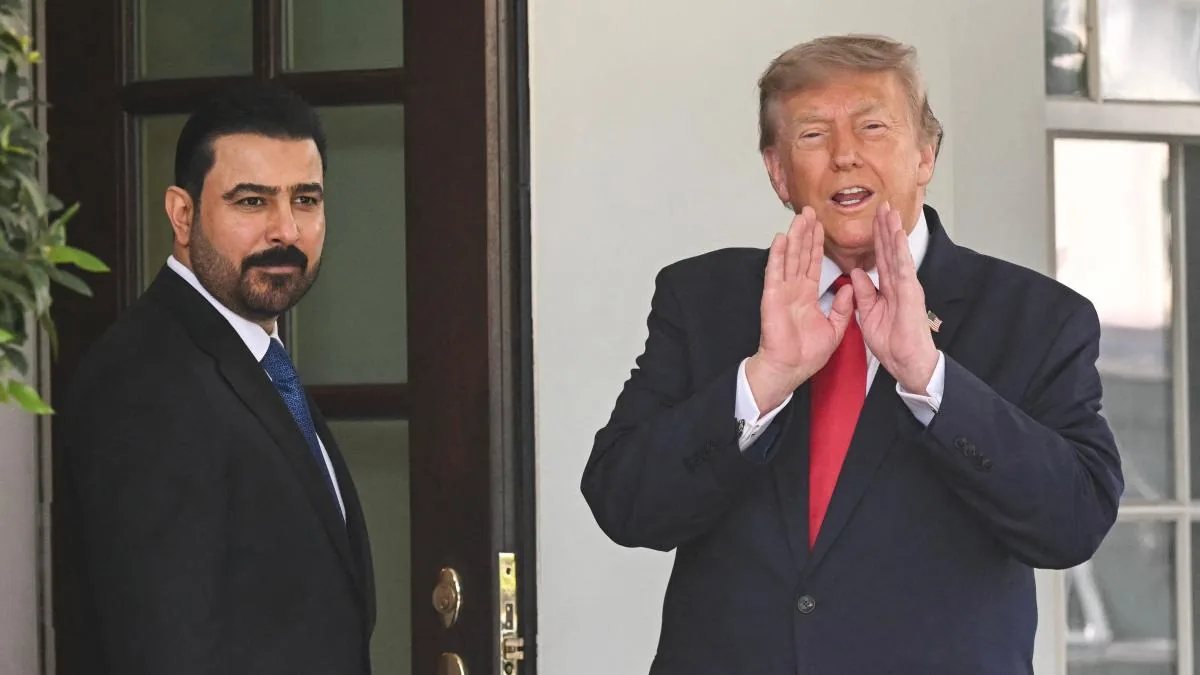
“The Strait of Hormuz is open to traffic from all ships, except those from Iran, and that is due to its lying, violent, and malicious leadership, which is leading the country down the path of total destruction,” Trump emphasizes in his post, produced just before his meeting with the new Prime Minister of Iraq, Ali al-Zaidi, at the White House. “Therefore, we will impose a total blockade, but only on ships heading to or coming from Iranian ports, or carrying any type of cargo related to Iran.”
Donald Trump, President of the U.S.
“We will impose a total blockade, but only on ships heading to or coming from Iranian ports”
The president notified Congress on Monday that, three weeks after signing an agreement with Tehran that he had called “historic,” hostilities have officially resumed. For the third consecutive day, the U.S. attacked the Islamic republic last night for five hours, which in turn launched missiles against U.S. allies in the region and oil tankers in Hormuz, a crucial route for international trade that is at the center of the dispute between the two countries.
While Tehran claims that the memorandum of understanding granted it control of the strait, including its ability to impose tolls, Washington announced yesterday that it would become the “guardian” of the bottleneck and intended to charge tolls in exchange for security, although it did not clarify how it planned to do so. The White House has emphasized since the start of its offensive on February 28 that it is “intolerable” for any country to impose unilateral tariffs that violate international law.
After initially navigating that contradiction, the president has finally backed down on the tolls, but not on the reimposition of the naval blockade on Iranian ports. “I don’t think anyone should have to pay any kind of tax for the strait, or any other strait,” he said this Tuesday during the meeting with al-Zaidi. “The Gulf countries are going to invest a lot of money in the U.S. and that is very comforting to me,” he added, justifying his turn.
The latest U.S. attacks hit targets throughout Iran, including the port cities of Bushehr and Bandar Abbas. According to the Pentagon, their goal was “to degrade Iran’s ability to attack commercial maritime transport.” Meanwhile, Iran attacked Bahrain, where the U.S. Navy’s Fifth Fleet is located, as well as Air Force assets in Jordan and two oil tankers linked to the United Arab Emirates in Hormuz. Most of these missiles were intercepted.
Read more France’s notes in the semifinal against Spain
Also read
The memorandum of understanding gave the parties 60 days to continue negotiating until reaching a definitive truce. The opposing versions of what was signed, as well as the deadlock on the most contentious issues—the control of Hormuz and the Iranian nuclear program—have made its implementation impossible. The return to war already has consequences on the economy: the price of Brent crude rose to a four-week high, surpassing 86 dollars per barrel, although it is still well below the peak recorded during the conflict, of 120 dollars.
Shortly after agreeing to the ceasefire, two months before the memorandum of understanding, Trump notified the U.S. Congress that he was ending the military offensive. He sought to evade the legal limit on external aggressions, which, according to the War Powers Resolution of 1973, is 60 days without additional authorization from Congress, extendable by another 30 days.
“As I previously informed Congress, I ordered a two-week ceasefire on April 7, 2026. Subsequently, that ceasefire was extended,” Trump wrote in his new letter to the Capitol. “Despite that commitment, Iran again attacked several neutral-flagged commercial ships transiting the Strait of Hormuz between July 6 and 7, 2026,” he added, placing the restart of hostilities on that date.
Congress approved a resolution preventing the resumption of attacks without its authorization, but its legal validity is unclear
The White House claims that, with this new letter, the legal period to request authorization from Congress has restarted. However, both the House of Representatives and the Senate approved last month resolutions aimed at restricting any new attack without explicit legislative authorization, although those measures had limited legal effect. As his predecessors have done in the past, Trump interpreted that vote as invalid and maintained that the president has the power to carry out military operations without legislative authorization.
Many legislators believe that, despite Trump’s notification in April about the end of the conflict, it has actually never stopped, because limited attacks have continued during the truce. Trump rejected that argument and stated that the new bombings constitute an independent military action, triggered by Iran’s violation of the ceasefire.
Read more The notes of Spain’s triumph in the semifinals against France