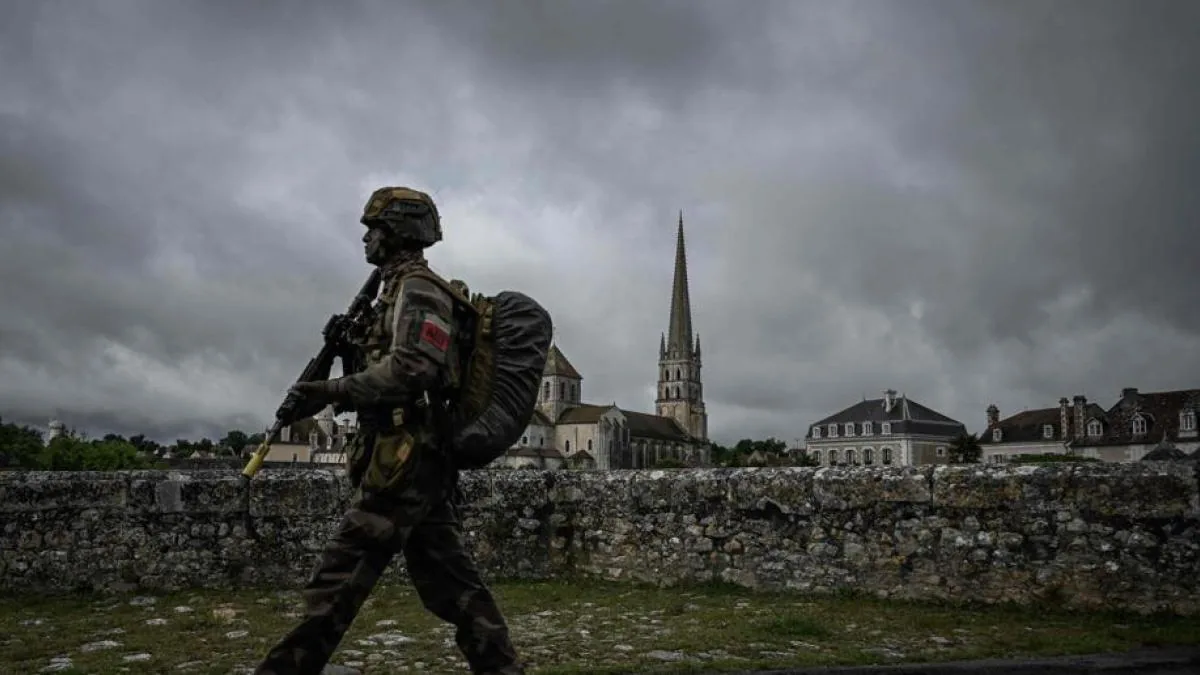
There are no oxygen tanks. The United States has backed down on its intention to cancel the deployment of 4,000 soldiers in Poland, but this does not change its plans to progressively withdraw its conventional defense capabilities in Europe. The Pentagon wants to accelerate the troop withdrawal from bases on the continent and could present its plans to allies in a few weeks, which will force European countries to agree on replacing the U.S. deterrent capability and embrace the idea of a more European NATO.
Read more Richard Marko: “It is easier to use AI’s capability to attack than to defend”
Allied sources confirm that U.S. plans involve this gradual troop withdrawal over the coming years, but they dissociate it from the supposed punishment by Donald Trump for the lack of European contribution to the Iran crisis. Long ago, even before the arrival of the current Trump Administration, the U.S. intended to reduce its military contribution in Europe to focus on other scenarios, especially the Indo-Pacific, as tensions with China increase. According to the German newspaper Welt , U.S. withdrawal plans will be completed within six months to a year and will be announced even before the NATO leaders’ summit in July in Ankara.
According to ‘Welt’
U.S. withdrawal plans will be completed within six months to a year
It is not just about soldiers: the U.S. also plans to suspend the deployment of fighters, drones, tanker aircraft, or long-range systems. Such as Tomahawk missiles that could be denied to Germany, essential to counter large Russian projectiles in case of direct conflict. The timing could not be more delicate for many European countries, while Russia plays with fire with its hybrid war and sending drones to allied borders. This very week, the Russian drone that left two injured in Romania has set off all alarms.
“If Europe is required to take more responsibility for its own defense, it will have to do more than just buy U.S. military equipment,” reflects a source within the Alliance. Discussions at the summit talk both about increasing military spending and how to better develop the European defense industry, but also about the need for greater integration among European forces. It is not so much about creating an army parallel to NATO, but how to make the continent increase its military cooperation if the United States dramatically reduces its presence in Europe. For now, the only damage has been moving a brigade from Germany to Poland – something with some operational sense given that it is the eastern border – leaving U.S. forces at levels similar to before the Russian invasion of Ukraine. There is much secrecy around the real figures of the U.S. presence in Europe, but it would be about 75,000 personnel, so the impact is minimal.
Also read
According to Luis Simón, director of the Real Instituto Elcano office in Brussels and co-author of a study on different scenarios of U.S. troop withdrawal in Europe, a change that would be radical but sustainable would involve withdrawing much of the conventional troops while maintaining intelligence capabilities and minimal brigades. In his view, it is realistic for Europe to have a greater degree of autonomy in the military and strategic field, but not to do so without any U.S. involvement. “For Europe to assume primary responsibility for conventional defense, it needs a much higher level of military integration than it currently has,” says the expert, stating that this is the main challenge right now for European armies. “The problem is the critical enablers, the indispensable intelligence, surveillance, or reconnaissance capabilities,” also the lack of integration of sensors or satellites that allow complete visibility of the battlefield, something in which the United States has a monopoly.
Read more Artificial intelligence threatens cybersecurity at an unprecedented speed
Another challenge, Simón recalls, will be military and political legitimacy: who will take command if the U.S. withdraws it in case of a total war. “Neither the British, nor the French, nor the Germans have experience commanding operations above a certain level,” he considers. There are some clues in this regard: Washington has already ceded command of two important branches of the organization. One, in Italy, the Joint Force Command Naples; and another, at the Joint Command Center in Norfolk, Virginia (U.S.). The first will be led by an Italian and the second by a British.
Critical capabilities
Europe needs the U.S. to get involved at least by sharing intelligence
“All these commitments (to increase defense spending) must be turned into tangible results, with faster execution, to achieve greater readiness and stronger deterrence,” recently said the chairman of the NATO Military Committee, Admiral Giuseppe Cavo Dragone, who has called the idea of creating a European army parallel to NATO a “contradiction” or “nonsense.” “We are not at war, but we are not at peace either. That is why we must redouble our efforts to focus defense investment according to our commitments,” warned the admiral.
Pentagon
Hegseth applauds Asians and scolds Europe
U.S. Secretary of War Pete Hegseth applauded countries like Japan, South Korea, or the Philippines for their commitment to military spending and their closeness to Washington while reproaching that the same does not happen with NATO European allies. “When our interests coincide, we act together with determination,” said the Pentagon chief in Singapore, during his participation in Asia’s most important defense forum, the Shangri-La Dialogue. “When our interests diverge, we adapt pragmatically, without dramatics or moralism. I think Western Europe should take note.” “Europe and NATO have to make some important decisions,” he defended. Hegseth reiterated U.S. plans to focus more on the Pacific, while downplaying tensions with China by assuring that relations between the two powers are at their best in years.
Read more The Badajoz Court decides today whether the trial against David Sánchez will proceed