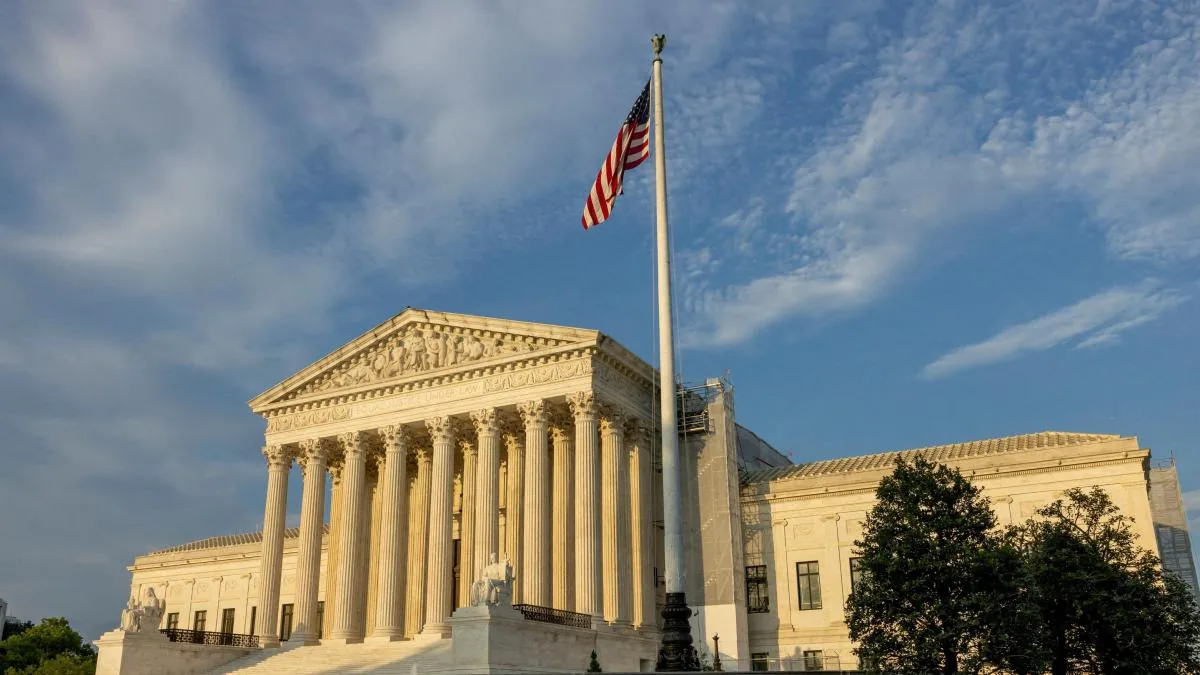
The conservative majority of the United States Supreme Court, with three judges appointed by Donald Trump, made a significant decision this Wednesday that will determine the outcome of the crucial midterm legislative elections in November and will reduce to a minimum the representation of minorities in states governed by Republicans.
By a 6 to 3 vote, divided along ideological lines, the high court decided to annul Louisiana’s electoral map because it created a district in which African Americans, a minority at the state level, would be the majority. The conservatives considered that the creation of this district based on race violates the 14th and 15th Amendments, which guarantee equality before the law and prohibit racial discrimination in voting.
Speed
One hour after the ruling, Florida Republicans approved an electoral map in which they expect to win four seats
However, the three progressive justices, in the minority, denounced that this decision dismantles a key provision of the Voting Rights Act, the historic law enacted in 1965 during the civil rights movement, which was designed precisely to prevent racial discrimination in elections. Specifically, its second section, which stipulates that states cannot impose any requirement, condition, or procedure “with the purpose of denying or restricting the right of any citizen to vote on account of race or color.”
In a majoritarian electoral system with single-member districts, like the American one, where the candidate with the most votes wins the seat in Congress in each district, the Voting Rights Act guarantees minimal representation of minorities, historically excluded from the political process. In its controversial interpretation, which sets precedent, the justices have eliminated a fundamental pillar of this law, which Democrats and progressives consider the beginning of its total dismantling.
This section has been used repeatedly by African American voters to challenge electoral maps with which they felt discriminated against through the tool of gerrymandering, the manipulation of districts to gain electoral advantage, a common practice in American politics. The dismantling of the second section, as applied in Louisiana, will allow legislatures in other Republican states greater freedom to redesign those districts, putting at risk more than a dozen House districts controlled by Democrats in majority Black areas.
Also read
In fact, Florida Republicans acted quickly: barely an hour after the ruling, their state House of Representatives approved a new electoral map with which they hope to win up to four new seats. The Louisiana case decided by the Supreme Court was the main justification used by Florida Governor Ron DeSantis, a Republican, to redraw his state’s congressional map.
Read more Andrada, suspended for 13 matches after his brutal aggression in the Huesca-Zaragoza match
The decision on Louisiana’s electoral map is the end of a long judicial process. It dates back to the 2020 census, when Republicans approved a new congressional map in which Black voters were only the majority in one of the state’s six districts. A group of African American citizens filed a lawsuit in March 2022 under the second section of the Voting Rights Act, arguing that it was reasonable to design a district that gave Black voters a majority in a second district, instead of diluting their voting power. A judge and an appeals court sided with them and ordered a new map to be drawn. After another appeal, the Supreme Court allowed its implementation for the 2024 elections.
But, with an eye on this year’s elections, Republicans decided to draw a new map. They rejected the plaintiffs’ proposals and adopted a district with which they believe they will preserve the seats of influential Republicans, such as the Speaker of the House, Mike Johnson, or Congresswoman Julia Letlow. When the map came into effect, however, a group of white voters filed a new lawsuit in another court, arguing that the new design violated the 14th and 15th Amendments because it classified voters based on their race. A panel of three judges sided with them and annulled the map, and now the Supreme Court has ratified that decision after an appeal.
Elena Kagan, Supreme Court Justice
“The decision will roll back the fundamental right that Congress granted of racial equality in electoral opportunity”
The judge who wrote the Supreme Court’s majority opinion, Samuel Alito, stated that his decision preserves the Voting Rights Act, as it only prevents legislators from drawing maps that intentionally limit the power of minority voters. Thus, to successfully challenge district maps under this law, plaintiffs must now demonstrate that a state “intentionally drew its districts to give minority voters fewer opportunities because of their race.” A legal challenge that “cannot separate race from the state’s racially neutral considerations, including politics, will fail.”
In her dissenting vote, progressive Justice Elena Kagan stated that, in practice, this ruling will make it impossible to use race in drawing electoral maps, so “the Court’s decision will roll back the fundamental right that Congress granted of racial equality in electoral opportunity.” Kagan read her opinion aloud from the bench, an unusual gesture indicating strong disagreement with the decision.
Read more The Euribor rises again in April and will increase the average mortgage by more than 50 euros