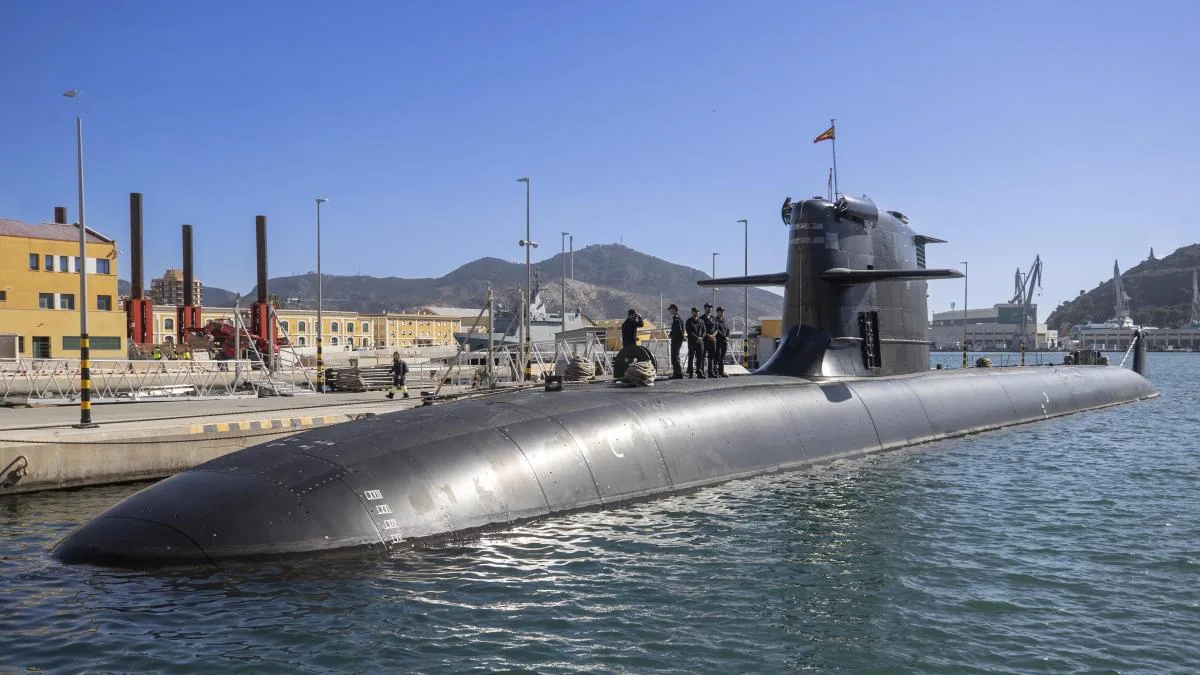
The Spanish super-submarine S-81 Isaac Peral, the jewel of the Navy, has been operating without the system to surface in case of emergency.
Read more The first victims of AI: software, consultants, and cybersecurity
It is one of the most serious incidents detected on the vessel, according to confidential information accessed by La Vanguardia. It is not the only one. The submarine has suffered failures in several vital systems, on which safety during immersion depends.
The Ministry of Defense minimizes the alarm, assuring that in every “highly complex program” there are “continuous adjustments and improvements that are a natural part of its evolution.”
The S-81 Isaac Peral is the first submersible designed and built entirely in Spain. Manufactured by the public company Navantia, it was formally delivered to the Navy in November 2023, more than a decade late and with significant cost overruns.
Defense argues that “adjustments and corrections are part of the process inherent to complex systems”
The Isaac Peral is the first of the four planned S-80 series and is the symbol of a strategic commitment: to achieve technological autonomy in the defense of a country with 8,000 kilometers of coastline and two archipelagos, in two seas. Even more so in a context of growing geopolitical tension.
Highly reliable sources explained to this newspaper that a critical failure affected the system technically known as emergency ballast blowing, which allows water to be quickly expelled from the tanks and buoyancy recovered in extreme situations, such as water ingress or loss of control during deep immersion. According to these sources, this system has been out of service.
The problem is concentrated in the so-called non-return valves, which have shown reliability failures and must be replaced. They were manufactured by the German company Schunemann, a regular supplier of components for the German group ThyssenKrupp Marine Systems (TKMS).
In the S-80, the valves were built based on technical specifications defined by Navantia.
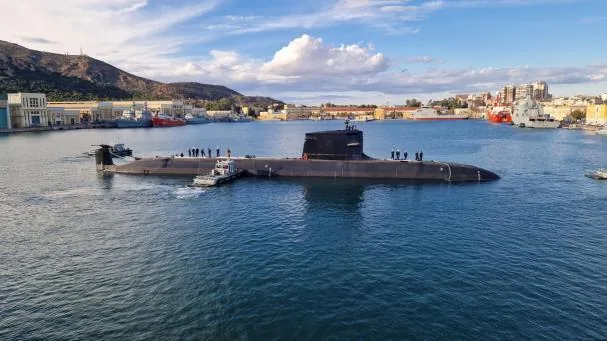
Sources familiar with the project place the origin of the failure in the design. The public company has had to redesign it and order new valves.
Ballast blowing is performed by injecting pressurized air which, upon expanding, cools and can freeze water residues in the tubes. This can block the system. Due to this risk, the valves were ordered to be taken out of service, according to these sources.
The submarine has continued to operate up to its maximum depth – about 300 meters – without this mechanism.
Defense sources maintain that as of today, the S-81 “is fully operational and certified. It has passed all technical and operational validation processes in accordance with the demanding protocols defined. Throughout its development and testing period, adjustments and corrections have indeed been made, which are part of the process inherent to complex systems, such as in emergency blowing (which has been and is fully operational) or hull valves. But always, in accordance with established procedures and without impact on safety.”
Defense adds that “all maneuvers, since delivery to the Navy, including dives to maximum depth, are always carried out under strict safety protocols, which ensure that critical systems are always available.”
The submarine is currently in the Cartagena dock for repairs. According to Defense, this is a “scheduled maintenance period” that is part of “its life cycle to ensure maximum levels of reliability and availability.” When this adjustment phase ends, it “will resume its activity with its participation in NATO’s Sea Guardian operation and its integration into the Dédalo expeditionary group,” the Ministry reports.
When the fine-tuning is complete, the vessel “will resume its activity with its participation in NATO’s Sea Guardian operation,” the ministry says
The incidents affect other key systems and, in some cases, have no immediate easy solution because they involve the replacement of equipment and components with long delivery times.
The hull valves, essential to guarantee the submarine’s watertightness, present design and material problems. They were ordered from the British company Truflo, a supplier to the Royal Navy, but manufactured according to Navantia’s specifications.
Some suffer corrosion due to the combination of materials with different galvanic pairs. During tests, failures were also detected in the seals after usage cycles lower than those required. Experts consulted point out that they should withstand up to 15,000 opening and closing cycles in perfect condition without intervention, for the entire useful life of the vessel. In the S-80, they were disassembled during tests, which, according to internal sources, caused concern in the Navy.
The propeller, designed by the Swedish firm SSPA, suffered blade deformations during maneuvering tests. Components were subsequently replaced, but vibrations and high noise levels persist. This is not a safety problem, but an operational one: it compromises stealth, which is key for a military submarine.
Read more The war in the heart of the Gulf
Provisional solutions have also been adopted in other systems. A failure in the purge valves of the diesel engines causes water to enter the engine room, up to one and a half tons in each operation.
Various key systems of the vessel have presented problems: valves, propellers, rudder hydraulics, snorkel…
The seawater cooling systems, also critical, are in question: their exchangers were supplied through a subcontracting chain that ended up with a company that only had experience in surface ships and also went bankrupt.
A technical report by the American company Electric Boat ten years ago recommended their replacement, but it has not been carried out.
Added to this are failures in the hydraulics that control the steering and depth rudders and in the snorkel.
The Isaac Peral has suffered significant incidents. In February, during a NATO mission in the Mediterranean, part of the hull’s superstructure detached during navigation, forcing the operation to be aborted. The episode was revealed by La Vanguardia on March 22.
Nor has the combat system responded as expected. For months, in exercises carried out with live fire, it failed to hit the target, although according to internal sources, it has been successful in recent weeks, which suggests that the problem could be on its way to being solved. Defense states that it is fully operational.
Navantia claims not to be able to offer explanations for a vessel that now belongs to the Navy, and merely assures that the company has “a total commitment to the S-80 program” and to the manufacture of products “with the highest standards of quality, operability, and safety.”
At the beginning of the century, Spain had eight submarines, but today there are only two, one of them forty years old
“In the current security context, having a modern submarine weapon represents a fundamental added value for deterrence and defense,” ministerial sources say, and the S-81 provides Spain’s defense with “advanced capabilities” by being “a silent element.”
Before the S-80, Spain lacked experience in the integral design of submarines. For decades, it built them with French technology, until at the beginning of the 2000s, it undertook solo development, a commitment to break that strategic dependence.
Many of the incidents are explained by this combination: own design without experience and integration of complex systems, along with the loss of experienced engineers after labor adjustments at Navantia.
The commitment to an air-independent propulsion (AIP) system, a technology that was not mature, is another of the obstacles pointed out. It was commissioned to the company Abengoa, which went through economic problems and failed to develop it on time. To date, the AIP is neither installed nor tested at sea. It is planned for the S-83 and S-84.
Since its delivery, the Isaac Peral has undergone a series of technical interventions. According to official data, it has accumulated 267 days at sea since it was delivered to the Navy, more than 880 days ago.
The consequences transcend the technical. Spain has gone from having eight submarines at the beginning of the century to only two today. In addition to the S-81, it has the Galerna, with 40 years of service and whose useful life has been extended with several modernizations, but with strong limitations.
We are no longer talking about peace missions, but about the real possibility of a high-intensity conflict in Europe”
Agustín Conde
Former Secretary of State for Defense (2016-2018)
“The operational reality is that Spain today only has one submarine that can fire torpedoes and hit the target. And it is 43 years old,” summarizes a high-ranking military officer in the reserve, who worked on the S-80 and does not want to be identified. He is one of those who believes it was a mistake to break with the French and not seek other technological partners. “If we had had a conflict, we would have had a very hard time,” he adds.
Agustín Conde, Secretary of State for Defense between 2016 and 2018, under the government of Mariano Rajoy, recalls the concern that existed during his mandate: “We had an extraordinary concern because our submarines were reaching the end of their life and the new ones were not arriving. Spain was losing its submarine weapon, and that is lethal for a country like ours.”
“Now,” Conde adds, “we are in another scenario. We are no longer talking about peace missions, but about the real possibility of a high-intensity conflict in Europe. We need combat capabilities immediately.”
A strategic agreement with Germany
Navantia announced this Wednesday that it had signed a memorandum of understanding with the German group ThyssenKrupp Marine Systems (TKMS) to explore a possible alliance to build submarines. The vessels would be manufactured in Spanish shipyards with German design. According to sources from the Spanish public company, the agreement is limited to future programs, especially oriented towards export, and does not affect the development of the S-80, which remains “its own strategic project.” Defense contemplates in its long-term plans “the need for more units,” although the decision rests with the Joint Chiefs of Staff.
The key now is what type of alliance will be articulated with the German group. The closest precedent is the cooperation model that Spain maintained for decades with the then French DCN, now Naval Group. From that relationship, the Scorpène program was born in the 1990s, an industrial consortium that allowed both countries to share design, production, and intellectual property.
The agreement, complex and negotiated for two years, allowed Spain to participate in the construction and export of submarines to third countries such as Chile, Malaysia, and India. The alliance ended with a total rupture: France sued Navantia, considering that the Spanish company had taken advantage of the cooperation to acquire knowledge and compete on its own, while Spain denounced having been excluded from international contracts.
Sector sources point out that the outcome of the negotiations with TKMS will be decisive: an industrial collaboration agreement on equal terms is not the same as a model in which Navantia acts as a mere subcontractor under German design. In the latter case, Spain’s ability to export submarines autonomously could be limited.
Read more Iran clings to the Strait of Hormuz