Former president José Luis Rodríguez Zapatero is alleged to have used his influence within the governments of Pedro Sánchez and Venezuelan Nicolás Maduro to conduct business, according to the judge of the National Court José Luis Calama, who has charged him. The question is: whom did he influence? The judicial order does not specify which senior government official or administration employee was influenced but, however, hints at meetings, encounters, contacts, or references regarding the moves that the former socialist leader and his network allegedly carried out to secure the bailout of the airline Plus Ultra.
Read more An English local radio station mistakenly announces the death of King Charles III
The former president allegedly met with Escrivá and Ábalos during the Plus Ultra bailout process
The magistrate notes a meeting with then Minister of Inclusion, Social Security and Migration José Luis Escrivá, another with Transport Minister José Luis Ábalos, contacts with his advisor Koldo García, another meeting with the Secretary of State for Transport, Pedro Saura, or calls with SEPI officials. Investigators suspect that all these contacts served for the General Treasury of Social Security to issue a certificate stating that the airline was up to date with debts, which was not true, and for SEPI to approve the 53 million euro aid with reports that “beautified” the financial situation. All this, according to the magistrate, was done for money. Specifically, for 530,000 euros that allegedly ended almost entirely in Rodríguez Zapatero’s account and in that of the company Whathefav, owned by his daughters.
The airline’s executives tried to get someone from the government to intervene on their behalf
For the crime of influence peddling to exist, the Supreme Court doctrine establishes that the influence must be real, effective, and capable of altering the decision-making process of the official (the influenced). That is, suggestions, informational meetings, or mediation are not punishable. The judge must tie the evidence that the former socialist government president (2004-2011) allegedly used his superiority to favor Plus Ultra.
Plus Ultra signed a contract with the former president’s friend for 1% of the bailout before it was approved
The top executives of the firm, led by Julio Martínez Sola, and their collaborators began in April 2020 an obstacle course to find someone capable of reaching the government. Their targets: Rodríguez Zapatero and Ábalos. The first thing they allegedly achieved, on July 22, was a meeting with Pedro Saura and his chief of staff, Francisco Ferrer, who explained that Transport was not the decision-making body for the aid but could give a positive opinion of the company. This meeting is detailed in conversations.
SMS from the plot: “Difficult times that can only be overcome with the support of friends and good relationships”
Zapatero’s trusted man, his “lieutenant” Julio Martínez Martínez, was aware and helped Plus Ultra’s executives prepare the meeting. “It’s clear they received us due to ‘high’ recommendations,” reads one of the network’s messages. The next day, the government approved the Strategic Companies Solvency Support Fund (Fasee) and seven days later Plus Ultra signed a consulting contract for 72,000 euros with Análisis Relevante, Martínez’s company created in February of that same year and from which the money went to Zapatero and his daughters.
The magistrate points to two former ministers, a secretary of state, and officials as contacted persons
Twenty days later, Plus Ultra obtained the negative debt certificate from Social Security that allowed it to apply for aid from SEPI. Just seven days later, on September 7, 2020, Zapatero allegedly met with Escrivá, as evidenced by a message sent by a senior ministry official to Koldo García. This advisor would have immediately told Ábalos, according to a WhatsApp message, and scheduled a lunch between his boss and the former president. “We are going to pressure him so that Zapatero talks to someone at SEPI,” reads a message amid nerves that the agency would not start the review process for the aid.
Read more Bad Bunny, caught incognito leaving a hotel in Barcelona days before the concert
On September 30, CEO Roberto Roselli told shareholder Rodolfo Reyes that Zapatero’s friend would talk to SEPI, with the latter telling him that “the key” was the two million euros. After that conversation, Roselli said he received a call from SEPI informing them that the review had already started. The plot attributed that call to “a letter,” the “details of which are unknown.” On November 5, as the order states, Plus Ultra paid 6,050 euros to Análisis Relevante, justified with an alleged consulting services contract. In the following weeks, SEPI made several information requests, which were answered with documents that beautified the company’s data, according to Plus Ultra executives.
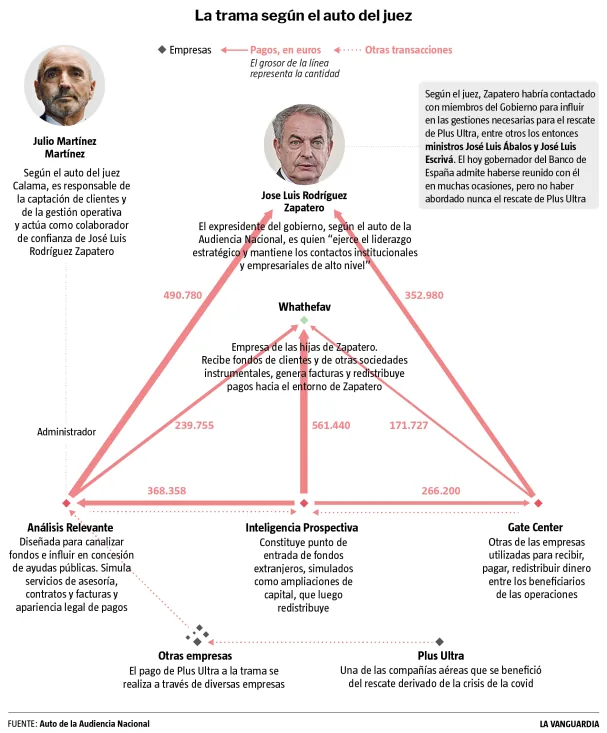
In January 2021, two months before the bailout was approved and with the arrangements advanced, Plus Ultra signed a consulting contract with another Martínez company (Idella Consulenza Strategica) for 1% plus VAT of the bailout amount. On February 6, Reyes asked Plus Ultra executives to organize a lunch with Venezuelan magnate Camilo Ibrahim Issa and Martínez Martínez. “You can organize a lunch with the namesake, you and Camilo. Camilo was with ZP today. He told him everything is going smoothly.”
In the timeline of the bailout management, February 17 is also marked in red; the day Plus Ultra’s top executives sent each other a screenshot of a conversation with the former head of government’s friend. In the conversation, they talked about the ongoing process, “which would be good to pressure.”
Also read
On February 26, Martínez informed Plus Ultra of obtaining the public aid; half a month before it was approved by the Council of Ministers. “My biggest congratulations for achieving the goal,” says Zapatero’s supposed “lieutenant.” To which Plus Ultra replied: “Without a doubt, thank you very much for the support. Difficult times that can only be overcome with the support of friends and good relationships.”
Read more How long does a tow truck take in 2026 and how to track its arrival in real time