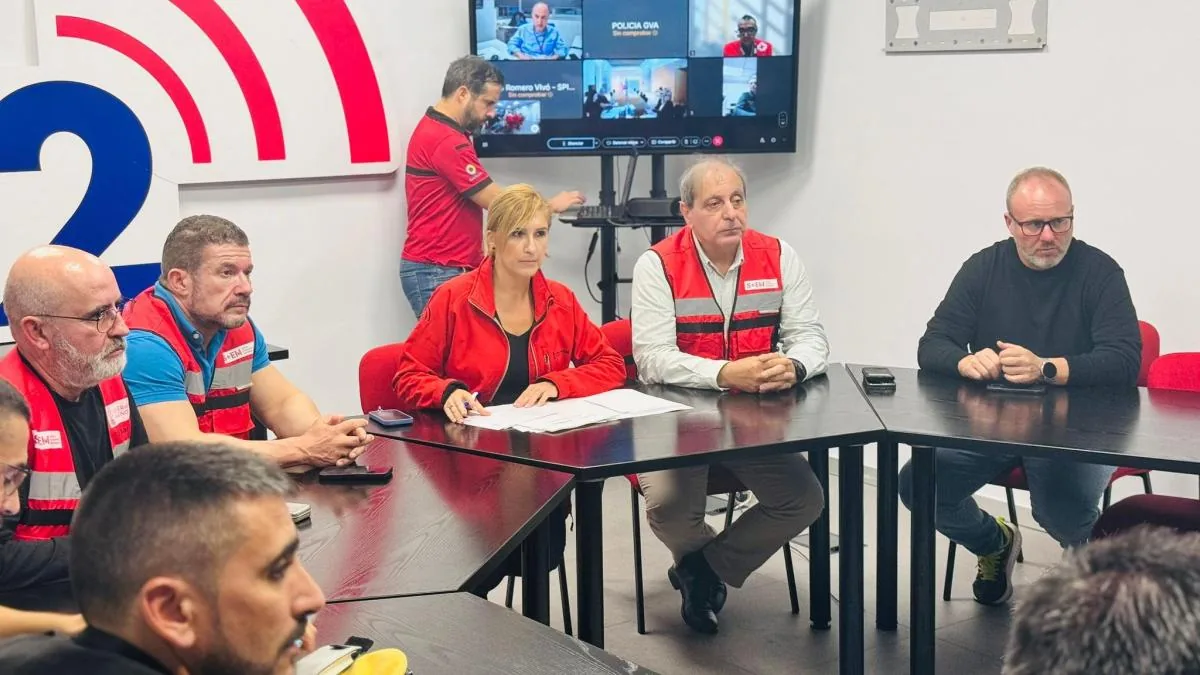
The judge overseeing the dana case has issued an order rejecting the holding of a confrontation between former councilor Salomé Pradas, under investigation in the case, and the Deputy Director General of Emergencies of the Generalitat, Jorge Suárez, at the request of the private prosecutors.
Read more Aitana Forcen, the Valencian trapped on the ‘Hondius’: “I am fine”
The magistrate argues that the confrontation procedure is exceptional and must be agreed upon when other means cannot be used to establish the facts, according to Supreme Court jurisprudence. Judge Ruiz Tobarra believes that everything related to the delay in sending the es-alert to the population has already been the subject of numerous investigative proceedings.
In her reasoning, the judge leans towards accepting Suárez’s testimony, for whom the delay in sending the alert and the fact that it did not include the recommendation for people to stay in their homes is attributable to the will of the investigated Pradas. The magistrate recalls that the former councilor can voluntarily request to testify “as many times as she wants in the procedure” if she rejects Suárez’s statements.
The magistrate recalls that the former councilor can voluntarily request to testify “as many times as she wants in the procedure”
The instructor reconstructs in a lengthy order how the decision was made to send a “late and erroneous” alert message. “Certainly, the warning to the population was late and the message was erroneous. The possibility of alerting the population practically with nearly three hours’ notice – the Cecopi was convened at 5 p.m. – was already pointed out at the Cecopi by Suárez. From that moment on, proposals followed and absolute indecision in the face of a situation that, far from improving, worsened as the hours passed,” states the instructor.
The judge maintains that Suárez himself read to those present at the Cecopi a proposed message at 5:45 p.m.: “Given the evolution of the emergency situation, it is recommended that you immediately move to higher areas and remain attentive to new messages.”
She recalls that “between 7 p.m. and 8:11 p.m. numerous deaths occurred or there were people trying to save themselves”
She explains that the proposal “was not to the liking” of the then head of the Provincial Fire Consortium – “nor was it assumed by the councilor,” who suspended the Cecopi at 6 p.m. to “consider the different options.”
At 6:38 p.m., an Emergencies technician proposed a new text: “Due to situations caused by heavy rains in your area, as a preventive measure, stay in your homes and be attentive to future notices through this channel and official sources.” Ruiz Tobarra recalls in the order that “between 7 p.m. and 8:11 p.m. numerous deaths occurred or there were people trying to save themselves. This is evident from the statements of the affected and the testimonies taken in the death files.”
The judge argues that there was no technical reason for the delay in sending the message, citing as an example that an Emergencies technician working remotely from home “with great efficiency, took only 2 minutes and 36 seconds to cancel a message, one written in Spanish and English, and to validate and send at 8:11 p.m. the one that finally arrived.”
“Likewise,” adds the judge, “the claim that the Es_Alert at 8:11 p.m. was sent exclusively because of the Forata dam (which had no negative effect whatsoever, nor is connected to the Poyo ravine) must be discarded for two simple reasons: the message was sent to the entire province and by that time the situation of the Poyo ravine was already known. Calls to 112 numbered in the thousands.”
Read more The mother sought advice on Google to protect her baby from the father’s abuse
The instructor maintains that Pradas had legal doubts about the confinement, which is why at 7:08 p.m. the draft alert message changed the order from “stay in your homes” to “avoid travel.”
Pradas herself sent a message to the then chief of staff of Carlos Mazón, José Manuel Cuenca, at 8:15 p.m., informing him that a message asking for caution had been sent to the entire province at 8:11 p.m., and that another message would be sent to the regions of Ribera Alta, Ribera Baja, Horta Sud, and Hoya de Buñol, recommending “confinement.” Earlier, Cuenca had insisted to Pradas that “confining the entire province was madness, to take that out of your head.”
At 7:08 p.m. the draft alert message changed the order from “stay in your homes” to “avoid travel”
“The expression ‘stay in your homes’ seemed to Pradas to have an imperative tone and she doubted the legal viability of the message,” despite “Suárez assuring her that she could adopt that measure,” the judge notes. However, “Pradas indicated that she was going to call someone in particular, that she wanted to make a legal consultation. Pradas entered and left the room several times along with Vicent Mompó – president of the Diputación – or Emilio Argüeso – Secretary of Emergencies and also prosecuted in the case. They could receive calls inside the Cecopi, but they always went out.”
The judge recalls that Pradas did not consult directly with the Generalitat’s lawyers, as stated in a report from this body submitted to the case. “It is unknown with whom she did,” she adds. “The fact is that the instructions for sending the two Es_Alert messages were given by Pradas,” emphasizes the instructor, and that “she said not to send the first message until she saw it written.”
“When Pradas finally returned to the command room,” she made corrections to the message “replacing ‘suspend’ with ‘should be avoided’,” as well as “linguistic corrections related to Valencian, with the help of Vicent Mompó,” after which “she took a photo of the computer screen and said ‘go ahead.’”
“The fact that the message text was changed for linguistic reasons added to the paralysis in decision-making, and in any case, the final text, with spelling opting for ‘Valencia’ and not ‘València’, or ‘tipo’ and not ‘tipus’, or ‘este’ and not ‘aquest’, is documented,” the judge points out, referring to changes usually made to try to differentiate Valencian texts from Catalan. The second message, the one that reached the population at 8:57 p.m., was “more accurate,” according to the judge, but “late for the populations of l’Horta Sud, as well as for Algemesí or Guadassuar.”
All this combined with the fact that the Cecopi was convened to address what was happening from early morning in Utiel-Requena at 5 p.m. and “was no longer effective for that area,” since “there were deaths before it started,” nor was it effective for the municipalities of the Horteta and Gallego ravines or the Hoya de Buñol nor for “the municipalities for which there was time, little, but there was.”
Read more A new strategy studied by the Clínic improves recovery after a severe stroke