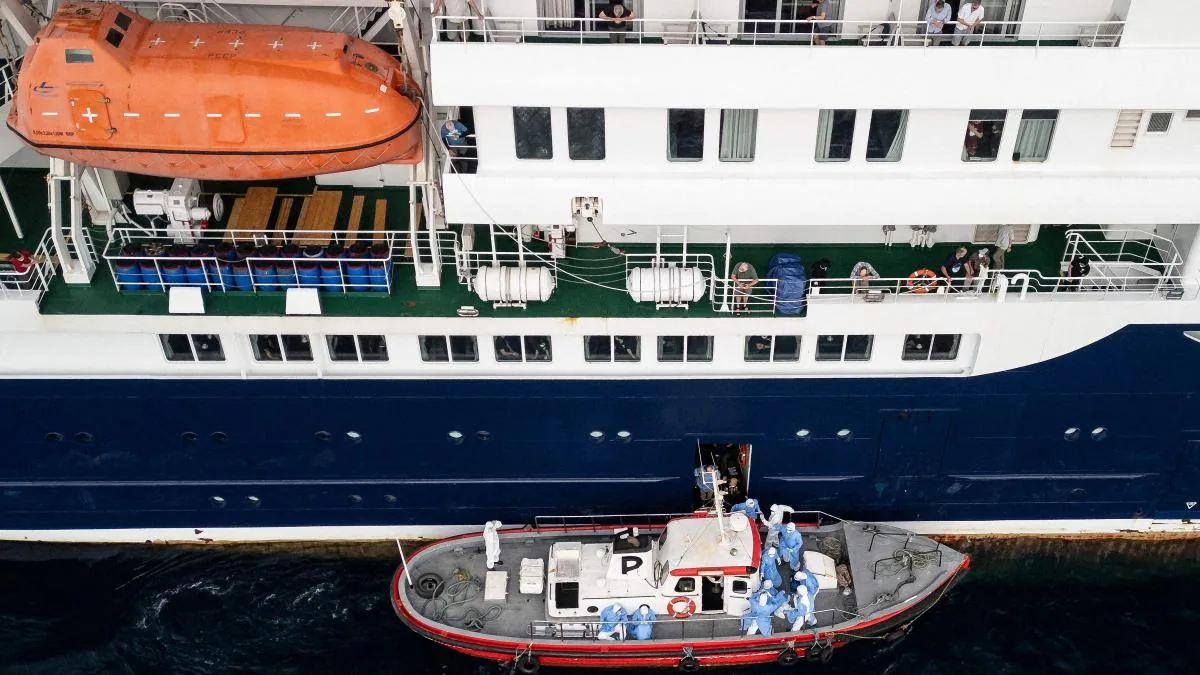
The luxury cruise ship Hondius, affected by a hantavirus outbreak, will finally dock in the Canary Islands, where it is scheduled to arrive next Sunday at twelve noon with more than 140 people on board, none of whom show symptoms of the disease. The three sick individuals on the ship, one of them the doctor and in serious condition, were evacuated yesterday on two medical planes and transferred to Amsterdam, where they are receiving the necessary medical care.
Read more Press conference of Marlaska and García on the situation of the MV Hondius
Although initially everything had been prepared to transfer this last patient to the Hospital de la Candelaria in Tenerife, which has a high-level isolation unit, the Ministry of Health together with the WHO finally decided to transfer him to the Netherlands. The plane carrying two of the sick had to stop in the afternoon at Gran Canaria airport to refuel. Morocco rejected this landing, just as Cape Verde initially did with the ship, and the Canary Islands accepted it but on the condition that no one from the plane would disembark, which was respected.
During that stop, as sources from Health point out, the doctor traveling on the plane reported a failure in the electrical support system of one of the patients. The airport provided the necessary electrical support until a new plane arrived and the journey continued to Amsterdam.
The rest of the cruise passengers, who left for the Canary Islands around 6:30 p.m. yesterday, will be transferred to their countries of origin – there are more than 23 nationalities – after arriving in Tenerife this Sunday. The 14 Spaniards traveling on the cruise, including five Catalans and one Valencian, will disembark and immediately be transferred by military plane to the Torrejón de Ardoz base, and from there they will be admitted to the Gómez Ulla Hospital in Madrid, where they will undergo quarantine. If they show any symptoms, they will be admitted to isolation units in that hospital; if not, they will remain in quarantine. The number of days has not been determined but is expected to be between 20 and 45. Each country will be responsible for the return home of its nationals, either through flights chartered for this specific service or with military planes. All passengers will remain on the cruise ship until their planes arrive.
The diversion of the ship to the Canary Islands has generated widespread social rejection, not only from the island authorities
As close sources explain, no one will disembark from that ship without having undergone medical examinations and an epidemiological and analytical evaluation. If anyone tests positive, they will have to be admitted to a hospital; if not, they will continue their journey. The Ministry of the Interior clarified yesterday that repatriation will be carried out following the European Union Civil Protection Mechanism, which has been activated more than 830 times, 64 of them in 2025.
The quarantine days have not been determined, but are expected to be between 20 and 45
While the device is being prepared on the islands for the ship’s passengers, the WHO and the authorities of the relevant countries have begun tracing 23 people who were on board the Hondius but left the expedition halfway, on the island of Saint Helena, and have been living normal lives for more than two weeks. Among them is a Swiss citizen who is hospitalized in Zurich and who traveled on the Hondius . The country’s authorities confirmed his case yesterday, raising the number of infected to eight (including the three deceased and the one admitted in South Africa). This tracing expands the perimeter of this health crisis caused by the Andes hantavirus, which has low human-to-human transmission but a high mortality rate, above 50%.
Read more Spain will host the hantavirus cruise and will care for the doctor, the most serious case
To avoid any risk to the citizens of the islands, the Government of Spain and more specifically, the Ministry of Health has chosen for the disembarkation of passengers in the Canary Islands an industrial port located south of the island of Tenerife with very little development. Fewer than a hundred workers serve a ship repair company operating in this infrastructure, which is not yet finished and belongs to the Spanish port system through the Port Authority of Santa Cruz de Tenerife. Its president, Pedro Suárez, assured yesterday that the ship will not dock at the port and will remain anchored until Foreign Health and Maritime Captaincy so indicate.
Another conflict that pits the central government against that of the Canary Islands
The Government of the Canary Islands criticized yesterday the “institutional disloyalty” of the State in handling and informing about the diversion of the ‘Hondius’ ship to the Canary Islands because after more than ten hours in a joint position that the ship would not go to the archipelago, the Ministry of Health unilaterally changed its stance. And worst of all, the president of the Government of the Canary Islands, Fernando Clavijo, learned of Mónica García’s decision from journalists of various local media who called him to ask about rumors circulating that the ship was indeed going to the Canary Islands. After being questioned, he called the minister who acknowledged that the Government of Spain had reached an agreement with the WHO to divert the ship to the islands with the passengers, as well as to send the most serious patient to be treated at the Hospital de La Candelaria. “It angers that they act this way, with imposition and without dialogue,” sources from the regional government indicated yesterday.
Early yesterday morning, Clavijo demanded an urgent meeting with the President of the Government, Pedro Sánchez, to receive the appropriate explanations. The meeting did not take place due to “contact via WhatsApp between both,” as Moncloa sources told Efe. Later in the afternoon, he was summoned to a meeting in Madrid with representatives from the Ministries of Health and Interior to determine the ship’s disembarkation operation.
On the other hand, the Health Minister of the Community of Madrid, Fátima Matute, also reproached the Government for not informing them about the transfer to Gómez Ulla and accused García of lack of coordination.
The diversion of the ship to the Canary Islands has generated widespread social rejection, not only from the island authorities, who consider that they do not have sufficient information to guarantee zero risk to their population. The Government of the Canary Islands acknowledged yesterday that there was concern about the ship’s arrival. Workers at the port of Granadilla and the association of users, entrepreneurs, and air transport professionals, as well as the Tenerife Medical Association and the island councils and town halls, have demanded greater clarity and information.
Each country will be responsible for the return home of its nationals, either through chartered flights or military planes
In this regard, the Minister of Health, Mónica García, sent a message of reassurance yesterday and indicated that, although the virus’s lethality is high, the risk to the population is low. She also assured, after meeting with the Minister of the Interior, Fernando Grande-Marlaska, in a meeting chaired by the President of the Government, Pedro Sánchez, that the operation will have all the necessary safety guarantees to avoid any contact with the local population and ensure the safety of the assistance personnel. “The situation is complex, but we have the means to respond to this type of situation with the strength of our country, but also of the European Union,” Marlaska assured. In this regard, García recalled that Spain’s action responds both to humanitarian principles and to international legal obligations derived from the WHO International Health Regulations, of which Spain is a State party.
In this regard, she recalled that Articles 13 and 44 of the Regulations establish the duty of technical and logistical cooperation between countries in the face of international health emergencies, while Articles 27 and 28 expressly regulate the management of infection situations on board international means of transport. She also pointed out that these treaties are part of the Spanish legal system and are fully binding on public administrations.
Read more The efficient Arsenal cancels Atlético and returns to the final 20 years later