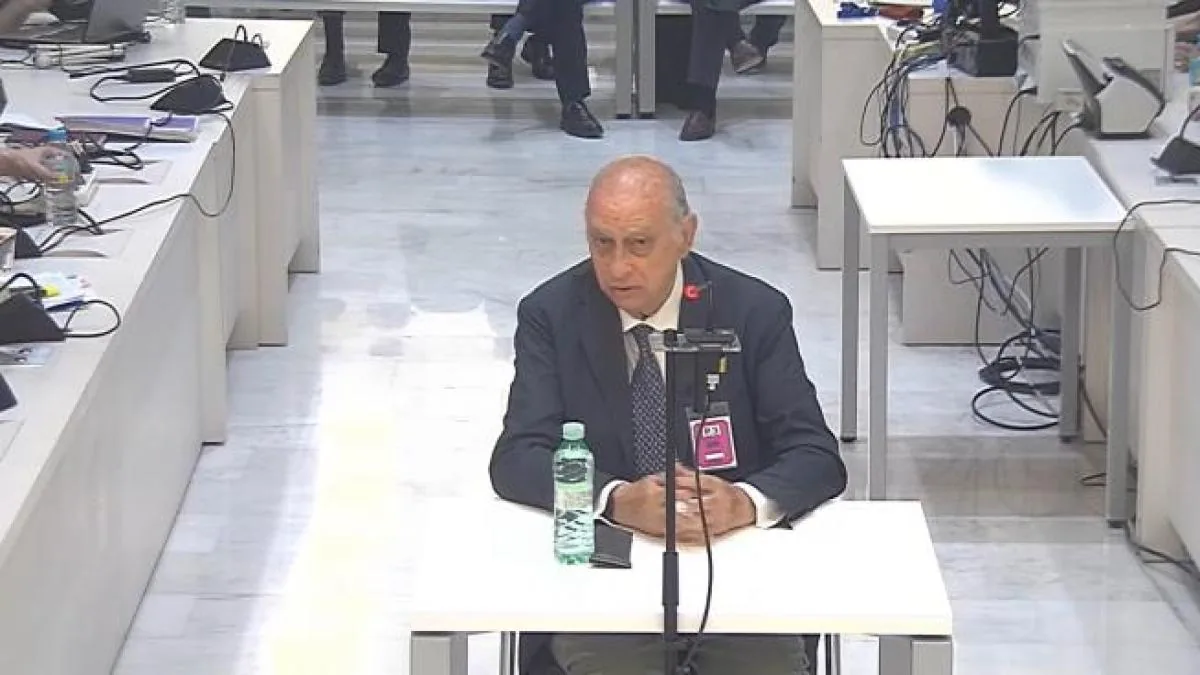
When the trial for the Kitchen operation started almost two months ago, there was doubt in the National Court about whether the leadership of the Ministry of the Interior during Mariano Rajoy’s government – with Jorge Fernández Díaz and Francisco Martínez in it – would end up stabbing each other to avoid being tagged with the “X” of the parapolice plot, financed with reserved funds, to steal compromising information for the Popular Party whose treasurer was Luis Bárcenas. With the very high-voltage confrontation they had during the investigation as a precedent, it did not seem far-fetched that they would go head-to-head in a every-man-for-himself fight. But yesterday, that idea vanished: there was a non-aggression pact.
Read more We do not deserve all this
So evident that, at the end of his testimony as a defendant, the former Interior minister crossed paths with his former number two, shaking his hand with a “in the end, the truth will prevail.” Thus they sealed a common strategy – although one loose end remained – with which the top officials denied to exhaustion the launching of a parapolice operation to prevent possible evidence against the Popular Party from ending up in the hands of the National Court. “Not the slightest idea,” insisted one. “Absolutely not,” assured the other, despite the evidence.

The accused only answer their lawyers; not the Prosecutor’s Office, which asks for 15 years in prison
Neither of the two, assisted by their rights, wanted to answer the questions of the Anti-Corruption Prosecutor’s Office, which asks for 15 years in prison for them. Both limited themselves to answering only their lawyers’ questions. Francisco Martínez opened fire, who, guided by his lawyer, wondered what interest he could have at that time in torpedoing the Gürtel case, when he was neither implicated nor appeared in Bárcenas’ papers. He described his relationship with the other accused, emphasizing the shady former commissioner José Manuel Villarejo, with whom he often spoke, although he never heard him talk “about anything illegal.” His lawyer dwelled on countless WhatsApp conversations that were intercepted (with allegedly corrupt commissioners, police officers, or even his partner). However, he did not spend a single second on the SMS with Fernández Díaz that he himself took to a notary and that caused the former minister to end up on the bench.
In those SMS, which throughout the sessions have been shown to possibly have been manipulated, Martínez informed a contact saved as Jorge Fernández Díaz that “the operation” had been “a success.” That was the main evidence against the former minister. For Anti-Corruption, this would show that the top Interior official was aware of the illegal operation. And yesterday, despite suggestions that Martínez himself could have fabricated them, he did not want to defend himself against those accusations.
Jorge Fernández and his former number two agree on non-aggression, setting aside the SMS that Martínez notarized
Unlike the former Interior minister’s lawyer, who delved into the matter. “Do you recognize this message? Did you send this other one?” “No,” he repeated, although he wanted to make clear that he “does not accuse anyone.” What Fernández Díaz came to defend is that an Interior minister does not get down to the police operational level, but his competencies are different. Likewise, the control of the reserved funds with which the mole of the plot was allegedly paid. He was not there for that.
Read more The Government denounces a plot to bring it down with the avalanche of legal cases
Hence, according to his version, he heard about the Kitchen operation for the first time at the end of 2015 or early 2016, when the first headlines about the illegal operation began to appear. Fernández Díaz handed over the Interior portfolio to Juan Ignacio Zoido at the end of 2016. When his fellow deputies then asked him about those first reports on the plot, he asked them not to talk to him about it because they were “sensitive, secret and reserved” matters.
The former Secretary of State defends that he had no interest in Bárcenas’ papers because he did not appear in them
Despite the parallel strategy – and the convenient manual of temporary amnesia that many witnesses have used – there was indeed a crack of contradiction between the two. Martínez, giving a specific date (July 13, 2013), said that the then minister called him to ask if he was aware that a police collaborator was embedded in the Bárcenas environment. The former Secretary of State – he detailed – called Eugenio Pino, deputy operational director (DAO) of the National Police, who confirmed it: the family’s driver. And so, supposedly, he passed it on. But this episode was flatly denied by Fernández Díaz, who repeated that he learned about the operation more than two years later.
The trial will resume next Monday with the testimony as a defendant of Eugenio Pino.
Read more Jonathan Andic’s defense claims another accidental fall of the father due to an ailment