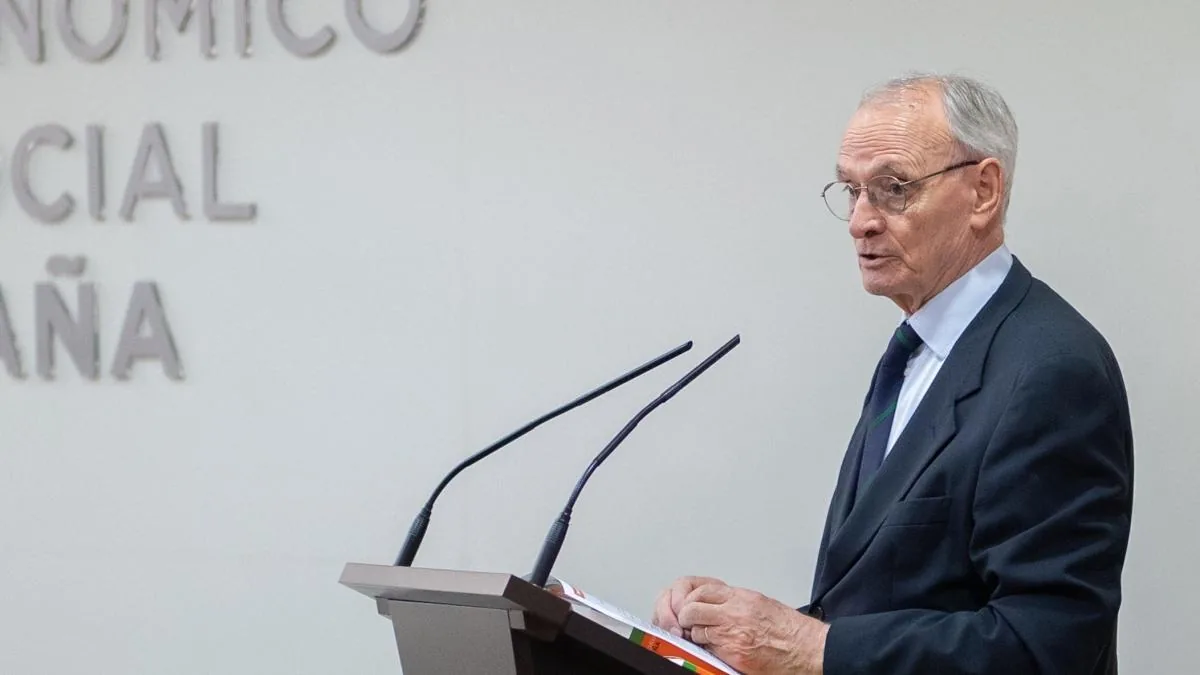
In difficult times like the current ones, the Economic and Social Council (CES) sends an optimistic message about the situation of the Spanish economy, diagnosing a structural improvement, but warning that this improvement does not sufficiently reach the well-being of citizens. On the way, there is a broken bridge. “That bridge that existed in the second half of the last century between growth and well-being has broken in many pillars,” said its president, Antón Costas, at the presentation of the Report on the Socioeconomic and Labor Situation of Spain 2025.
Read more The housing crisis drives donations to historic highs in Catalonia
There are two pillars of the bridge that have broken, according to this analysis. One is housing which, in last year’s report, the same CES already described as a “black hole” because it eats up the improvement in real wages. The problem persists. The second fallen pillar is the cost of living. Here, the accumulated effect of several years of inflation and especially its impact on the shopping basket of basic goods affects everyone, but very especially the most vulnerable households. Inflation is under control right now, pending the Iran war, but prices carry the legacy of the inflationary spiral.
Furthermore, Costas points out that, in his opinion, “probably, in many goods and services, we have a competition problem.” But he emphasized that this was a personal comment and did not want to elaborate further, because the CES, a consensus body par excellence, had not examined it.
The accumulated effect of several years of inflation and its impact on the shopping basket punishes the most vulnerable
This is the negative part of the Economic and Social Committee’s analysis: the reduced impact on the situation of citizens of the improvement in the big figures. On the other hand, the positive is the assessment it makes of the evolution of the Spanish economy, which it considers that, after five years of growth, it has reached a situation of structural improvement, no longer simply cyclical.
At first, it has passed “the 2025 stress test with an outstanding grade.” In a moment of global uncertainty, it has maintained the previous growth momentum, with a 2.8% increase in GDP, again well above that of neighboring countries.
Read more Seven Catalan universities among the top 10 with the highest academic performance in Spain
But, more significant for Costas, is the improvement over a longer period, five years, from 2021 to 2025, a structural improvement, which he calls “a change of skin, a skin mutation” with a more resilient and more inclusive economy.
A mutation of the economy based on two factors. One is the change in the structure of companies, with a reduction in the total percentage of microenterprises and self-employed and, on the other hand, an increase in medium-sized companies. And the second factor is the increase in productivity. Specifically, that in the last five years, for the first time in an economic expansion cycle, productivity also grows.
“When a trend is maintained for five years, it cannot be considered cyclical,” Costas highlighted, adding that there is a widespread consensus among economists about the increase in productivity, although with differences in the moment when the change started or the underlying causes that govern it.
Read more Black smoke in Education: the Government asks for more time to study the economic proposal