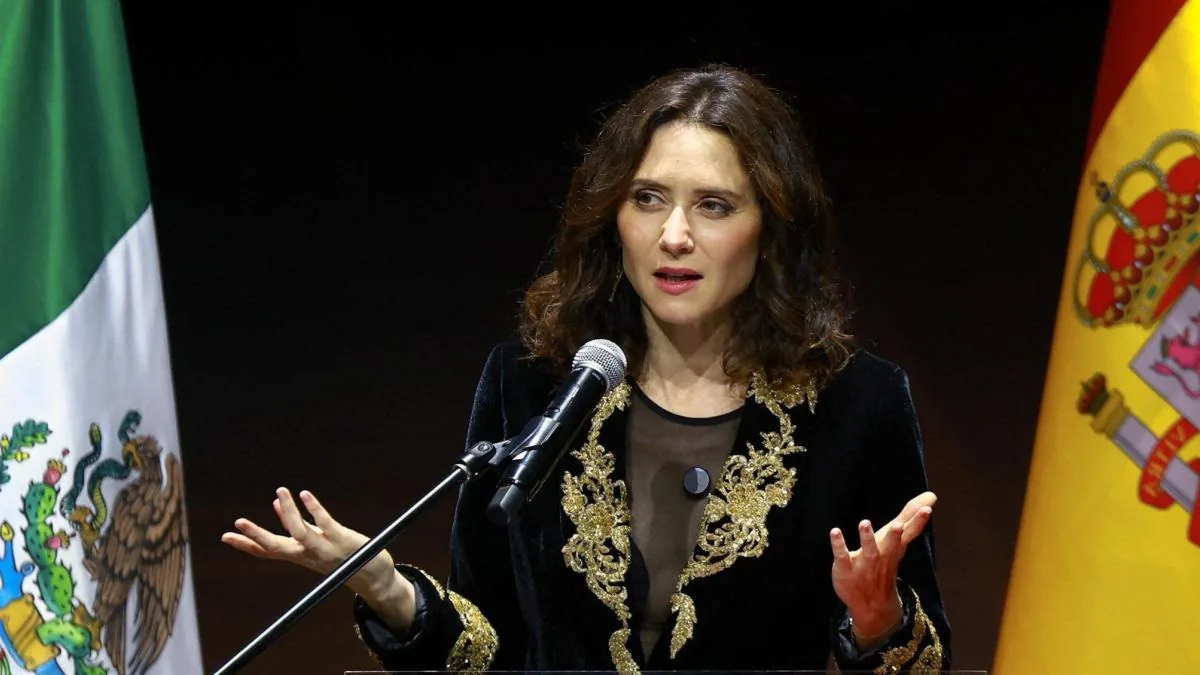
Isabel Díaz Ayuso has turned her institutional trip to Mexico, to “intensify” relations with the second largest investing country in the region, into a new episode of the cultural battle that has been waged in Spain for years around Hispanidad, which has earned her no few criticisms in the North American country. Even from the president, Claudia Sheinbaum, who has warned that those who seek to vindicate Hernán Cortés and his atrocities are destined for defeat.
Read more No bail for the killer of Esplugues
What was supposed to be an agenda of economic and political meetings, as summarized by the Madrid Government the official trip undertaken by the president of the Community of Madrid, ended up turning into a high-voltage symbolic controversy after the Madrid leader participated this Monday in a tribute to Hernán Cortés and Isabel the Catholic that provoked criticism from the Mexican government, indigenous protests, and the cancellation of the event initially planned at the Metropolitan Cathedral of Mexico City. All this, moreover, in contrast to the more cautious position maintained by the Spanish Crown in recent years, after Felipe VI publicly acknowledged the “abuses and controversies” committed during the colonial period.
The ceremony, finally moved to Frontón México – home of the musical Malinche directed by Nacho Cano -, had been conceived as a “Celebration for the Evangelization and Mestizaje in Mexico.” The change, wrapped in controversy, was decided at the last minute after the Primate Archdiocese informed that the organizers had not gathered all the necessary permits to hold the event in the Cathedral. The decision also prevented the tribute from taking place in the very historic center of the Mexican capital, a short distance from the church where Cortés’ remains rest and where indigenous groups had called a parallel protest against what they consider an “exaltation of the Spanish conquest.”
Far from lowering the tone, Ayuso took advantage of the event to openly claim the Spanish legacy in America and denounce the discourses that, in her opinion, seek to reinterpret the conquest from historical resentment. “Freedom never apologizes for being freedom,” said the Madrid president in a speech full of references to mestizaje and the Hispanic-American cultural community. Without explicitly naming either the former Mexican president Andrés Manuel López Obrador or the current president, Claudia Sheinbaum, Ayuso considered it “incomprehensible” that there are still leaders who “want to live off hatred” to “avoid the present and their obligations.”
The popular leader also insisted on an idea she has defended for years. The claim of the shared heritage between Spain and Latin America against what she considers a revisionist reading of history promoted by leftist and indigenous sectors. “You would have to be very foolish to hate each other and share surnames,” she said.
The event also featured the intervention of Nacho Cano, who has long been one of the main cultural defenders of the figure of Cortés. The composer maintained that the Extremaduran conqueror was also “the founder of Mexico” and tried to depoliticize the tribute despite the obvious ideological background surrounding it. “There is no political issue here,” he assured.
Read more Carney courts Europe while most Canadians dream of joining the EU
The event received a response this Tuesday from the president of Mexico, Claudia Sheinbaum, who at the ceremony of the 164th anniversary of the Battle of Puebla said: “To those who revive the Conquest as salvation, we say: you are destined for defeat (…). Those who seek to vindicate Hernán Cortés and his atrocities are destined for defeat.”
The controversy, however, had already escalated in the previous hours. The Morena parliamentary group in Mexico City harshly criticized Ayuso’s visit and accused her of coming to the country to pay tribute “to those who destroyed entire civilizations.” On social media, government leaders linked her to the “Spanish far-right” and questioned her political and business contacts in Mexico. The president of the Mexican Senate, Gerardo Fernández Noroña, even called her a “super fascist.”
The controversy has ended up enveloping a visit that originally sought to strengthen economic and institutional ties between Madrid and various Mexican states, but which has inevitably been crossed by a historical and political debate that remains deeply sensitive in Mexico. The demand for apologies to Spain for the abuses committed during the conquest, promoted in recent years by López Obrador and partially assumed by sectors of the Mexican government, has made any positive claim of figures like Cortés an explosive matter.
The criticisms have not been limited to Mexico. From Spain, Movimiento Sumar and Podemos also accused Ayuso this Tuesday of using the institutional trip to feed an ideological agenda and strain relations with the Latin American country. The general coordinator of Sumar, Lara Hernández, argues that the Madrid president has set out to “dynamite” the ties between the two countries, while Podemos leader Pablo Fernández has called the official visit “infamous.”
Read more The Pope to Trump: “If anyone wants to criticize me, let them do it with the truth”