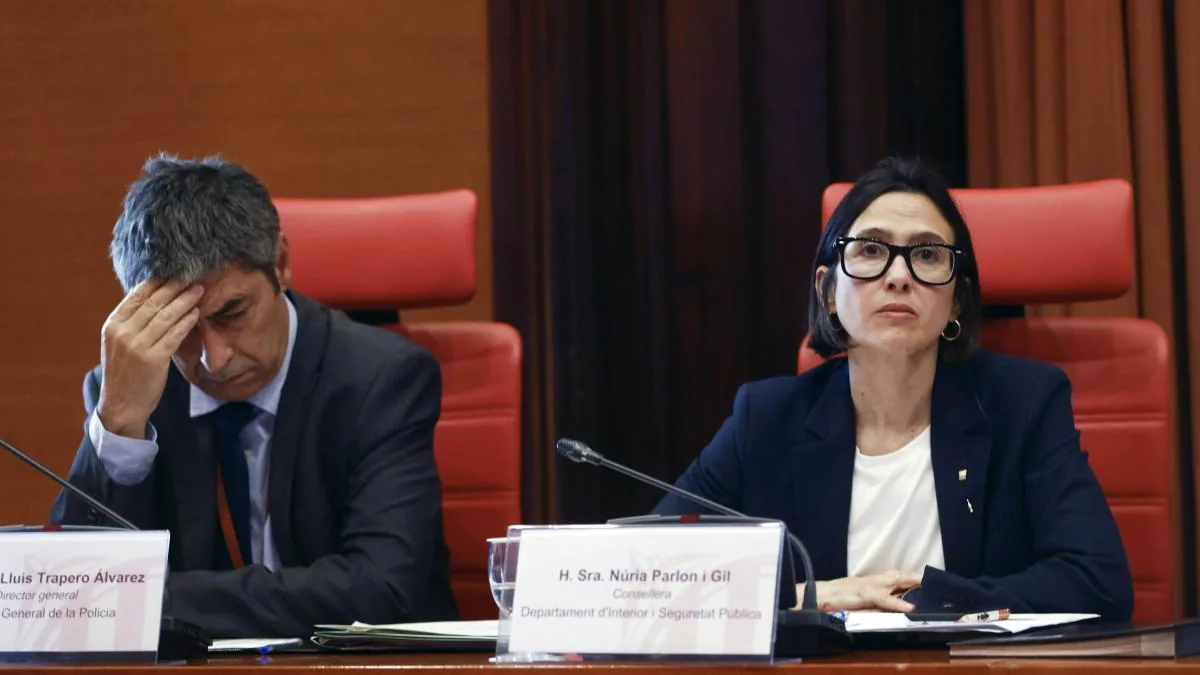
The Department of the Interior admitted this Wednesday the mea culpa for the infiltration of two agents from the Mossos d’Esquadra information unit in the teachers’ assembly in Barcelona, within the framework of the protests by Catalan teachers and the conflict they maintain with the Government. The Minister of the Interior, Núria Parlon, apologized to the teachers and union members, to whom she offered a meeting. “I apologize for the feeling of distrust and insecurity regarding the right to protest and your assembly work,” said the socialist leader to the teachers’ representatives present today in the Parliament.
Parlon pointed out that the presence of two agents at a preparatory meeting for the mobilizations was “a serious mistake” that cannot be repeated, a diagnosis also shared by the Director General of the Police of the Generalitat, Josep Lluís Trapero. “It is an intervention that is not justified,” both admitted, although they denied at all times that there was “bad faith” or political interference.
The minister and the major of the Mossos appeared before the Interior commission and emphasized that the decision was not made in the political sphere and that no information was transferred to the Department of Education headed by Esther Niubó, who will have to appear before that same body another day. “It was a well-intentioned and very poorly planned operational decision that has undermined the trust and image of the force,” lamented Parlon.
The minister used terms such as “unfortunate action” or “unnecessary risks.” She also referred to “past inertia” that she promised “will be broken.” “I recognize the mistake and the lack of opportunity, but not bad faith or democratic interference,” said Trapero in turn, who is in the opposition’s crosshairs but maintains the confidence of both the Minister of the Interior and the President of the Generalitat, Salvador Illa.
“One thing is the lack of opportunity and another is illegality,” said the Director General of the Police, who explained that the operation was supported by the current legal framework and by the police structure decree of the Generalitat, while denying the violation of a fundamental right such as the right to protest. In this regard, the Interior leaders guaranteed that the infiltration was limited to assessing the “risks” that, in their opinion, the teachers’ protests entailed and that the information was not used for managing the conflict with Education.
Likewise, Parlon and Trapero revealed that a confidential investigation into the action in question was opened on Tuesday and announced that in the future there will be “more filters” and processes will be evaluated to prevent errors of this magnitude from happening again. “We will modify the structure decree,” asserted Parlon, who conceded that to obtain information “non-invasive means must always be chosen whenever possible.”
At the beginning of her speech, Parlon extended a hand to the unions to give them the explanations they consider appropriate. “I extend a hand to the unions so that we can meet and provide personal explanations, those you deem appropriate,” said the Interior minister. “We need to strengthen spaces of trust between social activism and the force,” she insisted.
Trapero, in his turn, emphasized the fact that the heads of the general information police station and the techniques used have not changed with the last three Catalan governments. “Past inertia is costly and the one who has to reverse it pays the price,” Parlon concluded.
Opposition groups, like the unions, see the explanations as insufficient and, except for PP and Vox, demand Trapero’s dismissal
These explanations, however, have not satisfied the opposition, which except for PP and Vox – Aliança Catalana did not attend – has maintained the demand for the dismissal of the Director General of the Police and considers that the police intervention was not lawful. Junts and the CUP have also raised the stakes by again demanding the resignation of Minister Parlon and urging ERC and the commons to halt budget negotiations with the Government.
“This is not an operational error. It is a violation of fundamental rights,” said the post-convergent spokesperson in the commission, Josep Rius, who stated that what was done is “illegal” and that “the Catalan police model has been called into question.”
Laia Cañigueral, from ERC, pointed out that the intervention violates the Constitution and was neither “necessary nor proportional” and called for democratizing the police force.
Junts and the CUP raise the stakes and demand the minister resign and ERC and the commons break off budget negotiations with the Government
The commons, with deputy Andrés Garcia Berrio, demanded transparency and “a 180-degree change” in the political orientation of the police field; and the CUP stated that we are facing “dictatorial practices” from other times. “Dismiss the Director of Police immediately, and if he cannot or does not want to, resign,” concluded Xavier Pellicer.
On the other side of the scale, the PP reproached the Government for not defending the police action. “You say you apologize. What you have to do is apologize to the two exposed agents, you have been very clumsy,” concluded Alberto Vilagrasa. For its part, Vox wanted to probe the regulatory framework invoked by Trapero and highlighted that it was approved by Artur Mas’s government in 2011 and ratified in 2023 by Pere Aragonès’s executive. “It is very delicate to place undercover agents in a teachers’ assembly on strike. It does not smell right to us, we are not talking about violent groups but a workers’ assembly,” said Sergio Macián, who, on the contrary, has asked for protection for the two agents now that they have been identified.
CGT and Ustec see the apologies as insufficient
Representatives of CGT and USTEC, after listening to Parlon and Trapero, considered their explanations “insufficient.” Both organizations, which are studying legal actions against the Interior Department, believe it is “serious” that the person responsible for the operation is not identified and therefore call for the resignation of both the minister and the director general of the Catalan police. “We do not need apologies and we missed the words inadmissible, intolerable, and anti-democratic,” they responded.