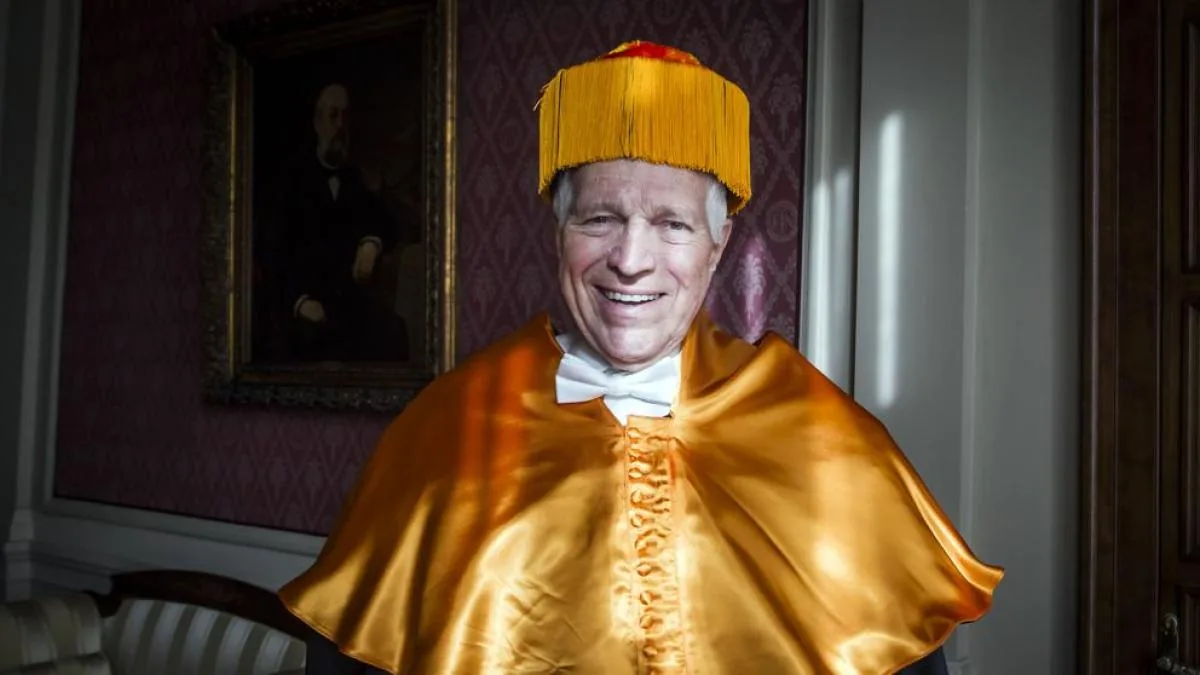
It was the year 2017. Donald Trump had recently moved into the White House. Seen through today’s eyes, he was a more moderate Trump than the current one. But even then Edmund Phelps (1933, Illinois), Nobel Prize in Economics in 2006, sensed that the magnate was a wolf in sheep’s clothing.
Read more Jordi Savall receives the greatest international classical music award in Munich
This academic criticized economic dirigisme
During a lunch in a private room, in a restaurant on Sepúlveda street, with a small group of journalists with tired voices, somewhat slow, but with a still very lucid mind, the American academic, asked about the new political course in the White House, did not hesitate to make a comparison between Donald Trump and Benito Mussolini, which left the diners stunned.
“He reminds me of an economic planner in the style of the thirties or forties. He wants to favor some sectors over others, distort trade at will. His ideas evoke those of Benito Mussolini’s corporatist economy,” said the prestigious academic.
He was never convinced by universal basic income to reduce inequalities
At that time, Donald Trump was beginning to test his tariff policy. Phelps did not hold back. “Adolf Hitler also resorted to protectionism in Germany, closed exchanges with the aim of favoring certain sectors, but the consequence was the fall in productivity.”
Phelps, who passed away this Saturday, also had radical opinions on controversial arguments such as basic income and the already emerging technological revolution that was coming. For example, the Columbia academic showed his deep “contempt” for the theory of universal basic income, a proposal that is also beginning to have some echo in Silicon Valley in the face of the challenge posed by the automation of work. “It is a disgrace. And it is a disaster from a moral point of view. Such income would interfere with production processes and, ultimately, depress real wages.” As for technology, for Phelps, it was not about fearing robots. “I am more concerned that work ends up being less attractive,” he said.
His concept of “natural rate of unemployment” is today very popular and adopted by the academic world
Defender of creativity and competition, lover of classical literature, in La Contra to Victor Amiguet a decade ago he delivered another of his prophecies: “Trump and Putin are two sides of the same disastrous coin: the coin of cronyism, the miserable coin of clientelism.”
From a scientific point of view, Phelps is considered one of the most influential macroeconomists of the 20th century. His most famous works are The Golden Rule of Capital Accumulation, from 1961, and especially his research on “the natural rate of unemployment,” which helped reconsider the Phillips curve (which relates unemployment and inflation). Essentially, Phelps believes that unemployment is independent of the effects of inflation in the long term due to the distorting effect of economic agents’ expectations on wages and prices.
Another Nobel laureate, Paul Samuelson, said of Phelps: “His contribution to the discipline is a project: to introduce imperfect information and knowledge, imperfect competition, and market frictions into macroeconomics, and I would add also into microeconomics.”