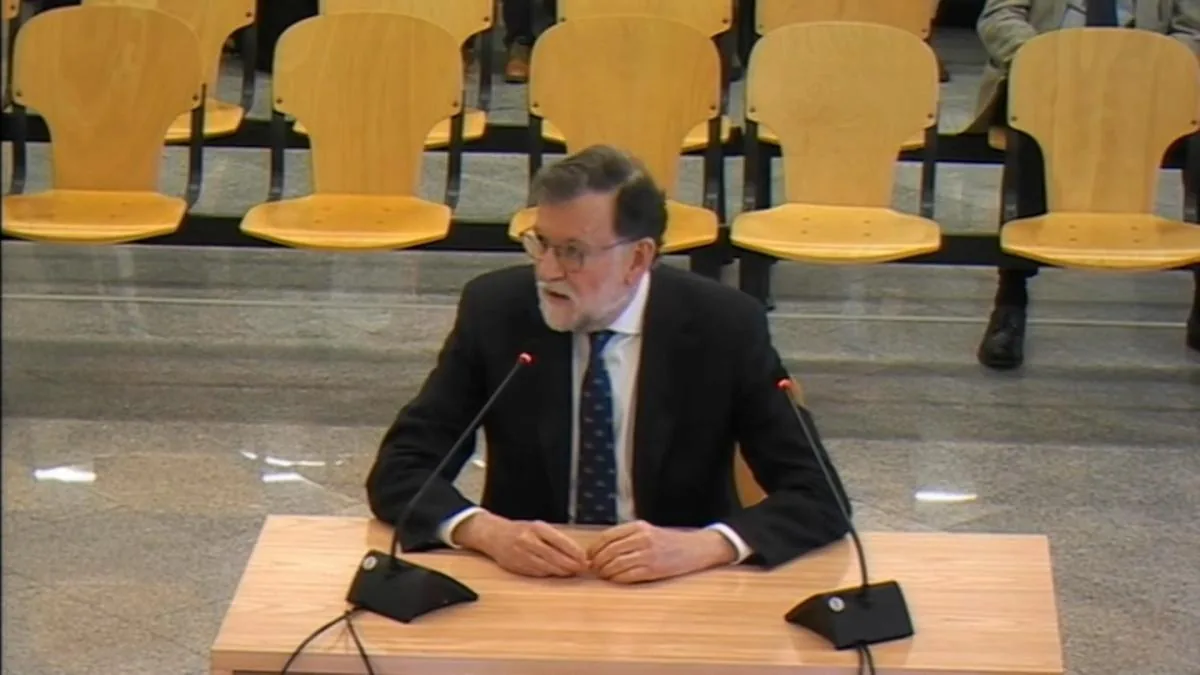
With that characteristic sarcasm, Mariano Rajoy once said about the party’s slush fund (B-box) he presided over: “We knew everything, except what appeared in the newspapers.” The Gürtel case politically brought down the leader of the PP, but he has never had to assume judicial responsibility for the illegal financing network that operated for years within the PP, providing undeclared bonuses to many of its leaders and serving to pay for the renovation of the party’s headquarters on Génova Street in Madrid, in addition to numerous electoral events and enriching some necessary intermediaries, such as the party’s treasurer himself, Luis Bárcenas. Several judges have investigated this case and its derivatives, but Rajoy has not been accused of anything in these years. Today he will testify again before the Audiencia Nacional. It is time to review, now with perspective, what has happened so that M. Rajoy’s involvement has not gone further and is only fodder for talk shows or social media memes. We will divide one of the most relevant corruption cases of recent decades in Spain into three phases:
Read more Cospedal on Bárcenas: “That person you’re talking about did not have compromising papers”
First phase
Baltasar Garzón, who joined the PSOE lists as number two for Madrid in the 1993 general elections, launched Operation Gürtel in 2009. He ordered the first arrests and searches. He realized that it was not small-scale corruption, but he made the mistake of ordering the recording of conversations between the ringleaders in prison and their lawyers, believing that they were receiving instructions to handle undeclared money. That was the end of the ‘star judge’. For that order, Garzón was sentenced by the Supreme Court to 11 years of disqualification for malfeasance and expelled from the judicial career in 2012. On the tribunal was someone who years later would occupy many newspaper front pages: Manuel Marchena. And also two magistrates who would be his colleagues in the powerful Second Chamber of the TS, Andrés Martínez Arrieta (today president of that chamber) and Luciano Varela (now retired).
But as they say, the judicial machinery was already in motion, and the Gürtel case gained relevance, occupying all media attention until the Audiencia Nacional’s ruling in 2018. The court condemned the PP as a legal entity in its capacity as a “participant for profit.” The judges affirmed that an institutionalized corruption structure existed within the party and questioned Rajoy’s testimony. He was the first sitting Prime Minister to appear before a court, although he only testified as a witness, not as an accused. He stated that he was not involved in accounting and barely knew Francisco Correa, the head of the network. Before him were three magistrates: the presiding judge, Ángel Hurtado, considered conservative, who drafted a dissenting opinion to the sentence opposing the PP’s conviction. Also, Julio de Diego, who supported the conviction, and José Ricardo de Prada, with a progressive profile, to whom the phrases in the sentence doubting Rajoy’s testimony are attributed.
In May of that same year, 2018, and as a result of that ruling, Rajoy was removed from Moncloa by the motion of no confidence presented by Pedro Sánchez and supported by other parties. Some, like the Catalan nationalists and independentists, were more motivated by other issues than by corruption itself. It could be concluded that, although not through judicial means, Rajoy did pay politically for the Gürtel case, although in no case has it led to any ostracism from his party; quite the opposite.
Second phase
Pablo Ruz, the antithesis of Garzón, a discreet judge, took over. He investigated the PP’s slush fund (B-box), the undeclared bonuses noted in the famous “Bárcenas papers,” and the payment for the renovation of the PP headquarters. It was in these notes that M. Rajoy’s name appeared. It was said then that Ruz, a very technical and meticulous judge, withstood pressure, but the truth is that he completed the investigation, and this separate part of the Gürtel case also ended in trial. The court called Rajoy again, also as a witness. Already out of government – it was 2021 – he did not have to appear in person and was allowed to testify by videoconference. He said everything was false: “There is no slush fund, there are some papers from a man named Bárcenas.” (That man explained this week before a judge that he showed his notes on undeclared money to Rajoy in his office, and Rajoy put them through a paper shredder. But the truth is there is no proof of that). The tribunal was formed by José Antonio Mora Alarcón, who presided over it and drafted the sentence that considered the parallel accounting in the PP proven. Mora Alarcón is not part of any judicial association and emphatically shies away from political labels. Also present were Fernando Andreu, who belongs to the progressive Judges for Democracy, and María Fernanda García, close to Isabel Díaz Ayuso. Judge José de la Mata continued Ruz’s work and sent the investigation to trial.
Meanwhile, that 2018 ruling was reviewed in 2020 by the Supreme Court, where practically everything was ratified, with one exception: it was considered that the Audiencia Nacional had overstepped by so emphatically affirming the existence of a slush fund (B-box) and that this should be judged in a separate piece (that of “the Bárcenas papers”). Ruz and De la Mata were already working on that, as we have seen. So much was published about these investigations that the PP leader himself, Pablo Casado, proposed in February 2021 to sell the Génova headquarters to turn the page. Casado had taken over the party presidency after a pact with María Dolores de Cospedal to relegate Rajoy’s candidate, Soraya Sáenz de Santamaría, in the race. Cospedal testifies today, also as a witness. Bárcenas said this week before the court that the operation to destroy his evidence was a party matter, meaning he pointed not only to Rajoy but also to Cospedal. And that’s where we enter the next phase.
Third phase
Casado saw it coming, yes. In October 2021, the sentence regarding the use of undeclared money in the renovation of the Génova headquarters was issued. Bárcenas was sentenced to two more years in prison. And that was that.
Read more Rajoy, rescuing his Interior leadership: “There was no political or police (illegal) operation”
Judge De la Mata began investigating Operation Kitchen, which is now being judged in the Audiencia Nacional and for which Rajoy and Cospedal are testifying today as witnesses. This is a plot in which the then Interior Ministry leadership is accused, with Minister Jorge Fernández Díaz at the head, and his number two, Francisco Martínez, but also a whole host of high-ranking police commissioners who allegedly used the economic and personal resources of that body to try to destroy any evidence Bárcenas might have against the PP leadership. The former treasurer has given different versions over the years. At first, he tried to take the blame, as it is colloquially said, or only pulled back the curtain a little. Now he has served eight years of his sentence, is free, has rebuilt his life, and wants to settle scores. But he has no proof.
Operation Kitchen is so named because the police recruited Bárcenas’s chauffeur for their purpose, whom they then placed in that institution, so that he could get “into the kitchen” (i.e., deep inside) in search of anything the former treasurer might have that could harm the then leaders of the PP. Of course, among the commissioners who lent themselves to all this, Villarejo, the ‘parsley of all sauces’ (i.e., involved in everything), could not be missing. But the evidence seems to be vanishing. It’s not just that neither Rajoy nor Cospedal are among the accused, but Fernández Díaz himself received good news during the trial, as his number two provided mobile phone screenshots with messages from his boss, but it cannot be proven that he did not manipulate them.
During this trial, Ignacio Cosidó also testified as an investigated party, although he seems to be off the prosecution’s radar. In his statement, he practically said he did not know Villarejo, even though he was the first person to mention that commissioner’s name to Fernández Díaz when the latter arrived at the ministry. By the way, Cosidó, already out of the Interior Ministry, when he was a spokesperson in the Senate, was the one who assured his colleagues via WhatsApp that Manuel Marchena had to be placed as president of the Supreme Court to control the Second Chamber (which would judge the independentists) “from behind.”
For his part, Fernández Díaz was always a man of Rajoy’s trust throughout his political life in Madrid. So much so that a person from the then president’s closest circle once commented to this journalist that he had appointed him Minister of the Interior because he could always be “a fuse” (i.e., a fall guy).
While awaiting the Kitchen sentence, it would still be necessary to investigate the outrages committed by those police officers with political backing, such as “Operation Catalonia” or the attempt to destroy Podemos. Regarding this second matter, we have learned about the sentences that have exonerated individuals from that party from the accusations received, but little else. That parapolice organization to destroy political rivals remains judicially uninvestigated. There will be no fourth phase.
Read more Maximum concern for Lamine Yamal: “He felt something, there’s an injury”