Rhapsody is a ‘stitched song’: epic poems assembled in ancient Greece, popular tunes and intertwined melodies, free music that united seemingly unrelated themes in Romanticism. The Hungarian musician Franz Liszt composed some famous rhapsodies. A Hungarian patriot of German origin – in Central Europe, identities formed a very complex mosaic – Liszt wanted to pay homage to Hungarian folk music with about twenty rhapsodies. Hungarian has been the music of this week.
Read more Macron announces the death of a French UN soldier in Lebanon and points to Hezbollah
Rhapsody number 1. The city defeats the countryside in Hungary. The urban vote has won the expected Hungarian legislative elections, to the detriment of a rural vote less cohesive than other times. Budapest, but also the main provincial capitals, have clearly leaned towards the opposition candidate in elections in which, to a greater or lesser extent, the main powers of this world have intervened. They have been the most important elections of 2026 in Europe.
The European Commission wanted Péter Magyar, leader of a young party called Tisza (Freedom and Respect), a supporter of Hungary’s reunion with the European Union without renouncing a conservative policy, to win. The presidency of the United States, the presidency of the Russian Federation, and the government of Israel were strongly betting, without disguising it, on the continuity of Víktor Orbán, at the head of Fidesz, a former liberal-conservative party, transformed into a battering ram of right-wing populism. Orbán has been the inventor of the so-called ‘illiberal democracy,’ a democracy with competition rules heavily rigged in favor of the ruling party. A future program that we cannot consider concluded
Read also
The pro-Europeans remained silent so as not to harm Magyar, who was labeled a “foreign agent” by Orbán’s propaganda machine. The American Vice President JD Vance traveled expressly to Hungary to support the outgoing president three days before election day. During the rally, Vance called the White House and gave the floor to Trump. They lost.
The pro-European bet won in elections on the verge of the impossible, since several opposition parties, starting with the Socialist Party, decided not to run to concentrate all votes on Magyar, the only way to circumvent the draconian electoral law imposed by Orbán after 16 years of uninterrupted government. Magyar won with borrowed votes, with the mandate to prevent the definitive dismantling of the democratic system in Hungary. Will he fulfill that mandate? His first gestures indicate that he is willing to carry out a profound reform.
Rhapsody number 1 has culminated with a very European tone, but some of its final measures can cause confusion. Has it been a local defeat for Orbán, due to the poor economic situation, inflation, the feeling of backwardness compared to neighboring Romania, fatigue after 16 years of regime, or irritation at increasingly visible corruption? Has it been more than a local defeat for Orbán? Has it been an unequivocal sign of the decline of the European populist far-right after the stumble of Giorgia Meloni in the recent Italian constitutional referendum? Has Orbán lost more heavily than expected due to the war in Iran and the interference of the Americans in Hungarian internal politics? A very accurate answer to these questions would give us very valuable clues about the times to come. But a rhapsody is still an assemblage, the more or less random sum of various factors.
Rhapsody number 2. Trump explodes against the Pope. Donald Trump doesn’t like losers. He repeats it daily. ‘Losers’ are his obsession. And last Monday there were three losers on the international scene: Orbán, humiliated at the polls; Vance, who achieved nothing with his trip to Budapest, and Trump, who had cheered on the big loser. On Tuesday, the President of the United States lashed out at the Pope of Rome in terms we already know. He was irritated by the call of León XIV to Catholics in the United States to pressure their political representatives to stop the war; he was indignant at the appearance of three American Catholic bishops on CBS’s 60 Minutes program, calling for an immediate end to the war. He could have lashed out a few days earlier, but Tuesday was a good time to try to ‘cover up’ the defeat in Hungary. A scandal fueled by social media could disguise the effects of a strategic defeat in Central Europe.
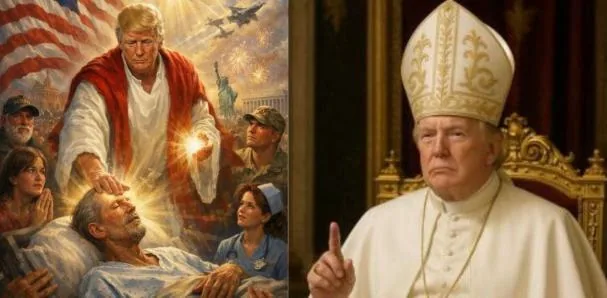 that he shared a year ago and in which he appears dressed as Pope ” class=”wp-image-52″ width=”607″ height=”298″ />
On Tuesday, Trump accused the Pope of complicity with the “radical left” and posted on his social network an image that has gone around the world: an image in which his figure adopts the role of Jesus Christ healing a sick person. Vance hammered the point home by recommending “prudenceto Leo XIV in the handling of theology. The president wanted to humiliate the Pope, and the arrogant vice president, a convert to Catholicism for seven years, tried to give him theology lessons. Vance claims to have studied Saint Augustine. Robert Francis Prevost was prior general of the Augustinian order for twelve years (2001-2013).
The emperor against the Pope. An unprecedented offensive that is causing a phenomenal debate in the United States. Millions of Catholics worldwide feel offended. Thrilling rhapsody: Trump and Vance have broadened Leo XIV’s ‘ordo amoris’: many more people in the world now feel appreciation for the Pope of Rome, who has become a standard-bearer of a Christian humanism that interests many non-believers.
Rhapsody number 3. Giorgia Meloni pays the price. This week’s melody now takes on a more ironic tone. Trump has also lashed out at his friend Giorgia Meloni, whom he now considers cowardly and disloyal. Meloni felt obliged to come out in defense of the Pope. One cannot preside over the Council of Ministers in Italy without defending the head of the Catholic Church. It is something organic in that country. Since the advent of Christian Democracy as a party in power in 1946, the figure of the Pope has had great strength in Italy. With the monarchy of the Saboya dynasty overthrown, the Pope is the only sovereign in the old Italian peninsula. The Christian Democrats no longer exist, but the Bishop of Rome remains the most influential religious personality in the world.
Meloni, very unenthusiastic about progressive Catholicism, a confessed admirer of Benedicto XVI, could not but defend Leo XIV. She has just lost a constitutional referendum, is in a moment of notable political weakness, public opinion is largely against the war in Iran, and more than 80% of the voters of the right-wing coalition that leads the government declare themselves Catholic. After losing the referendum on judicial reform, she could lose the legislative elections scheduled for next autumn. She needs to distance herself from Trump. Almost all European far-right parties today feel the need to distance themselves a little, or a lot, from Trump. All but one: Vox
Read more Iran reimposes restrictions in the Strait of Hormuz due to US blockade.
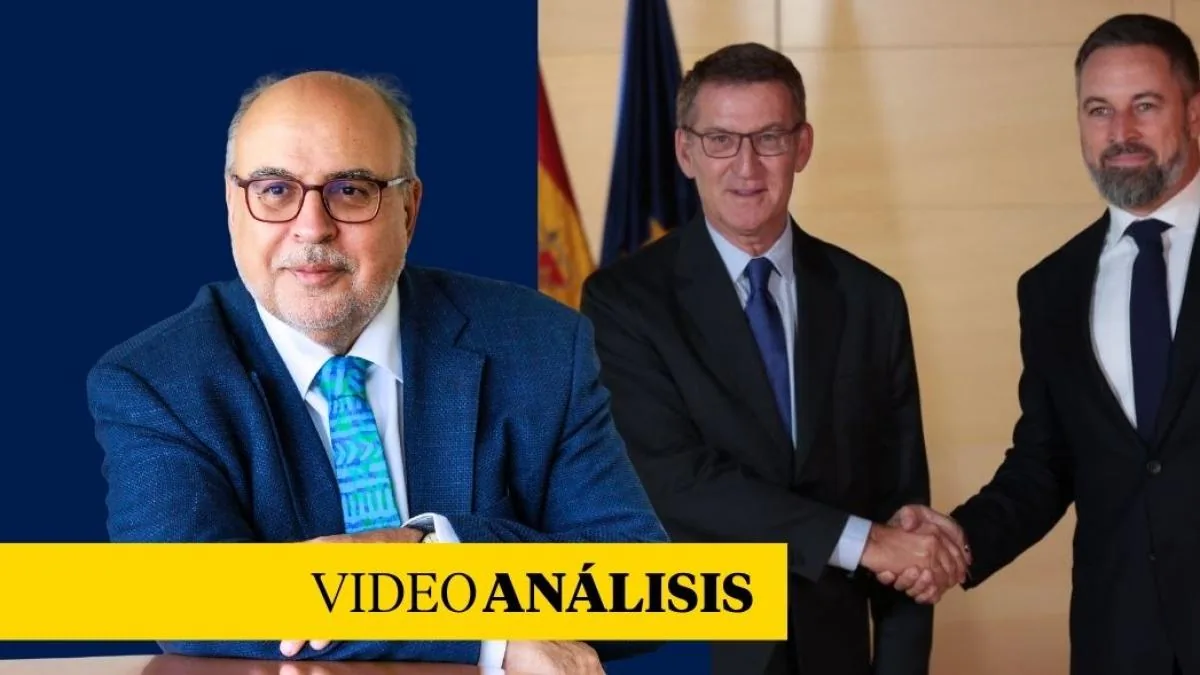
Rhapsody number 4. PP and Vox doing their own thing. While the beams of European Trumpism creak, further down the Pyrenees, oblivious to the tribulations of the great European plain and far from Roman labyrinths, PP and Vox have decided to close a government pact in Extremadura, which is projected as a true strategic agreement between the two Spanish right-wing parties for the coming years. They don’t care what Brussels might think.
With an impassive demeanor, Alberto Núñez Feijóo has always shown little interest in international politics, and Santiago Abascal doesn’t want trouble with Trump and the MAGA. He bet on Orbán two years ago, he bet on the Patriots for Europe platform, of which he is now president, and he wants to have direct contact with the new right-wing governments in Latin America. Let’s imagine that Flavio Bolsonario, Bolsonaro’s son, wins the presidential elections in Brazil in October, and that the Colombian right wins in that country in the imminent presidential elections in May/June. Abascal will want to be their communication channel in Spain, therefore, he does not intend to issue any criticism of Trump that could be read as a sign of weakness.
The two right-wing parties unite to defeat Sánchez and his left-wing allies within a year. Do they unite? They converge on a shared program, which, among other things, talks about the “priority of Spaniards” in access to public services.
There is little immigration in Extremadura. In Madrid, things are very different. In Madrid, the Popular Party wants to captivate naturalized Latin Americans (with voting rights) and those who will obtain nationality in a few years. The regional government of Isabel Díaz Ayuso dedicates increasing funds to the work of seducing the very numerous Latin American community. This year, ‘Operation Shakira’, near Hispanic Day, is planned: the installation of a removable stadium in the Spanish capital where several concerts by the most famous Colombian singer will take place. The venue will be called Macondo Park. You cannot seduce Latin American immigrants with festivities and at the same time tell them they will be relegated. For this reason, Díaz Ayuso has said that she does not like this point of the program agreed upon in Extremadura. Spanish Rhapsody. Liszt composed a Spanish rhapsody in 1863. It is considered one of his most original works.
The PP believes it can slowly control and absorb Vox. Vox believes it has imposed essential points of its program on the PP and considers that a renewed government experience in various communities will make a possible European veto on its presence in the Spanish Government difficult. Génova believes it turns Vox into a subordinate force. Bambú (a Madrid street where Vox’s headquarters are located) believes it traps the PP and continues to see Feijóo as the weakest leader, compared to Díaz Ayuso and Moreno Bonilla. Both sides did not count on Trump’s bad week.
Rhapsody number 5. Barcelona, seat of the new International. Progressive summit in Barcelona with the intention of creating a new international political platform aimed at stopping Trumpism in its tracks. Initiative by Pedro Sánchez, reinventing his famous ‘no means no.’ Birth of a new International. It won’t be little if they succeed.
Since Brazil and Colombia are in the midst of an electoral process and their presidencies could change hands in a few months, the Barcelona meeting has gained more weight with the presence of Mexican President Claudia Sheinbaum. The initiative is powerful, but it lacks two components to fly higher: the Canadian Prime Minister, the anti-Trump liberal Mark Carney, is not present, and social democratic leaders with more weight in Central and Northern Europe are missing. The PSOE triumphed in the transition with the support of northern social democrats, especially German social democrats, who are currently in a slump.
The Pope will travel to Spain (Madrid, Barcelona, and the Canary Islands) during the first half of June. It will be a visit with many nuances, with many layers of interpretation. León XIV and Pedro Sánchez will shake hands. Who is the anti-Trump leader with the greatest wavelength in the world today?
Five rhapsodies and a drumroll: at the time of writing these lines, Iran was allowing ships to pass through the Strait of Hormuz, after a truce was agreed in Lebanon.
Read more Trump’s orphan Patriots