The Government and the Generalitat took a new step this Wednesday in the architecture of Catalan self-government. After President Salvador Illa and the leader of ERC, Oriol Junqueras, sealed a key agreement yesterday to steer the Catalan budgets, the institutional machinery responded with unusual speed by holding a new meeting of the bilateral State-Generalitat commission to bolster the Generalitat’s competence deployment, strengthen the shared management of infrastructures, and provide political and economic coverage to the pact between socialists and republicans.
Read more Rufián, «willing» to be a candidate for a new left-wing space and sets conditions for ERC
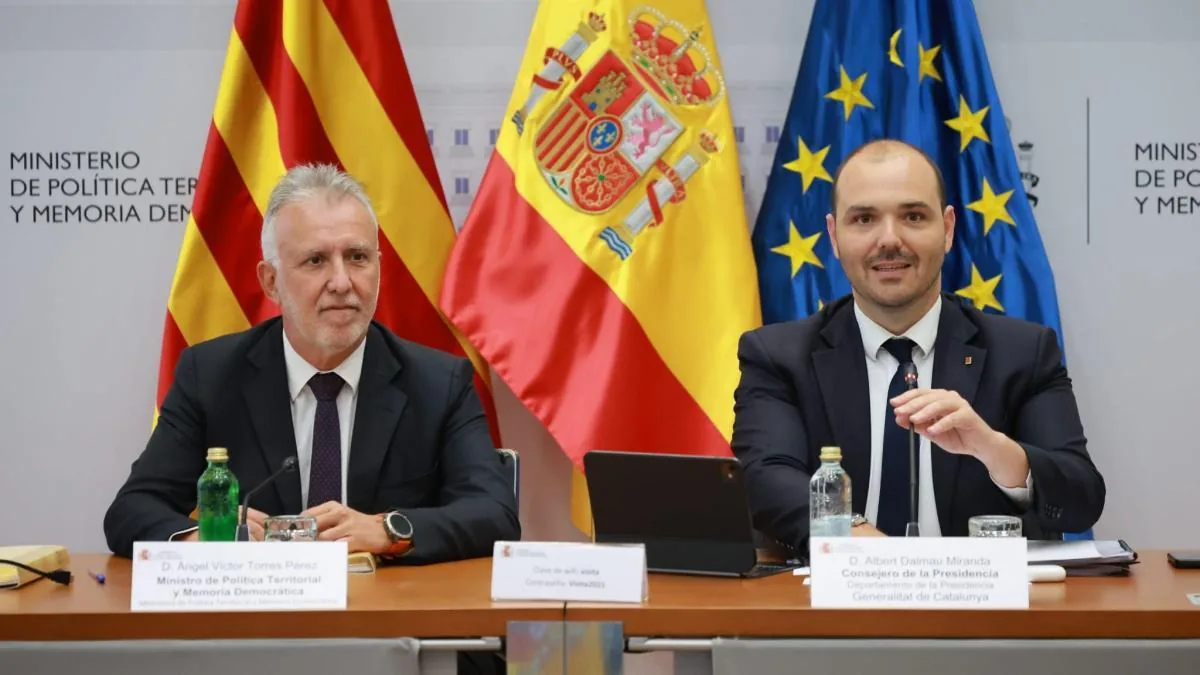
The meeting, held at the Ministry of Territorial Policy and Democratic Memory and led by the Minister of the Presidency, Albert Dalmau, and Minister Ángel Víctor Torres, took the form of a triple institutional summit. Coinciding simultaneously with the Joint Transfer Commission and the Joint Commission on Economic and Fiscal Affairs, the offices translated the political commitments of PSC and ERC into administrative structure, schedule, and financing.
Among all the agreements, the definitive unlocking of funding to expand the Mossos d’Esquadra staff to 25,000 agents by 2030 stands out – the current figure is around 22,000. In this way, the State will annually transfer the necessary resources with an initial cost of 70,600 euros per agent, a figure that will be updated according to the CPI. The transfer will gradually increase until reaching the agreed figure by the end of 2030. For the Government, the agreement holds strong political value because it financially guarantees a commitment that had been pending since the last bilateral meeting and allows ERC to showcase tangible advances in self-government and security.
The meeting also served to unblock another historic file: the management of state investments in Catalonia with the creation of a parity consortium between the State and Generalitat. It will be attached to the Ministry of Transport and complemented by a State Mercantile Society of Investments in Catalonia, participated by both administrations, which will have the capacity to execute studies, projects, and works with “greater operational flexibility.”
The agreement seeks to respond, among other things, to the persistent dissatisfaction with the State’s investment execution deficit in Catalonia, especially visible in the Rodalies railway network and the congestion recorded on the AP-7.
In the railway field, it includes the promotion of the Orbital Railway Line, conceived to break the historic radial design of metropolitan Catalan mobility. Both administrations have committed to signing a protocol this year that will set phases, priorities, schedule, and financing of a 120-kilometer transversal corridor with 40 stations connecting cities such as Vilanova i la Geltrú, Mataró, Granollers, Terrassa, or Sabadell without needing to pass through Barcelona. As a first functional phase, the current R8 and its connections with the rest of the Rodalies and Ferrocarrils de la Generalitat lines will be enhanced.
Another move with great symbolic weight has been the new distribution of the Consorci de la Zona Franca de Barcelona. The State will retain 45% participation, the Generalitat will increase its share to 40%, and the Barcelona City Council will maintain 15%. Although the presidency will remain in the hands of the City Council, the Government gains influence capacity in one of the main industrial and logistical instruments of the metropolitan area.
The day also saw advances in linguistic matters, agreeing to progressively extend the use of Catalan in the General State Administration, both in civil servant training and in digital resources and electronic procedures. Additionally, the subcommission on European Affairs and External Action, which the Generalitat considers strategic to strengthen its presence in Brussels, has been activated for the first time.
In parallel, it was agreed to promote the reform of the General Coastal Regulation to adapt the regulations to the competence framework provided in the Statute and strengthen the Generalitat’s role in managing the Catalan coastline, following the model applied in the Basque Country and Galicia.
The bilateral commission also agreed to launch a pilot Citizen Attention project conceived as a shared window between administrations to simplify procedures. The project will start with the administrative management derived from the death of a family member, one of the procedures that requires the most simultaneous management.
With these agreements consolidated, the Government manages to translate a good part of ERC’s demands for the budgets into concrete commitments, while the central Executive consolidates a cooperation dynamic with the Generalitat that Moncloa considers key for parliamentary stability.
Read more When chaos rules