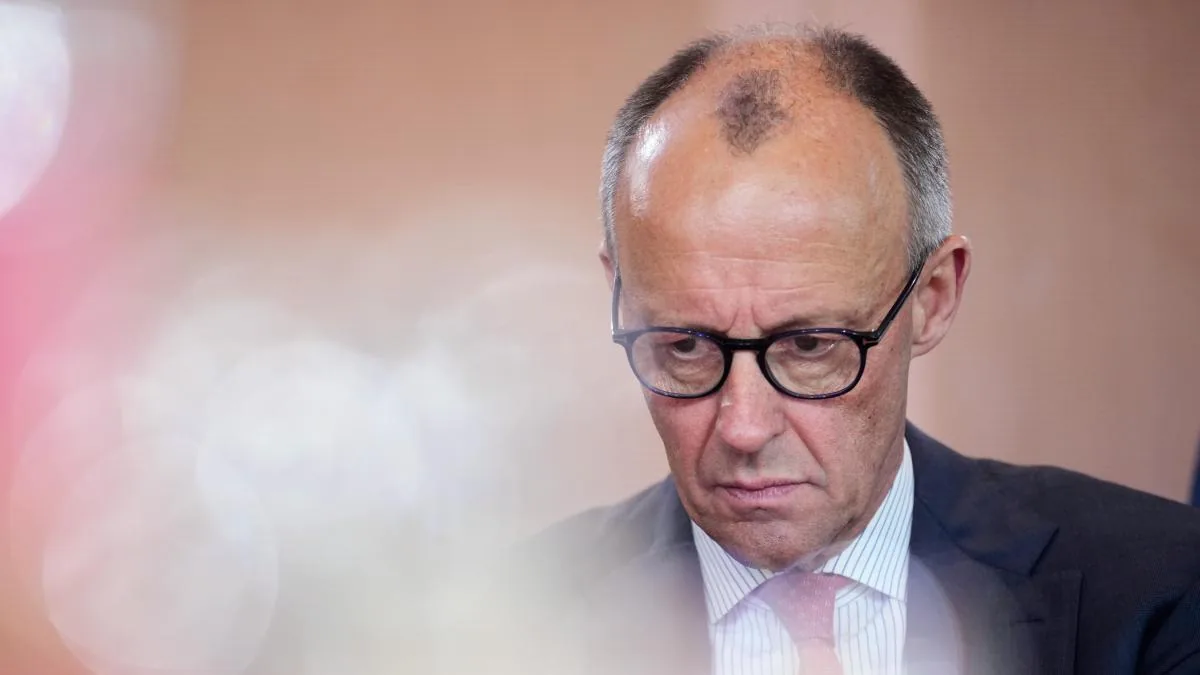
Perhaps what happened in the Bundestag (lower house of Parliament) a year ago, on May 6, 2025, when the Christian Democrat Friedrich Merz became Chancellor of Germany, was somewhat prophetic. The winner of the elections was elected Chancellor in a second vote after failing to secure enough votes from deputies in the first vote, an unprecedented event in the history of the Federal Republic. Thus was born, visibly weakened, his leadership as head of a coalition government of conservatives and social democrats that has often been at odds since then.
Read more Damm, from Alsace to the Eixample of Barcelona
Just one year later, this government is already less popular than the tripartite of the previous social democratic Chancellor Olaf Scholz in its final phase. Detested, divided, and without its promised reform plan being finalized, the coalition is collapsing in the polls, something analysts largely attribute to Merz himself.
To add to the humiliation, for months now the far-right party Alternative for Germany (AfD) has been leading in voting intention, capitalizing on discontent that feeds its ranks of supporters.
The internal quarrels in the coalition government of conservatives and social democrats already resemble those of Chancellor Scholz’s tripartite
According to a survey by the Forsa institute for the private television stations RTL and ntv revealed last Tuesday, 27% of Germans support the AfD, compared to 22% who support Merz’s conservative CDU/CSU bloc, and 12% who support the social democratic SPD.
The same survey reveals that, when asked “Are you satisfied with Chancellor Friedrich Merz’s management so far?”, 83% answered no, compared to a meager 15% who said yes. Another survey by the INSA institute, also from Tuesday, places him in twentieth and last place in popularity among political figures, a ranking headed by the Defense Minister, the social democrat Boris Pistorius, in which the AfD co-leader, Alice Weidel, occupies eighth place.
This collapse in Merz’s popularity – which, on the other hand, was never high – is a serious warning sign for his coalition government, reluctantly formed after the February 2025 elections. Since then, conservatives and social democrats have engaged in public confrontations over various issues, from a possible mandatory military service to reforms on pensions, social benefits, or healthcare adjustments.
Amid discontent with Chancellor Merz’s coalition government, the far-right AfD party thrives, leading in voting intention polls
“This government took office a year ago, and it was supposed to be completely different and much better than the previous coalition, but what citizens have experienced since then is that this promise, essentially, is not being fulfilled,” diagnoses Volker Kronenberg, political scientist at the University of Bonn.
Read more The crazy race of the magic sneakers: this is how the two-hour marathon was broken
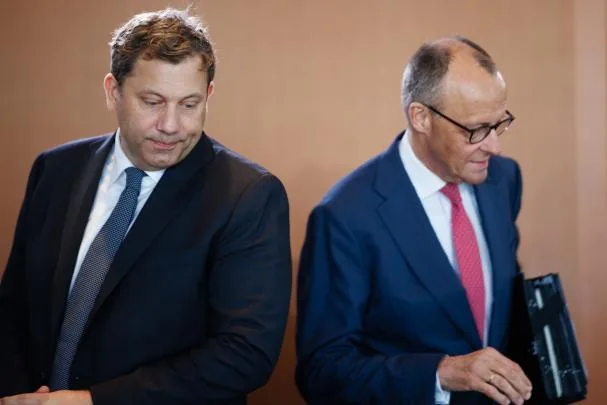
When the coalition came to power, it also promised less internal conflict than Scholz’s tripartite of SPD, Greens, and Liberals, but this has not been the case. This week, the magazine Der Spiegel reported on angry discussions between Merz and the Vice Chancellor and Finance Minister, the social democrat Lars Klingbeil. The Chancellor gets irritated easily, which complicates complex negotiations.
Also this week, in a video in the newspaper Bild, the influential Christian Democrat deputy Christian von Stetten is heard stating that the coalition “will undoubtedly not last four years,” the full term of a legislature.
“Friedrich Merz came to power with many promises, and what we are witnessing is quite dramatic,” continues political scientist Kronenberg. “It was supposed to be the autumn of reforms, the winter of reforms, then spring…, but that has not yet arrived. Now it is becoming evident, and they urgently need to get things moving before summer.” The conviction is that Merz has wasted a year when Germany most needs a boost.
Indeed, aside from quarrels, Merz is haunted by the reality of not having yet implemented measures capable of reactivating an economy stagnant for more than three years and whose growth forecast has just been revised downward due to the energy crisis caused by the war in Iran. The government foresees a meager growth of 0.5% this year compared to the 1% it forecast at the end of January.
The business community is furious. A survey by the economic research institute IFO of more than 6,300 companies gives the government an average rating of 4.2. “Currently, companies barely perceive progress on key economic policy issues; the evaluation is, therefore, negative,” says Klaus Wohlrabe, director of surveys at IFO. Among the public, whose sentiment is reflected in the polls, discontent is growing over the government’s slow response to price increases due to the war in Iran.
New fronts for Merz
Towards summer with budget pressure
As new fronts open for the German government to address, such as Trump’s announcement that he will withdraw 5,000 US soldiers from bases in Germany, Merz faces under enormous pressure a crucial stage of national politics until summer, focused on the 2027 budget. The bill, presented this week by Finance Minister Klingbeil, foresees new borrowing of 110.8 billion euros, apart from more debt to finance both 58.2 billion in special investment funds and 27.5 billion in defense. The coalition only agreed on general figures, so potentially explosive internal debates on budget details are looming. Klingbeil is also setting savings targets: about 4 billion euros annually across all ministries. “Of course, politics is also influenced by the general mood of the population, and this mood is now complex and multifaceted,” notes political scientist Kronenberg. “The unpopularity of the government and the chancellor, as well as the lack of trust, are key factors; from this perspective, the situation is dramatic.”
Read more “Catalunya has a very solid biopharmaceutical ecosystem”