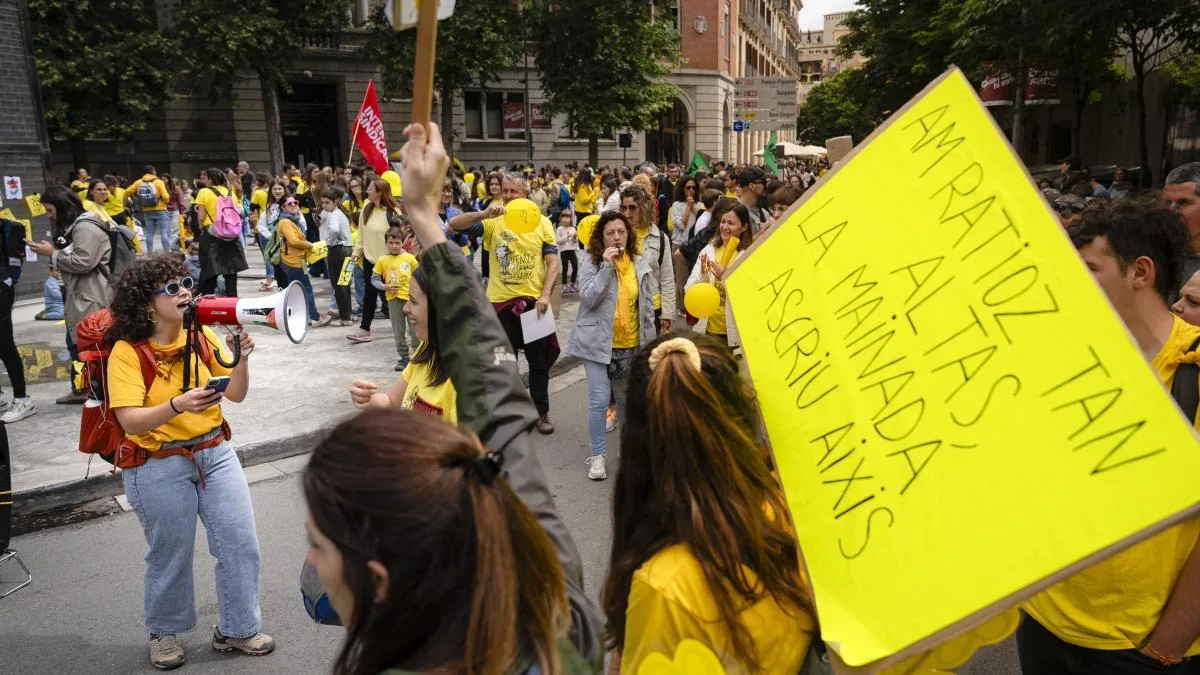
The teachers’ conflict is getting on track. The street protests continue and the risks of not reaching an agreement remain, but the truth is that the administration and unions have sat down together at a table again and have agreed to meet again next Tuesday.
Both the Secretary of Educational Improvement of the Generalitat, Ignasi Giménez, and the representatives of the CC.OO. and UGT unions, have welcomed the return of all the trade union organizations to the sectoral table after Ustec·Stes, Professors de Secundària Aspepc·Sps and CGT broke off dialogue following the signing of the educational pact last March.
CC.OO. and UGT state that the signed pact is “very transversal,” “reviewable,” “flexible,” “not closed”
Giménez considered yesterday that in this new “dialogue space” the “foundations have been laid to be able to work in the coming weeks and open ways to find a necessary outcome.” In his opinion, the agreed pact is sufficiently “broad, open and flexible” to be able to negotiate within its “margins.”
The meeting, held at the Departament de Educació i FP, was chaired by the consellera Esther Niubó. In it, the administration showed its willingness to improve attention to diversity with the incorporation of a thousand professionals (60% explicitly for inclusive schooling). But the unions also want to advance in concrete salary improvements.
Professors de Secundària (the second union, despite being focused on high school teachers) refused to continue negotiating unless concrete salary offers were put on the table. They question the inclusive school model and call for it to be changed so that classes are not so heterogeneous and the special needs of some students do not end up, they say, harming everyone. They do not reject that schools are provided with reinforcement staff, but believe the negotiation is labor-related.
Professors de Secundària questions the model and cost of inclusive schooling
The rest of the unions advocate for improvements in both areas. The spokesperson for Ustec, Iolanda Segura, clarified that for them inclusion, for which they have an advanced action plan, and salary are priority issues and that they would not accept negotiating only one of these areas.
New initiative
After the camps, tutoring for future teachers
The coordinator of the assemblies in the Girona region is promoting giving up the practice tutoring of education students. Fifteen have already joined. “This unpaid work is over,” emphasized a teacher who was gathering in Girona. The university students’ internships are mandatory for future teachers, but voluntary for educational centers. Precisely, Educació sent a notification to the management yesterday reminding them that measures such as the suppression of camps cannot be decided in the faculty meetings, which have a pedagogical function, but in the School Council, where the administration and families vote. And from one school year to another. The strike on Thursday in Girona and Central Catalonia reached 21% of the staff, a figure similar to the previous day in Baix Llobregat/Penedès. Today, the staff of Lleida, Alt Pirineu i Aran are called. Next Monday, a day before the meeting, teachers in Barcelona will strike and demonstrate
Trade union unity around the labor claim has considerable consensus, including the unions that signed the pact, CC.OO. and UGT, who presented the pact as a “transversal agreement,” “reviewable,” “flexible,” in short, “not closed.” In the agreement, a 30% increase in the regional supplement was agreed upon, which amounts to about 3,000 euros per month for everyone (without distinction between teachers and professors, dedication or time worked). According to what they stated then, the agreement contemplates reaching this figure in 2029, with conditions reviewable every two years and linked to the budgets.
For Segura, this agreement leaves no room for maneuver (as it does in inclusion, which is more ambiguous) and this negotiation must be reopened. For Giménez, the pact is flexible and there are elements (he avoided mentioning salaries) on which it is possible to negotiate to improve working conditions. “We are studying different measures that we will present at the table on Tuesday.” The unions have warned that if the offer – expected to be available on Monday – is not sufficient, they will not attend.
The unions demand the return of the debt from the stages
In any case, the Govern could also be counting on the possible approval of a budget for the Generalitat next week, which would give it more room to negotiate.
Giménez referred to the pact of 2,000 million euros over four years. Not a penny more. He wanted to emphasize that teachers will receive this month the 800 euros agreed for this year. He did not reveal whether he is considering improvements by shortening the time to complete the salary increase (which is progressive until reaching 3,000 euros in 2029) or if he refers to other aspects.
He also did not specify whether supplements will increase, such as those for camps, which has generated a wave of refusal of them or others. One of the claims of Professors de Secundària, which UGT also made explicit yesterday, is the return of the debt from the stages that affects 30% of the staff.
The teaching stages are a complementary remuneration that values the teaching staff’s experience. In the 2012 cuts, it was foreseen that the first six-year period would be paid at 9 years.
In 2024, this measure was reversed without returning the frozen years. The matter is currently before the High Court of Justice of Catalonia after the administration appealed. It is estimated that this debt amounts to 240 million.