Representatives of the Church, trade unions, business leaders, and the technology sector defended on Monday the need to take action in unity in the face of the challenges posed by artificial intelligence (AI), within the framework of the public presentation in Spain of Magnifica humanitas, the encyclical with which Leo XIV addresses the impact of new technologies on human dignity and the future of work.
Read more Sánchez and Feijóo take the exam
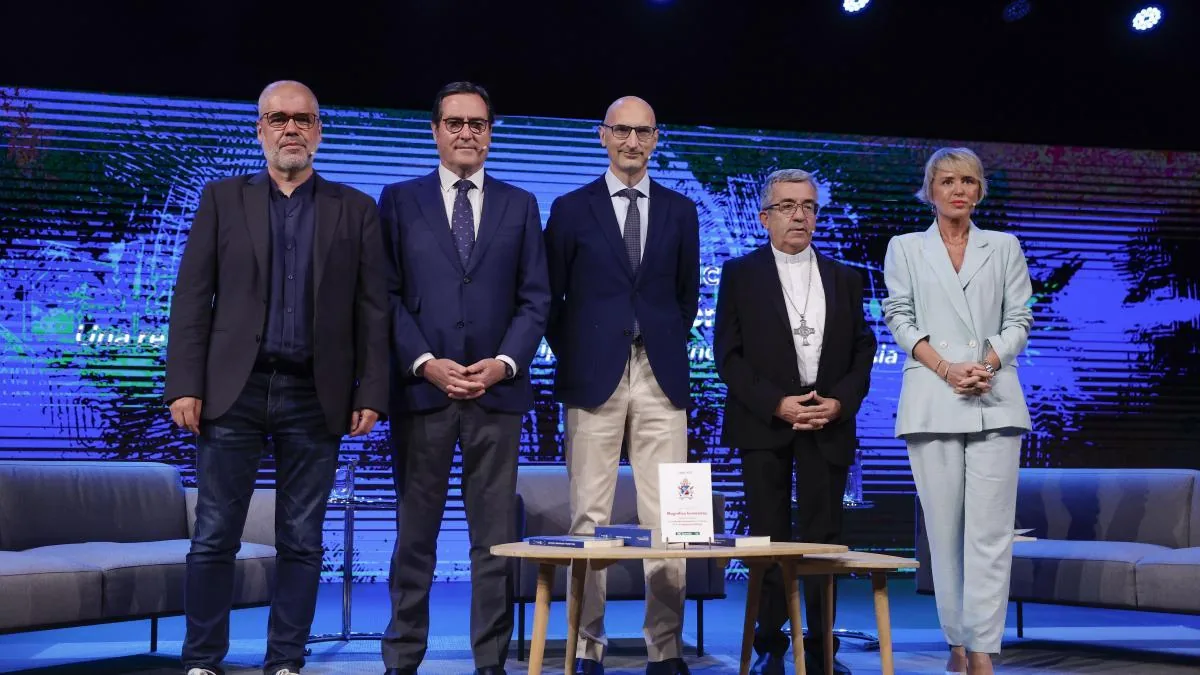
The meeting, marked by the recent opening of dialogue between the Church and the major trade unions, after more than two decades without institutional-level interlocution, brought together at the Pablo VI Foundation the president of the Spanish Episcopal Conference, Luis Argüello; the president of the CEOE, Antonio Garamendi; the general secretary of Comisiones Obreras, Unai Sordo; and the co-chair of the United Nations Advisory Council on Artificial Intelligence, Carme Artigas, also Secretary of State for Digitalization and AI of the Government of Spain. All of them defended the “courage” the Pope has shown in raising the impact of artificial intelligence and new technologies on human dignity and work and the need for their regulation.
Artigas was the most forceful in “demanding society’s participation in the future of AI.” The technology expert encouraged citizens to say “I don’t buy the story” of the tech industry, which sells its products with “metaphors, which are big traps,” such as artificial intelligence “learning,” when what it does is take “all the knowledge protected by copyright.” “It is not learning, it is sucking up free data to make massive patterns and statistical calculations,” she emphasized.
Secretary of State for Digitalization and AI
Carme Artigas: “Human beings must stop being narcotized by technology and take action; a social pact is urgent”
She also warned about the humanoid profiles of AI. “They say AI thinks, it doesn’t think because it doesn’t suffer. The virtual beings of AI are psychopaths, they are entities that emulate emotions, that make you believe they love you, that they understand you, but they don’t,” she detailed. But combating these ideas, she pointed out, requires knowledge on one hand, and in this regard she said Leo XIV’s encyclical “is very illustrative,” and also moving to action. “If we remain passive, someone will decide for us. The world is what we decide it to be today, from the public sphere, from the private sphere, from the individual sphere.” Therefore, she defended regulation, but also issued a warning: “Human beings must stop being narcotized by technology and take action, it is the most important thing.”
Artigas highlighted the advantages of the “new capabilities that AI can add to human beings” in areas such as science, but warned that we must not “keep up with the pace of AI.” And, in this sense, she warned that there is not much time to act, there are not “five or ten years” of deadline, but “geopolitics is imposing that it be done in two years,” and therefore “work on state pacts on how we are going to mitigate those effects” should already be underway.
In the discussion, moderated by Jesús Avezuela, director general of the Pablo VI Foundation, the president of the Episcopal Conference, Luis Argüello, defended the Church’s intervention in this debate on the impact of artificial intelligence. He pointed out that “the Gospel always has a social dimension” and there are issues that always concern the Church, such as human dignity above all, the pursuit of the common good, social justice, solidarity, or the cry of the poor.
President of the Spanish Episcopal Conference
Argüello regrets that electoralism does not allow for long-term proposals
Argüello said that Leo XIV’s encyclical delves into the concept of truth, “so that democracy can survive,” in times of “moral relativism” and announced that the Pope, on his next visit to Spain, will “encourage trust in the value of the word,” which is “listening” and will ask to “break the dialectic of opposites.”
He also advocated “raising one’s gaze,” which is the motto of the Pope’s visit next week. “Raising the gaze is looking long-term and taking it step by step. One of the weaknesses of parliamentary democracy is that everything is played out in four-year periods, with very self-interested aims to win elections, which is legitimate but prevents proposals on this issue” of how to deal with artificial intelligence, which is “greater and long-term,” he said.
“For the long term, a building framework is needed, to build either Babel or the alternative proposed by the Pope. And this framework is spiritual, ethical, cultural, and political,” he defended. But, in addition to the framework, “you have to work brick by brick, and here any brick is good for the convent, whether they come from non-believing sectors, from sectors of different sensitivities,” he detailed. And this task, he said, must start now: “It’s very good that we have a discussion but it is necessary to start building processes” for that common good, he urged the participants in the discussion.
President of the CEOE employers’ association
Garamendi suggests it is “almost impossible” to get all levels of government to agree on AI regulation
For his part, the president of the CEOE employers’ association, Antonio Garamendi, said the Pope’s encyclical is “more than timely” because “relativism is present” in society. “The problem is not a new technology, but whether society is prepared to see how we manage it,” he proposed, and defended that AI poses “a paradigm shift,” so he defended the need for “a new social contract, seeing how we work to face this issue together.”
Faced with the possibility that the machine takes over from the human being, the president of the employers’ association, who defined himself as Catholic, said that AI regulation is “almost impossible.” “I say this from experience,” he said, referring to what happens in Spain with the different autonomous communities and at the European level. “The first question is who owns the data, which generates income, and people come second. That is why it is important to reach agreements on a new social contract, with social dialogue,” he defended.
General Secretary of the CC.OO. union
Sordo highlights that the Pope’s text is ethical and moral, but also political, not programmatic
The general secretary of the CC.OO. union, Unai Sordo, described Leo XIV’s encyclical as “very dignified” and “with a contribution of great significance.” “It places the challenge of AI not in abstraction, but in the field of the dispute of interests regarding what the power of the big tech companies represents,” he emphasized. “And it touches on all aspects of how it affects not only the company, but all social values. It is not that AI essentially challenges the human being, it questions social, cultural development and the structures of economic and social power,” he said, at a time when he understands that the boundary between democracy and dictatorship “is not so clear.”
Therefore, Sordo specified that the content of the text is “ethical and moral,” but it is also “politically relevant,” although “not programmatic.” And he highlights that “it does something important, which is not to technocratize the debate but to link it to power relations and social organization relations, something that is key in the world of work.” He gave the example of the application of this technology in job selection processes and control of production flows. “We need elements of algorithmic transparency. The law has to intervene, but it is important that the agents who work downstream have the capacity to intervene,” he demanded.
Read more The miracle