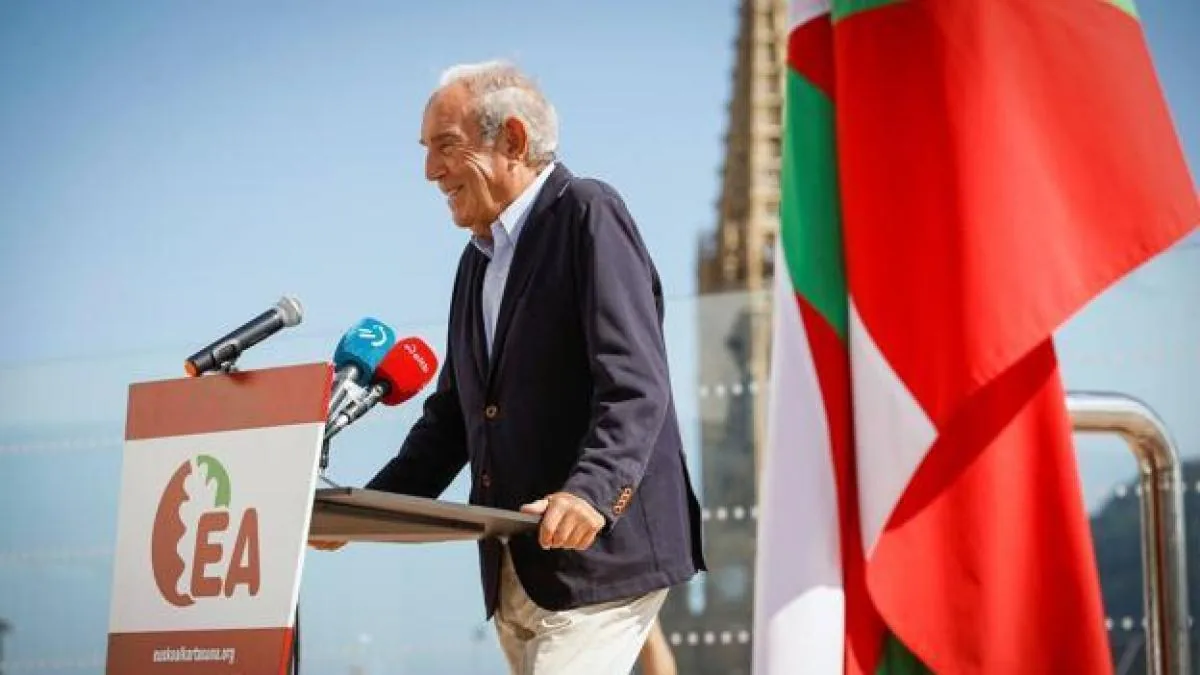
Carlos Garaikoetxea, first lehendakari after Francoism (1980-1985) and a key figure in the recovery of Basque self-government, has died at the age of 87 due to a heart attack, according to the Basque public television portal Orain.
Read more Iran attacks United Arab Emirates with drones and sets fire to an oil complex
The politician born in Pamplona in 1938 was one of the main promoters of the establishment of Basque institutions after the dictatorship, leading a decisive stage in the recent history of Euskadi.
Founder of Eusko Alkartasuna, a social-democratic party split from the PNV in 1986 and now part of EH Bildu, and a reference of Basque nationalism during the 80s and 90s, Garaikoetxea played a decisive role in the development of the Basque Government and in the consolidation of its self-government and competences.
After the approval of the Statute of Gernika, Garaikoetxea, politician, lawyer and economist, was elected lendakari in 1980, and was re-elected in 1984 with 32 seats. Previously he had led the PNV in Navarra until between 1977 and 1980 he presided over the party’s highest body, the Euzkadi Buru Batzar, and was president of the Basque General Council (provisional government) between 1979 and 1980.
His mandate as lehendakari was characterized by the construction of the Basque autonomous government and institutions. Thus, he had to develop the 1979 Statute of Autonomy. Among the assumed competences were public order, with the consequent creation of an autonomous police force (the Ertzaintza) in 1982, the creation of the Basque Health Service (Osakidetza) in 1983, or the creation of Basque radio and television, EiTB, with a first broadcast on December 27, 1982. It was a stage characterized by austerity in government spending, or the achievement of the Basque Economic Agreement in 1981.
In 1985, he was replaced by José Antonio Ardanza due to disagreements with the leadership of his party, which led to the only split the jeltzales have experienced in their entire history. The disagreements focused on the “Law of Historical Territories,” which was to delimit the competences of the Basque Government and those of the Provincial Councils of the three historical territories.
Read more A 26-year-old man arrested for fatally stabbing another in a hair salon in Valencia
He presided over EA until 1999, a party for which he was elected deputy of the Basque Parliament in the regional elections of 1986, 1990, 1994, and 1998. From 1987 to 1991 he was a deputy in the European Parliament (between 1987 and 1989 as head of the list of the Coalition for the Europe of the Peoples, with Esquerra Republicana and the Galician Nationalist Party (PNG); from 1989 to 1991 as head of the list of For the Europe of the Peoples, with the same partners, to whom he ceded the seat for the rest of the legislature, according to electoral agreements). Between 1990 and 1991 he was president of the European Free Alliance.
He was again head of the list of the coalition formed with ERC to run in the 1994 European Parliament elections. The electoral failure (the candidacy did not win any seats, due to the drop in votes in Navarra and the Basque Country) led Garaikoetxea to resign as president of Eusko Alkartasuna, which was not accepted. In November 1999 he retired from active politics.
In June of last year, the current Basque Government, led by the lehendakari, Imanol Pradales, paid tribute to Garaikoetxea as a “key figure in the institutional construction of the Basque Country.” The former president was recognized as “the extraordinary architect of Euskadi” for his fundamental role at the head of the first Basque Government of democracy.
The event, presided over by the current lehendakari, Imanol Pradales, brought together prominent political and institutional figures, including two of his successors, Juan José Ibarretxe and Iñigo Urkullu, as well as representatives of the family of José Antonio Ardanza.
During his speech, Pradales recalled the first meeting of Garaikoetxea’s Executive in Ajuria Enea, held 45 years ago, and highlighted his “legacy of resilience, prosperity, and well-being.” “He arrived in a Basque Country in ruins, hit by recession, unemployment, and violence, and knew how to design the foundations of a better country,” said the lehendakari.
Read more From Zendaya to Meryl Streep: the big absences at the 2026 Met Gala