
Artificial intelligence (AI) is starting to claim its first victims on the stock market. And they are not companies nostalgic for the past. On the contrary. For months, global leaders in the software, cybersecurity, and consulting industries have been experiencing an unprecedented debacle for years. The most alarmist have dubbed the situation SaaS-pocalypse , something akin to a software apocalypse.
Read more The war in the heart of the Gulf
Are there reasons to sound the alarms? The S&P Software & Services Select index in the United States has dropped more than 20% so far this year (see chart). Adobe, Salesforce, SAP, Oracle, Palo Alto Networks, CrowdStrike, IBM, Accenture, Capgemini, Gartner… are some examples of multinationals that are suffering the impact of AI and, specifically, the impressive advances of Anthropic. The latest, called Mythos, has caused a setback in the world of cybersecurity. Its algorithm is so intelligent that it has been able to detect cybersecurity breaches that had existed for decades and that cybersecurity groups had overlooked. The potential is so great that Anthropic has been forced to restrict its capabilities to prevent the collapse of critical infrastructure.
The S&P Software & Services Select index in the United States has dropped more than 20% this year
The traditional technology industry – in the sense that it has dominated the scene for two decades – is unable to keep up with the dizzying pace of advancement of native AI groups. And stock market investors are starting to make the more specialized companies pay for it (not so much the big tech , with more diversified businesses).
“The curious thing is how it hasn’t happened before. The technology industry has been booming for years, spurred by the coronavirus pandemic, and as a result, there has been a widespread overvaluation of the digital sector. Finally, the market is beginning to discern businesses with fewer growth prospects,” says analyst Jaume Puig, CEO of investment firm GVC Gaesco.
The surprising thing about the phenomenon is that this drop in valuations is occurring while the vast majority of affected groups are reporting rising results. “Clearly there is a disconnect between the stock market value and the growth in revenue and margins reported by these companies,” says Jaume Clotet, CEO of Infini consulting firm, recently integrated under the Forvis Mazars group umbrella.
On the stock market, as is known, everything is a matter of expectations. This time, medium-term expectations. “The annual result does not interest investors. The key lies in business prospects three to five years out. That’s where there are doubts about the business growth of these sectors,” says Puig.
In the case of cybersecurity groups, the concern is evident: “AI is much faster than traditional cybersecurity groups at detecting security breaches and creating defenses against potential attacks. However, the business model in this new paradigm is still to be defined, as these groups are already forging alliances with AI companies themselves,” says José Luis Rojo, cybersecurity partner at EY consulting firm. In fact, this week Anthropic has granted access to the powerful Mythos application to a select group of 40 companies, including cybersecurity leaders such as Palo Alto Networks or Crowdstrike.
In the world of software companies, which have recovered slightly on the stock market this week, uncertainty has dominated for months. “The concern is explained by the fact that customers will start moving towards a do it yourself model, that is, do it yourself,” points out Josep Salvatella, CEO of RocaSavatella. According to the consultant, AI models from companies like Anthropic, OpenAI, Google, or Microsoft allow “companies to design their own CRM, that is, their business software, at a very low cost and without buying third-party licenses, a reality that threatens the business prospects of technology groups”. However, Clotet points out that not everything is that simple, because the maintenance costs of AI-developed CRMs and the protection system for all business data are not yet clear.
Read more Iran clings to the Strait of Hormuz
Furthermore, there is another aspect that worries the market: the change in business model. Clotet explains that the seat pricing system – seat pricing – through which clients pay based on the number of professionals using software, i.e., the more seats (or users), the more payments the software group receives, is no longer sufficient. “With AI, this billing model breaks down because tasks are more efficient and do not require the involvement of so many people,” comments the consultant, who points out that the new business model is still to be defined.
AI breaks the traditional people-based business model of consulting and software firms
In the case of technology consulting firms and professional services firms, something similar is happening. To date, the business model has been based on charging for services according to the junior workers dedicated to each project. However, with “AI, this ceases to make sense because less staff is needed. Consulting firms may have lower labor costs and their business may be reduced because AI can replace a part of it,” he reasons. Furthermore, Clotet argues, AI has made market studies more accessible that until now were in the hands of a few. The reasonable thing, he comments, will be to transition towards a model of charging by objectives or results.
In the case of EY, one of the big four consulting firms, these changes are beginning to be noticed despite not having the pressure of stock markets because its shares are not publicly traded. “The business model is evolving, we want to do more things, and in this business evolution, payment is already for added value and not just per person dedicated to the project,” comments José Luis Risco, talent partner. In contrast, in the case of PwC, sources from the consulting firm assure “that their model has not changed as a result of AI, although they are applying this technology in the services they provide to their clients”. Deloitte and KPMG – which, along with EY and PwC, are the four major big four consulting firms – prefer not to comment on the impact of AI on their business.
In any case, stock markets are warning large corporations that their hegemony may be at risk if they do not change anything in their operations. “The generalized fall in stock prices can force their reinvention,” says Jaume Puig. For now, the SaaS-pocalypse –and its extension into the world of cybersecurity and consulting firms– has not caused significant harm to employment, although some relevant layoffs have occurred. For example, consulting firm McKinsey laid off 10% of its global workforce last year, while Capgemini announced a collective redundancy plan (ERE) in Spain due to the impact of AI.
The ‘SaaS-pocalypse’ on the stock market does not currently have a massive effect on job cuts
In the technology world, and more specifically in software, there is no massive wave of layoffs like the one that occurred three years ago following the end of the pandemic bubble. However, AI is causing a series of staff cuts that are happening one after another. According to the agency Trading Platforms, AI has had a direct impact on a total of 39,088 layoffs in digital companies worldwide. The most significant cut was led by the Oracle group, specialized in software, which has laid off 18% of its workforce, with 25,254 cuts. Other companies that have followed suit are Block, with 4,000 layoffs, WiseTech (2,000) Atlassian (1,600), Snap (1,000), Meta (900), eBay (800) or Pinterest (675).
Puig argues that “mass layoffs will not happen immediately, but when the decisive moment arrives within three to five years, when AI is widely implemented”. The analyst adds that, currently, layoffs attributed to AI can in many cases serve as a fantastic excuse to justify cuts for reasons unrelated to this technology”.
Programmers, in danger
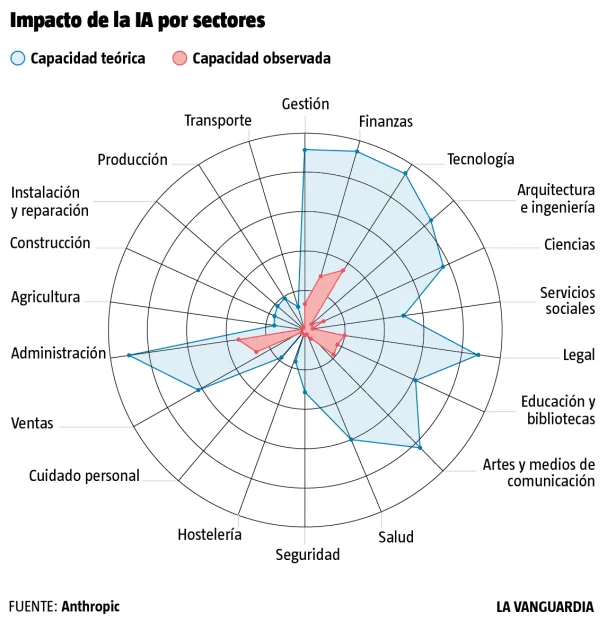
Anthropic is the leading company of the moment in the artificial intelligence (AI) industry, and its most recent predictions confirm something that has been causing concern for months: programmers will lose prominence in the technology sector. According to this American group, AI can cover 75% of their activity, which mainly consists of coding and maintaining its correct functioning. Other highly affected professions are those related to customer service – with 70% automation – and specialized jobs in medical data collection (67%) and market data analysis (65%). AI can also compromise sales teams, except those specialized in technical products, as well as financial, investment, and software-related testing analysts. As reflected in the chart above, prepared by Anthropic, a large part of the economy’s sectors are highly exposed to the advances of AI: technology, health, finance, legal, administration, education…