









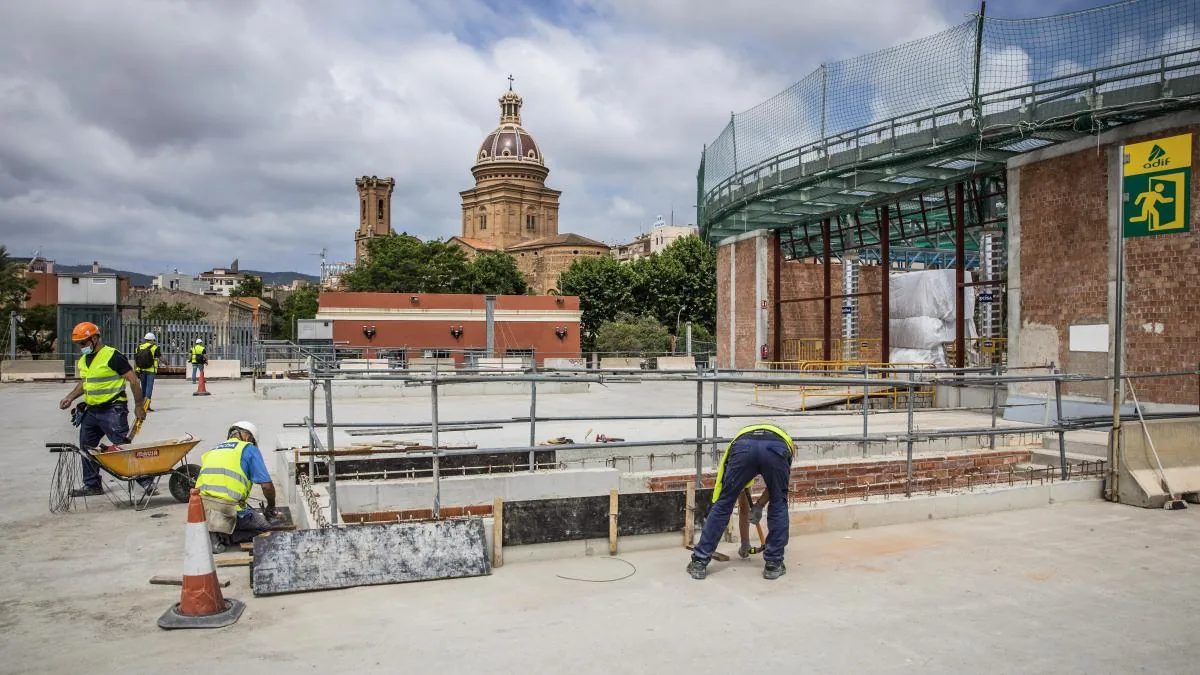
Catalonia has been carrying a deficit in the execution of state investment of almost 13 billion euros since 2009, a burden that, according to the construction sector, explains much of the accumulated delay in infrastructure. The Cambra de Contractistes d’Obres de Catalunya (CCOC) warns that the State only executed 57.4% of the budgeted investments last year, while calling for doubling the volume of public works to recover lost ground.
Read more The Ombudswoman opens ex officio proceedings to clarify the impact of PISA in Catalonia
The latest report from the employers’ association estimates that the accumulated deficit in infrastructure already reaches 49.5 billion euros and maintains that Catalonia should tender works worth 7.365 billion each year, equivalent to 2.2% of GDP. However, in 2025 public contracting stood at 3.972 billion, practically half of what is considered necessary.
The Cambra de Contractistes values Illa’s housing plan but calls for acceleration: “only 3,000 flats have been tendered”
Between 2009 and 2025, the State left 12.935 billion euros of budgeted investment in Catalonia unrealized, while the Generalitat reached an execution rate close to 90%, with an accumulated deficit of 3.107 billion. According to the Cambra, half of the non-compliance corresponds to Adif.
The analysis presented this Thursday also outlines a scenario of strong pressure on housing. Last year 16,572 homes were completed, 25% more than the previous year, but still far from the around 30,000 annually that the sector considers necessary to meet demand. Furthermore, the number of homes started fell by 6.6%, which anticipates that supply will continue to be insufficient in the coming years.
In this context, the employers’ association positively valued the Generalitat’s plan to promote 50,000 public homes, although it called for speeding up its execution. “So far only 3,000 homes have been tendered,” recalled the president of the CCOC, Lluís Moreno, who insisted that announcements must translate into finished work. He also called for speeding up the granting of urban planning licenses and eliminating the obligation to reserve 30% of new developments for protected housing in Barcelona, considering that it has slowed down construction.
The Cambra also highlighted that 45% of public tenders received only one or two bids during 2025, a sign that many contracts come to market with budgets far from real costs.
Despite everything, the sector maintains an optimistic outlook and expects to grow between 3.5% and 4% this year, provided that the committed investments become a reality.
Read more The assault on the Ceuta fence seen from mobile phone cameras