









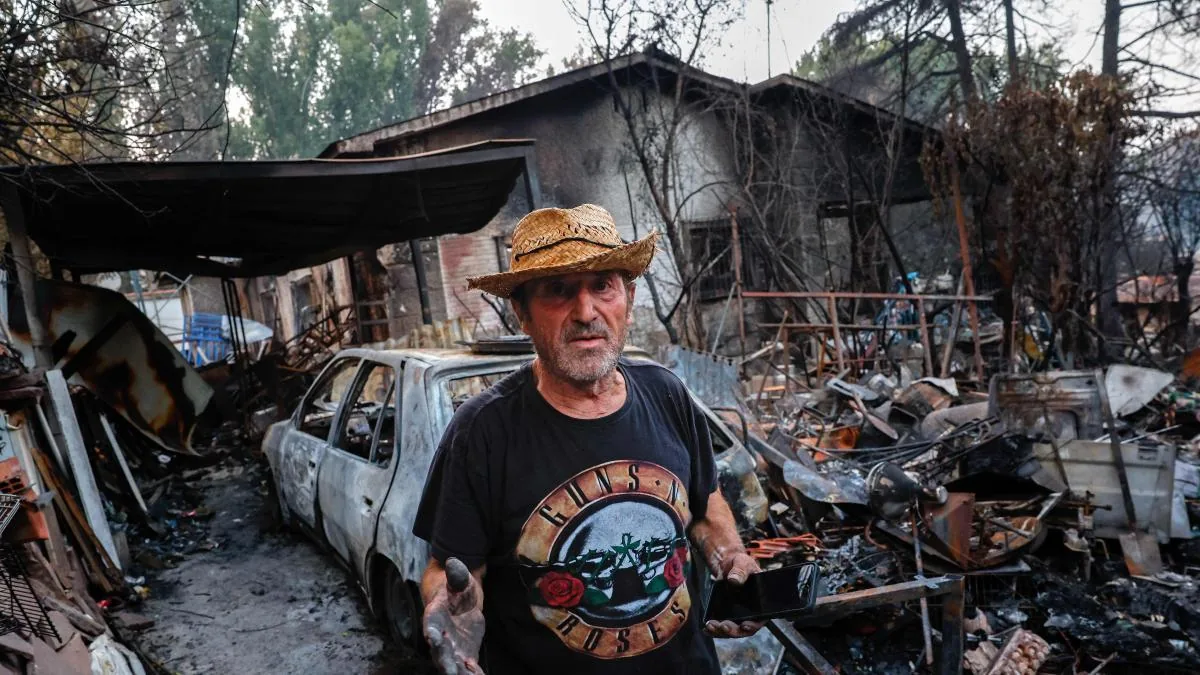
Human beings have an amazing ability to quickly move from one situation to another. From living in sports centers, sleeping next to dozens of people they barely know in military bunk beds, eating whatever they were given, to returning home and resuming routines as if the previous events had never happened.
Read more The woman murdered in Sant Martí was arrested two weeks ago for domestic violence
At first glance, this seems to be the prevailing situation in nearly twenty towns in the western Madrid mountains and Gredos in Ávila affected by the mega-fire that has been ravaging the central peninsula for a week, a fire that, in the words of the Interior Minister, Fernando Grande-Marlaska, is “technically stabilized,” but not controlled. There is still much work to be done by the firefighting forces to achieve that.
But behind this apparent normality, fears, concerns, and anxieties emerge. Ámparo has lived in a house near Cadalso de los Vidrios for just under eight years, right after retiring. She was fed up with Madrid, the traffic, the rush. And that despite living near the lung that is El Retiro Park. But she needed to leave the city behind and move to a town where she could lead a simple life, surrounded by greenery, nature, birds, and sunsets.
Firefighting technicians advise against planting cypress trees near houses: “They are gasoline for the flames”
So, her partner and she sold their apartment in Madrid and settled there… “These years have been wonderful, waking up and seeing the mountains is priceless… But now I am afraid, afraid of living in the middle of the forest and that the fire will come again,” she cries. “I don’t know how I’m going to overcome this fear, but I look anxiously out the window and feel all my senses on alert, especially my sense of smell. I have the smell of burnt wood ingrained in my body. I don’t know what I’m going to do,” she recounts. Her husband hopes that “with time it will pass,” although he also admits that “he also feels his heart shrink. It’s true that now you see the danger and feel afraid of dying in hell.”
From this couple’s window, the damage caused by the fire can be seen, although not as much as one might imagine. There are green areas, others very black, pitch black, and others that alternate between gray and brown.
A firefighting technician at the Navalcarnero command post explains that the great speed of the fire caused it to “almost pass over” some areas of land more superficially. In other areas, everything was burned. The flames raged and left the skeletons of pines, houses, warehouses, and cars. And in others, a change in wind at a certain moment left green areas. Therefore, they say, until the fire is declared extinguished (“there is still time,” he clarifies), it will not be known exactly how many hectares have burned and, of all of them, how many are “usable.” It is estimated that between 15 and 20% could be “saved.”
The first initial estimates of burned homes point to more than a hundred
It is also not yet known how many houses have burned, although the first estimates (well above) speak of about a hundred.
Cecilio, in Villa del Prado, has saved his property. Incredibly, the fire did not cross his fence; “only the boundary burned, because that is not mine. I was sure nothing had happened to it,” he says upon returning from Méntrida (Toledo), where he took refuge from the fire. The flames jumped that space and he knows why: “Everything is clean. I have the pines trimmed and everything inside the enclosure has no dry branches. That’s the only way,” recounts this man who is already over 70.
Read more Judge Pedraz summons the former director of the Civil Guard as a suspect in the ‘Leire case’
“Only four olive trees that are on another plot burned, and that’s because the owner of the neighboring olive grove doesn’t take care of it. Do you know what I have to do to claim those four olive trees?” he asks.
“They did well to evacuate us. With the smoke, embers arrived that caused fires”
Encarna and her family also stayed in Méntrida, at her brother’s house, when they were forced to leave Aldea del Fresno. The fire did not enter this town as it did in neighboring Villa del Prado (especially in the industrial area and residential developments). “Here they evacuated us because of the smoke,” she says. Encarna admits that there are people in the town, including her husband, who are very angry because they were not allowed to enter to see their animals or businesses. “I don’t see it that way, I think the most important thing is that no one died. That is the most important,” she insists.
And she points to the property just 300 meters from the town center: “I think they did well to get us out of here. Now we all act tough, but with the smoke, embers arrived that caused fires, which were immediately extinguished by the UME… They don’t remember that.”
Most of the roads in the western Madrid mountains (also in Ávila) are already open. But there is not much traffic, except for intercity buses, delivery trucks, and UME vehicles. In Aldea del Fresno, next to the Perales River (which prevented the fire from entering this municipality), technicians from this unit monitor to ensure no new fires start. “What can citizens do to help?” two men who are checking the damage ask them. The answer is dry and blunt: “Stop planting cypress trees as walls to prevent people from seeing into their homes. They are gasoline for the fire and put us in danger.”
“I am disappointed with many neighbors who didn’t lend a hand to help”
Mariví, one of the volunteers who has been tirelessly assisting relocated neighbors from Aldea del Fresno at the Villamanta sports center, as well as firefighting personnel, says she heard that comment about the cypress trees repeatedly from them these days. “What I don’t understand is why they don’t ban them if that’s the case, because people don’t know.” Mariví, over 60 years old, admits she is tired: “The first days I went 72 hours without sleeping. Then, a routine was established, which made everything easier.”
And Mariví assures that the much-touted solidarity often mentioned in the media has not been as it has been portrayed: “No, it’s not true. I am very disappointed with many neighbors who only talk and talk but do nothing. Here, it has been mainly women and young people who have helped.”
Read more The judge authorizes the UDEF to track the accounts of Zapatero, his daughters, and his secretary