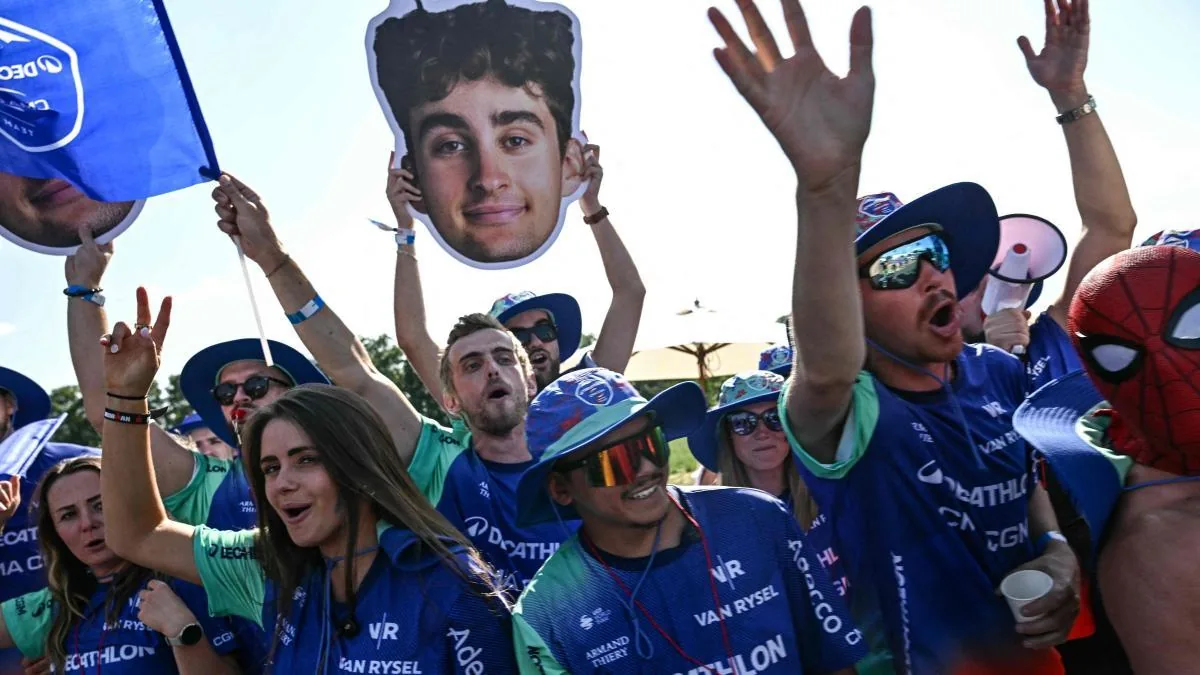
Paul Seixas is the new phenomenon of French cycling. At just 19 years old, the rider has become one of the great revelations of the Tour de France and the hope of a country that has been searching for decades for a successor to fight for victory again in the most important race in the world. His talent, his precocity, and his performance in the general classification have skyrocketed expectations around him.
Read more Third attack in five days against Wildberries, the «Russian Amazon»
This media attention has led some to wonder if the pressure of being the great jewel of French cycling can also influence the decisions made around the Tour. One of those who has opened this debate is Matej Mohoric, who has questioned the equality in the application of nocturnal anti-doping controls and has cited the young French rider as an example.
Five in the morning for us is practically dawn”
Matej Mohoric
Bahrain Rider
Mohoric, a compatriot of Tadej Pogacar, has questioned the system after revealing that Bahrain Victorious was subjected to a surprise early morning control five days ago.
The Slovenian explained that one of the controls carried out on his team took place at five in the morning, a particularly difficult time for cyclists who finish stages very late. “This is a bit uncomfortable for us, it takes away our rest time and consumes a lot of energy,” Mohoric told the Slovenian media outlet Sportal. “Five in the morning for us is practically dawn, as we go to bed at midnight because the stages finish late and we have breakfast at ten in the morning.”
I think it’s a business; they have to show that they work and that the sport is clean and fair”
Matej Mohoric
Bahrain Rider
Mohoric went further and questioned the current control system. “The body that carries out the tests has a fairly high budget and somehow has to justify it. So I think it’s a business; they have to show that they work and that the sport is clean and fair,” he stated.
The Slovenian did not question the importance of the anti-doping fight, but considered that the system must find a balance between vigilance and the recovery of riders. “We are paying the consequences of cycling’s past, but even so, it would be advisable to establish certain human limits, or at least guarantee equal treatment for everyone. After all, we know that a certain French rider, well-placed in the general classification, did not undergo this control,” said the Bahrain Victorious rider, referring to Paul Seixas, one of the great revelations of the Tour.
For its part, the Professional Cyclists’ Association (CPA) has also expressed its concern about the wave of controls carried out at night. Its president, Adam Hansen, expressed his “disappointment” with the current direction of the fight against doping and advocated for a change of approach.
Current cyclists are paying for the mistakes of previous generations. Is that fair?”
Adam Hansen
President of the Professional Cyclists’ Association
“While modern cycling is much cleaner today, current cyclists are paying for the mistakes of previous generations. Is that fair?” Hansen wrote.
“Think about how you perform in your regular job after only four hours of sleep, or after being woken up right in the middle of your REM cycle at two in the morning for a blood test. Now imagine that happening during a Grand Tour, between two crucial mountain stages, after two full weeks of competition,” he explained.