The images recorded by the cameras of the Iryo train that crashed in Adamuz (Córdoba), collected in a new report by the Railway Accident Investigation Commission (CIAF), support the hypothesis of a rail break on the Seville-Madrid high-speed line as the cause of the derailment and subsequent collision with an Alvia, which resulted in the death of 46 people. The analysis of the videos “does not show evidence”, as stated in the report accessed by La Vanguardia, of “anomalies” in any of the trains involved before 19:43:22 on January 18, when Iryo car 6 was circulating at the height of “the breaking point”.
Read more Trump receives the British royals with pomp and boasts of being King Charles III’s distant cousin
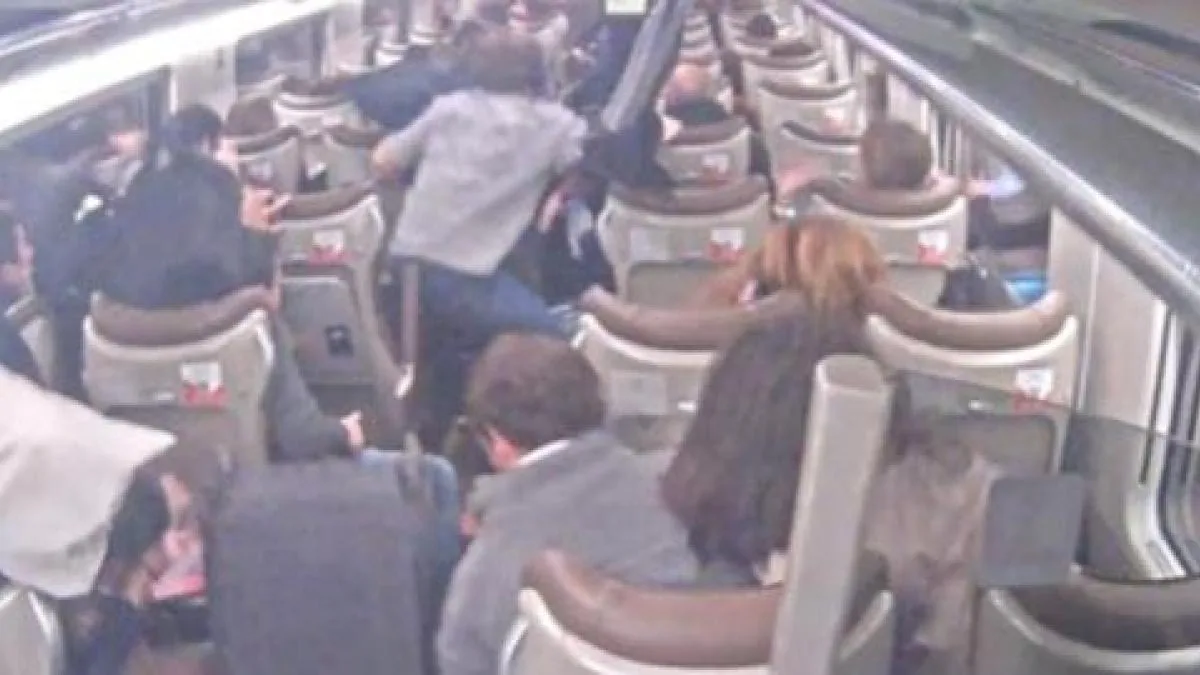
The report, which has been sent to the judge in Montoro (Córdoba) investigating the case, focuses on Iryo car six, the first car to leave the tracks. At that moment, the train was traveling at a speed of 207 kilometers per hour. In the videos corresponding to that car and the subsequent one, car seven, the beginning of the vibration associated with the derailment is observed. At that moment, the catenary voltage drops from 25,180 watts to 590 to recover later, and from then on, it suffers fluctuations.
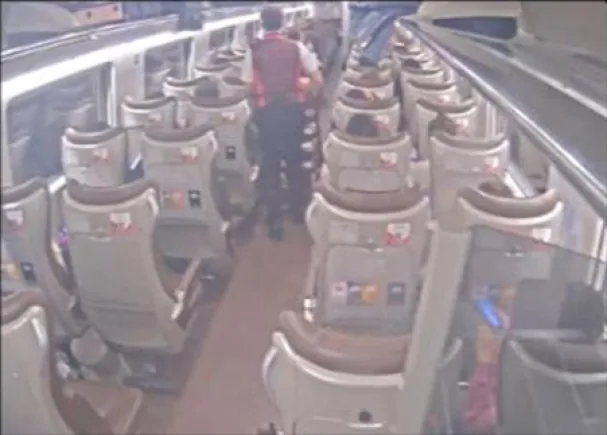
In the images of car eight, at the height of seat rows three and four – on the inter-track side – “what appear to be incandescent splinters are visible through the windows”, presumably “from the friction between the derailed wheels and the metallic parts of the infrastructure”. The report states that at 19:43:36, images from different cameras in cars six, seven, and eight are lost. At the same time, in the cameras located in cars one and three, “brake inertia” is observed, causing standing personnel to hold on to avoid falling.
Everything happens in hundredths of a second. The authors of the report highlight that when switch A644 reports a trailing point movement, possibly due to the invasion of the inter-track by the derailed Iryo cars or due to the damage these cars cause to the turnout elements. In the images from car five’s camera, at 19:43:38, movement of car six towards the outside of the infrastructure appeared. At that same moment, in car seven’s camera, lateral movements also towards the outside of the infrastructure are recorded. Also vertical movements.
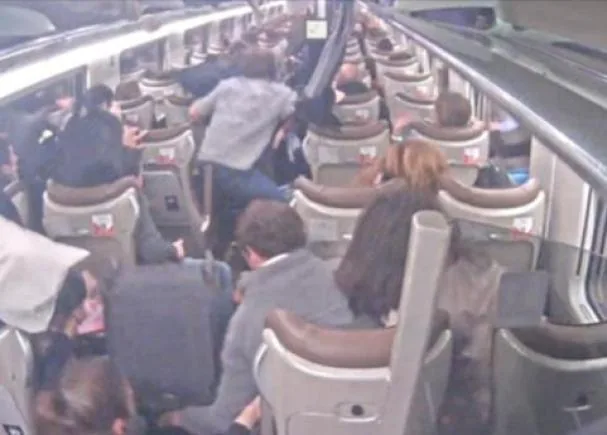
At 19:43:40, “headlights” of the Alvia train are observed through the Iryo windows. In car one, these lights are not visible due to the camera’s focus angle. At that instant, in car five, the lateral movements of car six continue to be observed. In car seven, during that second, it moves from the inter-track towards the outside, and finally, “the camera image is lost”.
Read more Young people don’t believe immigrants take their jobs, but they do believe they take resources
At 19:43:41, the emergency button is pressed by the driver. At that time, the Iryo was traveling at a speed of 180 kilometers per hour. Its speed, the report says, had decreased due to temperature alarms in the gearboxes and the anchoring effect of the derailed cars. At 19:43:41, the headlights of the Alvia train are observed through the Iryo windows in the middle of car four and car five.
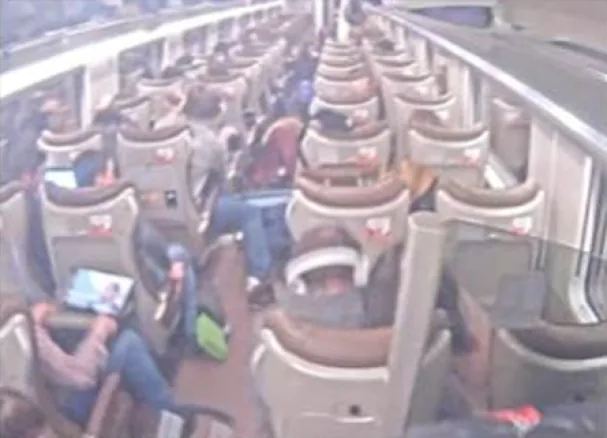
According to the CIAF, the first point of collision between the Iryo and the Alvia is located in the rear area of car six. At that moment, the former was traveling at a speed of 152 kilometers per hour and the latter at 204 kilometers per hour. In the video from car five’s rear-facing camera, a displacement of car six towards the inter-track is observed at the end of second 41. Just at the beginning of second 42, “vibration” is observed in the car, presumably due to the impact of the Alvia with the end of car six, and immediately after, car six moves to the opposite side: outside the infrastructure.
This is an internal report with the aim of establishing a spatiotemporal framework for the event. The data contained, as the CIAF emphasizes, are provisional until the final report is drafted, “and new findings may emerge during the investigation that modify the hypotheses considered for the calculations made”.