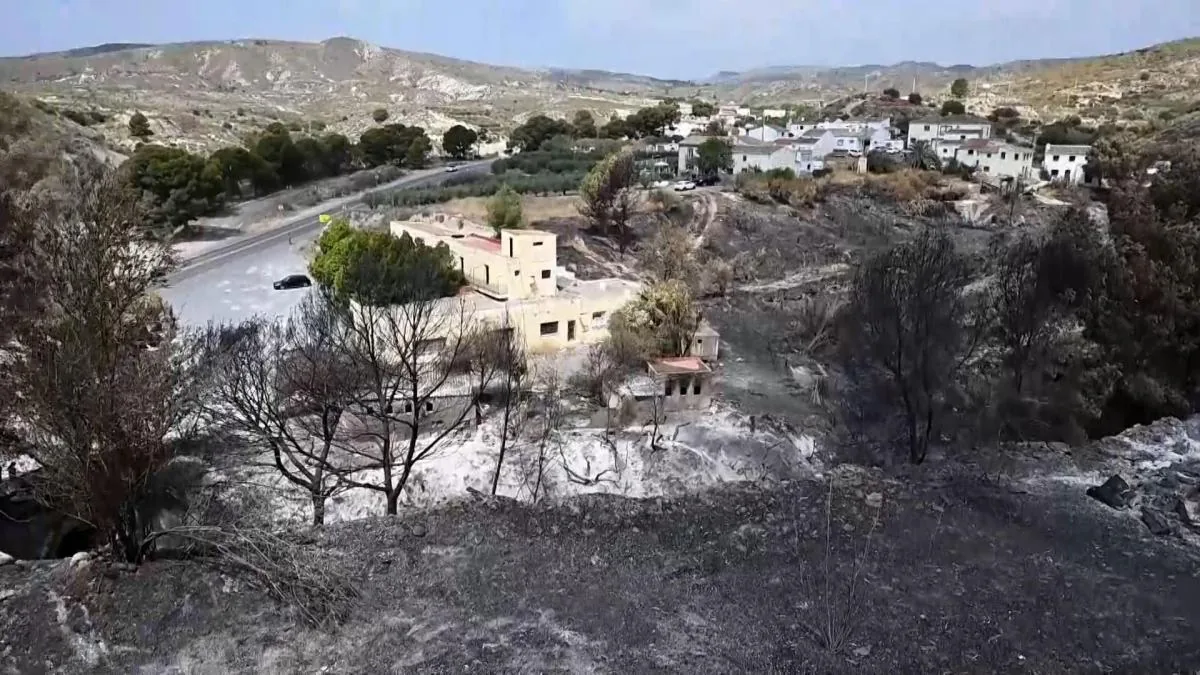
Data from this year’s campaigns, up to July 15, indicate that 59,961.48 hectares of forest have already burned in Spain, in 18 large fires (over 500 ha), tripling the tally compared to the same time last year. In 2025, up to July 15, data showed that 20,466.25 hectares had burned, with 6 large fires, according to data provided by the Ministry for the Ecological Transition, based on information collected by the autonomous communities.
Read more The UCO maintains that Cerdán stopped using his credit card when Ábalos arrived at the Ministry
Forest fires are proving to be especially virulent again this year, something that happens after two years of above-average rainfall. But this favorable rainfall has fostered such lush vegetation that, when it dried out in spring, it ended up being fuel for the flames.
The Minister for the Ecological Transition, Sara Aagesen, visiting the Cinco Villas region in Zaragoza (where 12,000 ha have already burned), called it “fundamental” to remember that the country is experiencing increasingly extreme temperature conditions and heat waves. Furthermore, she expressed confidence that “all this is also worsened by one of the great or let’s say the great challenge of our time, which is climate change.”
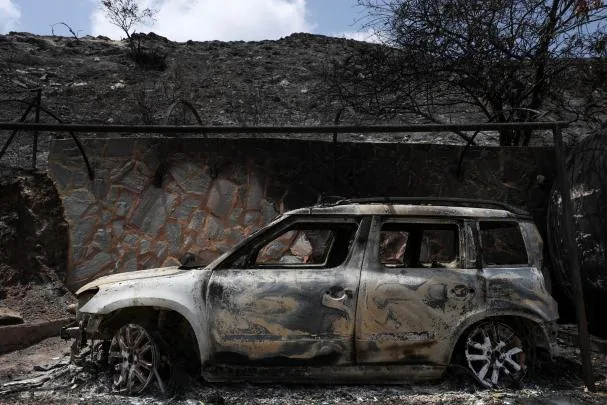
The provisional fire tally is a bad omen, but the final result will not necessarily surpass last year’s, when 350,000 hectares burned, the worst tally so far this century according to data collected by the Ministry for the Ecological Transition.
But it is also by no means a reason for hope that so far this year about 50% more forest area has burned than the average of the last decade (37,791 hectares, up to July 5).
Sara Aagesen recalls the Aemet alert
In the face of a possible new heat wave
Minister Sara Aagesen reiterated that “it is essential to work together” and asked the entire population for “maximum caution.” “We are seeing a high, very high fire risk index today and in the coming days, so I ask everyone to be cautious,” she demanded.
In this regard, she emphasized that “just two days ago” Aemet issued an informative note “which spoke of temperatures much higher than normal.” “We are talking about those temperatures that will continue throughout this week and with a possible heat wave that may arrive this weekend or early next week, so high temperatures, a low humidity situation, and wind regime worsen the fires,” she stressed.
The worrying trend of major disasters
What worries experts is the trend toward major disasters. When the fire cannot be contained in time and gets out of control, its effects are devastating. Last year the number of fires decreased by 10% compared to the average, totaling 8,199 incidents – of which 2,598 were actual fires over one hectare.
But the number of large forest fires – over 500 hectares – rose to 63, and 47 of them occurred only in August, with the worrying fact that 5 devastated more than 20,000 hectares.
And this year this trend is consolidating. Up to July 15, there were 18 large fires over 500 hectares, the highest number of the decade.
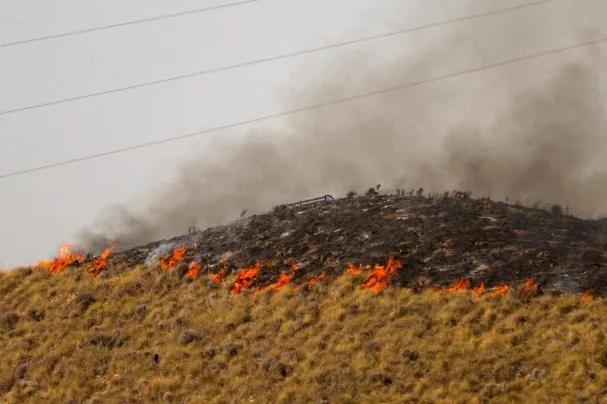
Another fearsome effect is simultaneity. Last year, in just two weeks of summer, 90% of the total burned area was concentrated, which overwhelmed firefighting resources, complicated evacuations, and reduced the emergency teams’ capacity to control so many fronts at once.
Read more The T2 of El Prat airport is updated with the biggest renovation since the Barcelona Olympic Games
The climate crisis combined with rural abandonment and loss of land management are key for WWF
And what are the causes? The climate crisis, lack of prevention, and rural abandonment are three of the main reasons experts at WWF point to as causes of the large fires. More specifically, behind these events, they mention “the low investment in prevention, the entrenched use of fire still practiced in rural areas, and the abandonment of the agroforestry landscape.” Added to all this is “the absence of forest management and the lack of territorial planning.”
“The climate crisis combined with rural abandonment and loss of land management make the agroforestry landscape increasingly vulnerable to fires,” explains Lourdes Hernández, an expert at WWF Spain. Furthermore, there are a large number of homes located within or near forest areas lacking planning or adequate self-protection measures, according to this organization, “which worsens the problem.”
We need a change in strategy that goes beyond firefighting and addresses comprehensive management based on prevention and adapting the territory towards agroforestry mosaics, preventive territorial planning, and sufficient resources to face emergencies,” Hernández adds.
Heat waves and other elements of the debate
Many voices, such as those of WWF, emphasize that the limits of the current fire-fighting model “have become obsolete in the new climate context.” Currently, 78% of resources in this area are dedicated to firefighting and only 12% to prevention (forest management). The rest goes to restoration.
Another revealing fact is that 95% of these events are caused by sometimes negligent human activities (especially the use of fire as a management tool in rural areas), and the remaining 5% are attributed to lightning. Therefore, there is a wide margin to avoid them.
The European Copernicus program highlights that Spain accounts for 40% of all burned area in the EU in the first half of 2026. The situation coincides with a succession of heat waves that have increased the risk.
Two-thirds of the Peninsula (except Galicia, Asturias, and parts of Castilla y León, Madrid, the province of Valencia, and Andalusia) were yesterday at very high or extreme forest fire risk. This risk remains very high today in Aragón, Catalonia, León, Zamora, Valladolid, Soria, Teruel, and Granada, although the situation has eased today in the southern and western half (as shown by this Aemet map).
Broad sectors consider a broad political agreement on this matter key to comprehensively addressing prevention and territorial adaptation. The Government tried through the proposed State Pact against the Climate Emergency but it did not succeed in Congress.
Read more End of the Japanese princesses’ elopement: imperial law reformed to guarantee succession