The Court of Justice of the European Union (CJEU) has just endorsed the Amnesty law for those convicted, prosecuted, and charged in the Catalonia secessionist process, the most unique declaration of independence in European history, perhaps in the entire world, which consisted of doing nothing after its announcement.
Read more Musk says Le Pen is «France’s last hope»
Almost a decade after the October 2017 events, European justice rules that the Amnesty law has been useful for reconciliation, without harming or prejudicing European law. This morning, the Luxembourg Court has written an entire page of Spain’s history.
Not a paragraph, an entire page. Let’s get to the heart of the matter. Let’s not get lost today in the branches of the political conjuncture. Nine years ago, the Spanish State faced a serious dilemma. What to do with Catalan independence once Article 155 of the Constitution was applied, which consisted of taking control of the Generalitat Government, dissolving the Parliament, and calling elections immediately?
After applying Article 155, the hardline immediately won, led by the State apparatuses, especially the high judiciary
There were two possibilities: subject the independence supporters to exemplary punishment or proceed in a more subtle and benign way, to slowly overcome the political crisis, avoid fifty years of bitterness and an irreparable chasm between Spain and the majority of Catalan society, since many Catalans opposed to secession did not want to see their compatriots in jail.
Crime of rebellion or crime of disobedience. Serious attack against the unity of Spain or poorly calculated adventurism, fueled by the sleepless electoral competition between Convergència and Esquerra Republicana, the two branches of mesocratic Catalan nationalism. A mortal blow to the Constitution or an attempt to overflow the Constitution, stopped at the last moment for fear of worse outcomes. No flag was lowered after the gesture of October 29, 2017. No demonstration was called in Sant Jaume square. No declaration was published in the Official Gazette of the Generalitat of Catalonia. Nothing. Conspiracy or irresponsible adventurism. Maximum punishment as a warning to future generations. Moderate penalization and search for a political solution, once a secession that in reality never had a minute of validity was stopped. That was the dilemma.
The hardline immediately won, led by the State apparatuses, especially the high judiciary, which wanted to interpret the King’s speech of October 3, 2017, as an order for a forceful response. Someone even wrote that the Catalan procés could mean for Felipe VI, in terms of social legitimacy, what the 23-F coup attempt meant for his father. I don’t think anyone today can uphold such a thesis without blushing.
The high judiciary pressed the accelerator. It cannot be categorically stated that at that time Mariano Rajoy’s government wanted immediate prison orders. The Parliament is not dissolved and urgent elections called in Catalonia to send people to jail the following week and facilitate the victory of Carles Puigdemont, who fled to Brussels with the legitimist flag. That is what happened. The State apparatuses demonstrated their capacity to act “autonomously” in a serious political crisis. This is an important fact.
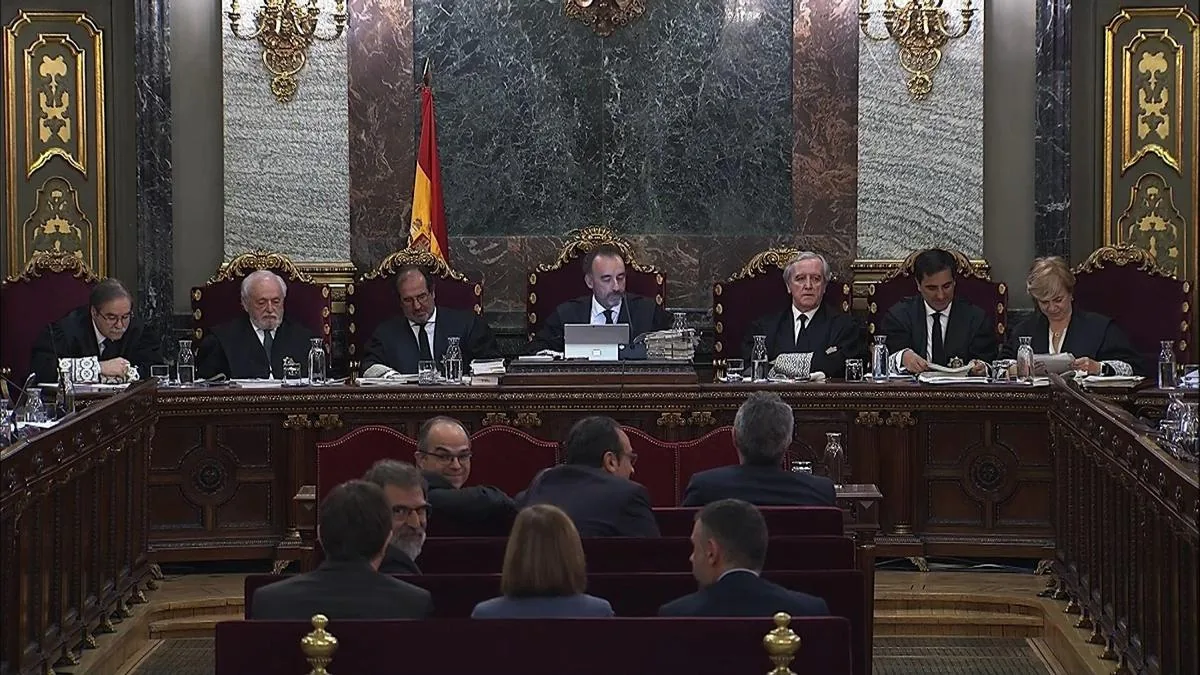
Two years later, October 2019, the second chamber of the Supreme Court did not dare to convict them of rebellion, for fear of not passing the filter of the European Court of Human Rights based in Strasbourg. Sedition, embezzlement, and disobedience. Sentences between 9 and 13 years in prison for the nine main defendants. Seven independence leaders took refuge in Belgium, Switzerland, and Scotland. Hundreds of people prosecuted throughout Catalonia awaiting trial. Fines handed out freely.
Read more This is (according to the French) the most beautiful village in Provence… and in France
Two years later, June 12, 2021, the Council of Ministers approved the pardon for the imprisoned independence supporters. When presenting the motion of no confidence against Mariano Rajoy in May of that year, socialist leader Pedro Sánchez established a tacit agreement with the forces supporting him, awaiting the Supreme Court ruling. There would be pardons.
The State apparatuses demonstrated their capacity to act “autonomously” in a serious political crisis
“We support the motion to open a new political phase that allows turning the page,” declared Marta Pascal, leader of PDECat (the first metamorphosis of CDC, before becoming Junts), who played a special role in that episode. Puigdemont, it is worth recalling now, was against voting for that motion of no confidence, he wanted confrontation, and above all feared being sidelined in Brussels while his people negotiated in Madrid. He could not control his deputies and purged Pascal after a while. History is always written with crooked lines. Whether convinced or not, Sánchez embarked on the path of forgiveness. Only Ciudadanos could have prevented it. And they did not know how to do it. If in spring 2019, after the general elections of April 28 that year, Albert Rivera had facilitated Sánchez’s investiture, he would have imprisoned the PSOE in a policy of national severity. Ciudadanos could have avoided the subsequent alliance of the socialists with Podemos, which Sánchez did not want. But Rivera was made to believe that he was destined to be, sooner rather than later, the future president of the Government of Spain. The limelight of Madrid always dazzles the unwary.
Two years after the pardons, in July 2023, this story goes two years at a time, the failure of the left in local elections pushed Sánchez to an early general election, which he managed to outflank the Popular Party, without obtaining an easy majority. Again a dilemma: amnesty, let Feijóo and Vox govern in minority, or repeat the elections. Sánchez decided to set sail, provoking the saturnine anger of Felipe González.
After so many vicissitudes, the CJEU has just said: “Go ahead.” Europe once again helps Spain out of the labyrinth
And what happened, happened. The hells opened. Six consecutive demonstrations in Madrid over a year, the tense National November, led by Vox on Ferraz street in Madrid, demonstrations of judges in robes in front of provincial courts – an image never seen in Spain -, an unprecedented climate of excitement in the democratic period, calls for general mobilization until provoking the fall of the Government, whoever can do it, a showy display of the ‘autonomy’ of the State apparatuses, before a Government without a structured parliamentary majority, before a PSOE that no longer has the social muscle of the eighties and nineties of the last century. Before a PSOE without sufficient internal oversight mechanisms given the judicial processes that have accumulated in recent months, after the Constitutional Court stamped the Amnesty law. This time they could not alter the composition of the Constitutional Court at the decisive hour, as happened with the deliberation on the new Statute of Catalonia, the true starting point of the story we have just told. After so many vicissitudes, the Court of Justice of the European Union has just said: “go ahead.” Europe once again helps Spain out of the labyrinth.
Smart politics has won, written with many crooked lines. Two years after the approval of the amnesty, this story goes two years at a time, many people begin to understand its meaning. Today it is understood better, without a doubt. Alberto Núñez Feijóo has just traveled to Catalonia to announce that he is also willing to turn the page. (And the next day José María Aznar reprimands him). July 16, 2026. The same day the Luxembourg Court issues a historic verdict, the Madrid Court sends the Prime Minister’s wife to trial with a popular jury for alleged crimes of influence peddling and embezzlement. There are days when a country’s history becomes crystal clear. There are days when the truth is carved in marble.
An intelligent idea of Spain has won. Amnesty means all included. Europe cannot survive without that principle, because difficult times are also coming for the stability and continuity of the European Union. Reconciliation, integration, that is also what the CJEU verdict says.
Soon we will see the PP establishing more visible agreements with Junts, and the future Catalan Alliance exchanging cards with Vox.
Read more The highest uniformed chief of the Civil Guard admits that he asked the UCO not to be «proactive»
All included.