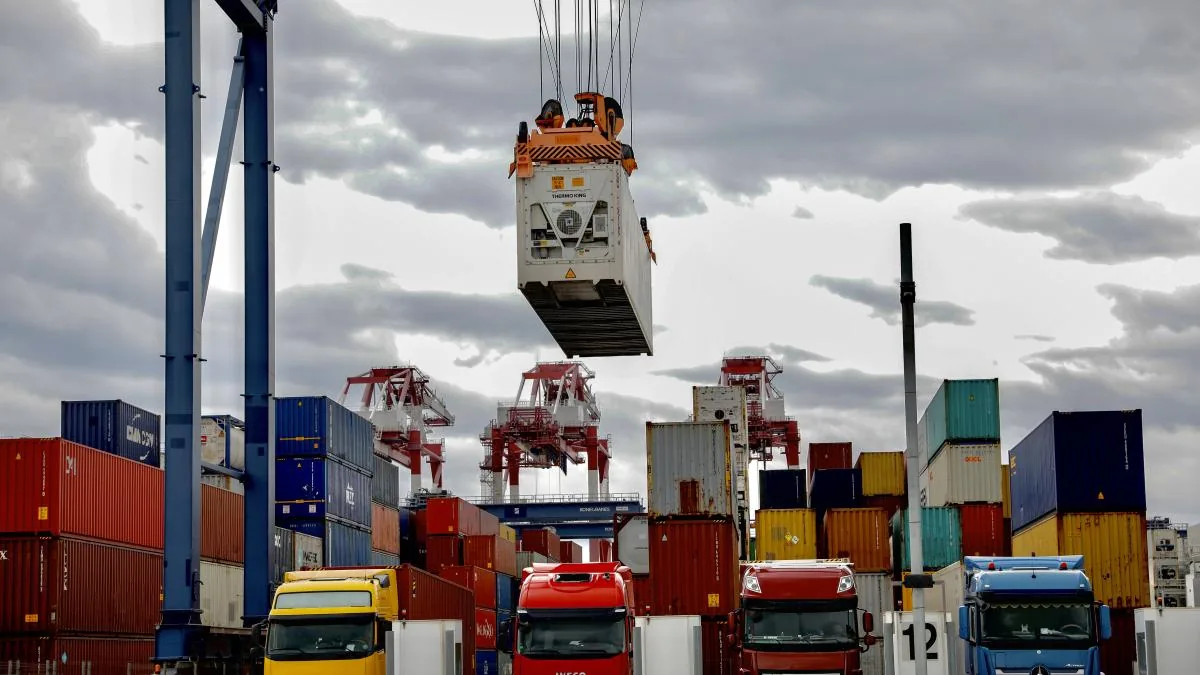
“Services have continued to be the main engine of the Catalan economy.” That is one of the conclusions of the Annual Report on the Catalan Economy 2025 presented this Thursday at the Palau de la Generalitat. With a “gradual recovery of the agricultural sector,” the Catalan economy shows this new face in which the industry has not yet regained the brilliance of previous years. “The weakest increase was recorded in the industrial sector,” the report states.
Read more The Nuclear Safety Council approves the extension of Almaraz until 2030
In 2025, the Catalan economy grew by 2.7%, a figure higher than expected. For the fifth year, the increase in the GDP (gross domestic product) of the community exceeds the growth of the eurozone (1.4%) and is similar to that of the Spanish economy (2.8%). The Department of Economy led by Alicia Romero has highlighted in the report that “this result has been achieved despite the adverse international context marked by the increase in trade and geopolitical tensions and by the persistence of European stagnation, which have weakened external demand.”
Apart from the sectors that have acted as a locomotive (services), the report states that “the growth of the Catalan economy is mainly due to the strength of internal demand, which contributes 3.5 points to growth.” As other institutions have already warned, the report also alerts that “the good macroeconomic moment does not reach all households equally, and places long-term productivity and housing as major pending challenges.”
Last year, Catalonia managed to improve productivity measured as GDP per inhabitant: it grew by 1.6%. “One of the growth drivers is the dynamism of household consumption, driven by the good performance of the labor market, the increase in real wages, and demographic growth which, together with the acceleration of investment in digitalization and artificial intelligence, have offset the negative contribution of external demand,” the report notes.
Regarding wages, the data show that between 2021 and 2024, the minimum wage has acted as an effective floor since “the wages of the lowest-paid 20% of workers have continued to grow in real terms” while the rest “have lost purchasing power.” The exception is also the highest wages which have maintained purchasing power.
At the presentation of the Report at the Palau de la Generalitat, the director of economic analysis of the Government, David Lizoain, pointed out that the gap between Catalan and eurozone productivity continues and emphasized that “our priority is that the great results reach everyone.”
Read more The PP shows “absolute respect” for the CJEU ruling on Amnesty