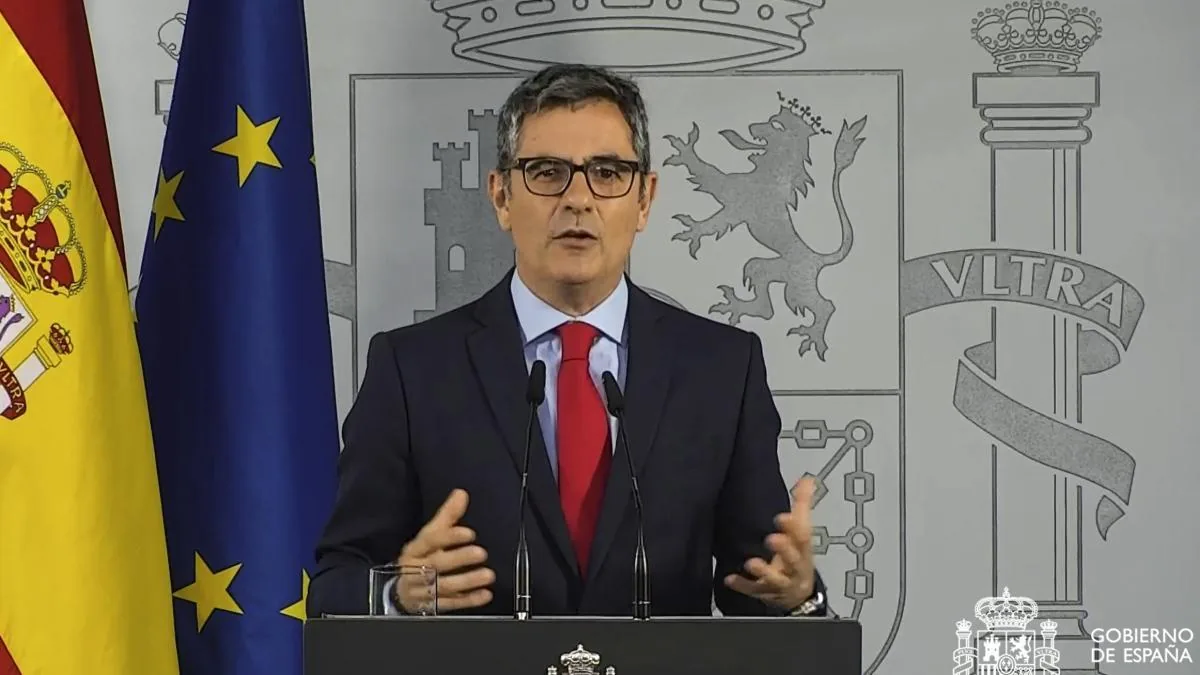
“It was worth it, it is worth it, today is a great day,” said the Minister of the Presidency and Justice, Félix Bolaños, after the Court of Justice of the European Union (CJEU) endorsed the Amnesty law this Thursday, thus taking a step further to pave the way for the return of Carles Puigdemont, almost ten years after the procés independence movement broke out in Catalonia.
Read more Junts demands the Constitutional Court to resolve the protection appeals before going on vacation
In an institutional statement from the Moncloa Palace, Bolaños said that European justice has sent a message of great importance “in times of polarization” like those suffered by Spain and the rest of the world. “No country is destined to perpetuate its conflicts until one side ends the other, but democracy has the necessary tools to make coexistence and reconciliation possible.” And he guaranteed that the Government will always be willing to “seek and follow the path of agreements among different parties.” Despite the many difficulties he admitted this path is having.
At Moncloa, they had already been “hopeful” in recent days that the CJEU ruling would be “positive” to endorse the amnesty, as a culmination of their commitment to institutional, political, and social normalization in Catalonia after the turbulent years of the procés independence movement. “It implies that steps are being taken that help fulfill our commitments and remove the blockages that the Popular Party has tried to place on a legitimate law,” they highlighted. The possible return of Puigdemont to Catalonia, which they have been expecting for many months, is the “window of opportunity” they trust to mend the broken ties with Junts.
Being very aware, however, that Junts has been “very forceful” in warning that a favorable CJEU ruling “will not change anything” in their relationship with the Government, which Puigdemont’s party declared broken last October, Moncloa insists that their intention is “to continue reaching agreements with Junts… also for the budgets.”
Step by step, however. “The Government took a risk to bring back normality and coexistence, and it succeeded. We inherited a constitutional and social crisis, and we have achieved a more united country and stronger institutions and laws. It was worth it,” Bolaños insisted. And now only full compliance remains. “The horizon is now clear for the full application of the law. But the law will only be fully fulfilled, as approved by the Cortes, when it is also applied to the political leaders who promoted the independence process. This will be the last stage of the institutional, political, and social normalization process in Catalonia, and it would be positive for everyone if this stage is completed as soon as possible,” he demanded.
Bolaños highlights that the political and social sectors that reject the amnesty will also benefit: “No one, not even its fiercest critics, would want to give up its fruits”
The minister emphasized that even the political and social sectors that rejected the Amnesty law will also benefit from it, with the PP first. “I am convinced that once its effects are seen, today no one, not even its fiercest critics, would want to give up its fruits,” Bolaños assured. And that is why he called the law a “collective achievement.” “All Spaniards, without exception, are beneficiaries of the Amnesty law and of the normality, coexistence, and stability it has guaranteed,” he stressed.
“There is no longer any doubt: the Amnesty law is constitutional and complies with European law,” Bolaños emphasized. And he assured that the Executive has always defended what the European court has “firmly and literally” affirmed today: “Amnesty is an appropriate instrument to calm a political or social conflict, reduce the institutional and political tensions generated by the Catalonia independence process, and facilitate a scenario of reconciliation.”
Illa warns: “There is no longer any democratic, constitutional, or European obstacle preventing the full application of the law”
In Spanish, Catalan, and English, the President of the Generalitat Salvador Illa also valued the CJEU decision from the Gothic Gallery of Palau as “very good news for Catalonia, for Spain, and for democracy.” “Europe says yes to amnesty. Catalonia says yes to the future,” he concluded, and that is why he demanded the application of the law “diligently, fully, and without subterfuge.” “There is no turning back: the Amnesty law is part of our legal framework with all its consequences and, therefore, its application is mandatory,” he warned, and “there is no longer any democratic, constitutional, or European obstacle preventing the full application of the law,” he insisted.
The president claimed the law’s objective, which reads in its organic name – “institutional, political, and social normalization in Catalonia” -, to point out that “the vast majority of citizens, from Catalonia and Spain, are committed to reunion, dialogue, coexistence, and a new future,” and this translates into “people, political formations affected by the law, and Catalan society must be able to participate and contribute to Catalonia’s future.” For the president, now is the time to “continue building this future based on seeking what unites us, celebrating our diversity, and transforming our political plurality into agreements in favor of collective progress.”
“The legislature makes sense and has strength, we must keep moving forward,” say Sumar
From Sumar, a partner in the government coalition with the PSOE, they also highlighted that the CJEU ruling “supports the Government’s hypothesis, legally and politically.” “Legally, because, as we always said, this law contained no such problem. And this has been confirmed. And politically, because we have always bet on dialogue and plurinational agreement. The CJEU decision legitimizes the political decision,” they stressed.
“Amnesty has always been a legal tool to address a political conflict that should have been resolved from the start through dialogue. The attempts by the right-wing and part of the judiciary to sabotage this legislature by undermining the amnesty have failed. The legislature makes sense and has strength. And it has it precisely when we build it from this plurinational perspective. This is the best path, both for Spain and Catalonia. We must keep moving forward in this direction,” Sumar celebrated.
Read more What is Puigdemont’s judicial path after the European court’s endorsement of the amnesty?