





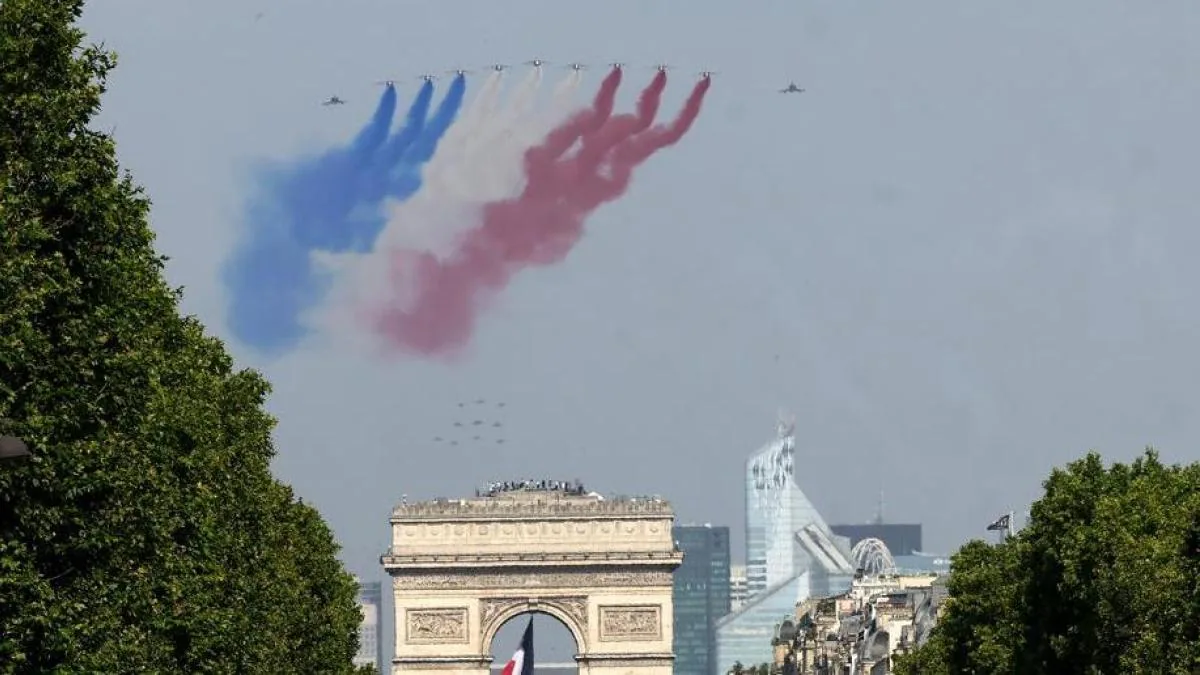
When in February 2022 Vladimir Putin ordered the invasion of Ukraine, which he even denied the right to exist, he could not have imagined that four and a half years later soldiers and pilots from Kyiv would parade in Paris as heroes and allies. The military parade this Tuesday on the Champs-Élysées, on the occasion of Bastille Day, the French national holiday, was a demonstration of European unity and a tribute to Ukraine for its courage.
Read more The UCO warns that the PSOE used front companies to pay Leire Díez
The last July 14 parade under the presidency of Emmanuel Macron, who will leave the Élysée in May 2027, was meant to be special, with more participants than ever – 6,800 soldiers on foot -, 315 vehicles, about a hundred planes and 31 helicopters. But the most significant was the presence of 500 soldiers from allied countries, mostly from the Coalition of Volunteers for Bosnia. Spain sent 21, with representation from land troops, marines, and members of the Air and Space Force. An F-18 fighter based in Zaragoza also flew over the Parisian sky.
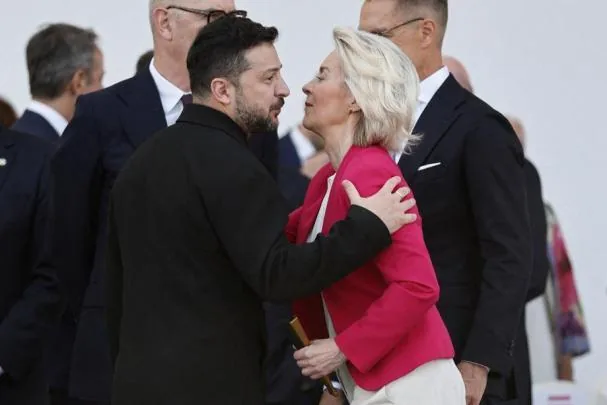
The number of foreign soldiers was necessarily reduced, for logistical reasons, but with symbolic weight. The parade chose the motto “The strategic awakening of Europe,” a clear message against Russia and also directed at the Trump Administration amid its continuous snubs to its NATO allies. Many European leaders were present in the stands, including Pedro Sánchez, Chancellor Friedrich Merz, and outgoing Prime Minister Keir Starmer, who supported Ukrainian President Volodymyr Zelensky, accompanied by his wife. The day before, they all attended a dinner at the Élysée.
The 25 Ukrainian soldiers marched at the end of the allied contingent. At the opening of the parade, two Mirage 2000B flew alongside the nine Alphajets of the Patrouille de France, the national aerobatic unit. Two Ukrainians trained in France served as co-pilots of the Mirages.
It was significant that among the French units chosen to participate in the parade were several deployed on NATO’s eastern flank to ensure protection against the Russian threat. Among them were soldiers from the tank regiment stationed in Romania, the NATO multinational battalion in Estonia, Mediterranean divers and bomb disposal experts, and rapid deployment special forces of the Air and Space Force.
As every year, the parade serves to display France’s nuclear deterrent power, the only country in the European Union, after the UK’s exit, that possesses its own atomic weapons. Over the Champs-Élysées flew a tanker and transport Airbus, vital for strategic projection in case of crisis, as well as seven Rafale fighter-bombers capable of carrying nuclear missiles. Sailors from the nuclear submarines marched on foot.
Read more David Sánchez, brother of the president, sentenced to nine years of disqualification
Under Macron’s impetus, France has claimed in recent years, through multiple initiatives, its vocation for European leadership in defense. One of the most important steps was taken in early March, during the president’s visit to the Île Longue base (Brittany), which houses the four submarines carrying long-range nuclear missiles that rotate to maintain a permanent patrol. The visit to this highly sensitive and heavily protected base, almost always inaccessible, was exceptionally open to a group of French and foreign journalists, with the express intention of publicizing it.
At Île Longue, Macron gave a speech to launch his offer of “advanced deterrence,” an initiative criticized by the far right. The president said that France was putting its arsenal as a guarantee for other allied countries in Europe and to deter a potential enemy from an attack. This could eventually include the occasional deployment of French weapons on allied territory, something that infuriates Moscow. It is an attempt, although partial and insufficient for now, to overcome the US protection umbrella in place since the end of World War II. Those who have joined this project, such as Germany, Belgium, Poland, the Netherlands, Greece, or Denmark, agree to conduct joint exercises and planning with the French, although the final decision to press or not the nuclear button will always correspond to the president of France.
The parade was not without some internal controversy. The selection of those who march is based on various criteria. No one wants to be forgotten, neither the National Police, the Gendarmerie, nor the firefighters, the latter very busy with the multiple forest fires caused by the latest heatwave. There were criticisms for the presence at the event, for the first time, of five agents from the Brigade for the Repression of Violent Action (BRAV-M), who operate on motorcycles and have been involved in actions condemned for their excessive force during demonstrations.
The parade concluded with a specific tribute to the Navy, founded about four hundred years ago by the intervention of Cardinal Richelieu, and the singing of the national anthem, La Marseillaise.
Read more The ‘fast tech’ trap: why we replace our mobile phone so often