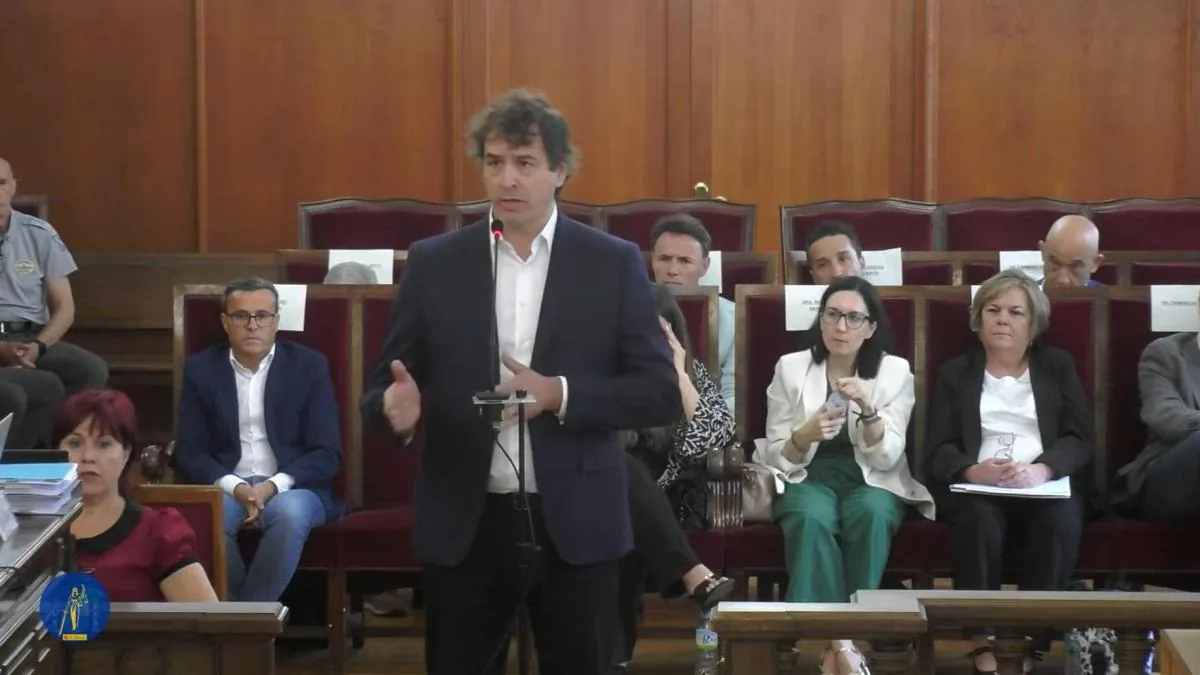
David Sánchez’s statement this morning at the Badajoz Court has surprised due to its brevity and its complete lack of references to his hiring as coordinator of conservatories at the Badajoz Provincial Council in 2017. David Sánchez only answered his lawyer’s questions, which were limited to two issues: his change of position in 2022 when he became director of the Office of Performing Arts, and the hiring in 2023, also by the Badajoz Provincial Council, of his friend Luis Carrero as coordinator of cross-border centers and activities.
The brevity of David Sánchez’s statement, accused of crimes of malfeasance and influence peddling, has irritated the popular prosecution. At the end of the morning session, the lawyer for Manos Limpias requested that the interrogation of the president’s brother during the investigation phase be reproduced. That statement was much more complete. David Sánchez’s lawyer responded to that request and revealed why the accused did not refer to his controversial entry into the Badajoz Provincial Council.
The defense considers that issue “to be time-barred.” On last Monday’s court day, the tribunal resolved the preliminary issues and accepted one raised by David Sánchez’s defense, the statute of limitations for a minor offense of accepting an illegal appointment. What the defense lawyer now argues is that if that act, which occurred in July 2017, is time-barred, then all previous acts are also time-barred, and consequently, he requests that all charges against David Sánchez for his alleged irregular hiring at the Badajoz Provincial Council be dropped.
For now, there is no response to these two requests, from the prosecution and the defense. The president of the court, José Antonio Patrocinio, has summoned the parties this afternoon at 6:00 p.m. to reveal his decision regarding these issues. Afterwards, the conclusions phase will begin. Next Monday, the final reports will be presented, and the trial is expected to be adjourned for judgment.
This morning’s session was marked by the statements of David Sánchez and the former president of the Badajoz Provincial Council, Miguel Ángel Gallardo, accused of having designed a senior management position tailored to the brother of the President of the Government.
Read more The director of the Civil Guard met three times with Leire Díez
During the investigation, David Sánchez could not specify what the Office of Performing Arts, which he directed between 2022 and 2025, was. Today he has corrected that error and stated in response to his lawyer that this office “was not a physical place with a counter.” What the accusations suspect is that David Sánchez requested a change of position to avoid exclusivity with the Badajoz Provincial Council and to be able to dedicate himself to other tasks. Thus, the modification of the job position would have been made to eliminate the incompatibility, but that was not legal.
David Sánchez has tried to address these accusations and stated that at a specific moment he wanted to carry out an activity with a Portuguese orchestra, that he asked his boss for permission, and that it was not granted. The president’s brother wanted to make it clear that he did not perform other tasks on his own while he was part of the staff of the Badajoz Provincial Council: “I never had compatibility to do other tasks and I did not do them. I had no private activity,” he emphasized.
He also denied that the hiring of his friend Luis Carrero in 2023 was intended for Carrero to do his work because he was busy with external tasks, as the prosecution claims: “It was impossible for Luis to do my job, because he is not a musician and does not know how to conduct an orchestra,” he assured after admitting that his friend did lend him a hand “on some occasions.”
For his part, the former president of the Badajoz Provincial Council, Miguel Ángel Gallardo, accused of creating a job position tailored to David Sánchez, denied having met with Pedro Sánchez to discuss this matter. He stressed that in the PSOE primaries in May 2017, he supported Sánchez’s rival, Susana Díaz, and insisted that the idea of creating that position was not his, as the UCO claims, but rather “emerged from the Culture department.”