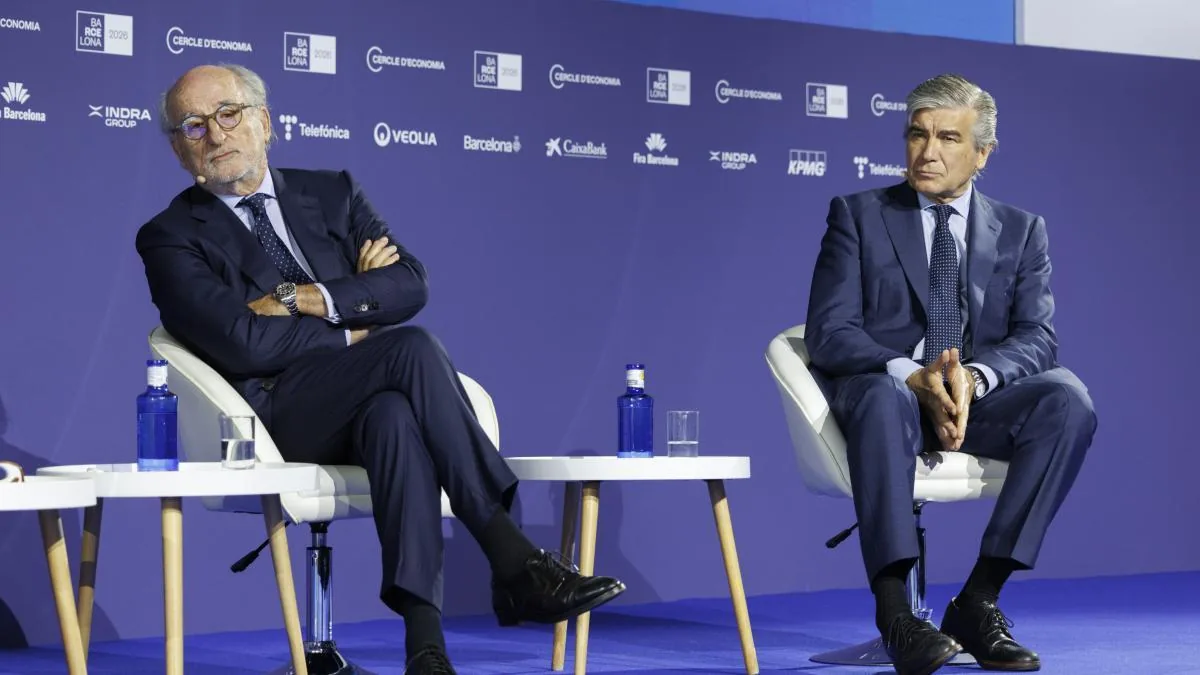
The impact of the war in Iran on the energy system has put Europe in front of the mirror. Is it possible to maintain supply on the continent in the face of global-scale disruptions like those experienced in the Strait of Hormuz? The Annual Meeting of the Cercle d’Economia brought together this Tuesday two heavyweights of the sector in Spain, the president of Naturgy, Francisco Reynés, and that of Repsol, Antonio Brufau, to solve this mystery and many others. And their answer to this first question is clear: Spain can withstand the ”shock”, but only as long as the conflict does not last too long.
Read more Barak Ravid, the Israeli journalist who dominates the exclusives of the Iran war
“In the short term, action has been quite agile. We have changed flows, and those that used to pass through the strait now go through the Red Sea,” Brufau pointed out. The president of Repsol also recalled that investments in Spanish refineries have helped avoid a greater shock, especially in the supply of kerosene. “But this cannot last long because approximately 10 million barrels per day have been removed from the market and this consumes many strategic reserves,” he stated.
In this regard, Brufau warned that if the Strait of Hormuz does not open, the world could end up “in a conflict situation,” marked by runaway inflation and a “first-rate food crisis.”
Brufau warns that the world could reach “a conflict situation” and a food crisis if the strait does not open
For his part, Reynés emphasized that Spain has resisted this exceptional context better thanks to the Medgaz pipeline, which connects the country with Algeria, and of which Naturgy is owner together with the Algerian state company Sonatrach. “Spain is quite safe in the short term from suffering a shock in gas receiving capacity because it has diversified its sources and has regasification facilities with greater capacity than the rest of Europe,” said the gas company president. However, he warned that today the EU still lacks the European interconnections that could bring it closer to the strategic autonomy that is the focus of this week’s Cercle debates.
Read more The Mossos are working with the hypothesis that the minor from Sant Roc was injured «accidentally»
Geopolitics also appeared in the dialogue between the two executives, with strong statements from Brufau against China: “It is destroying the planet.” The president of Repsol criticized that Europe centers all its energy strategy on sustainability, while Beijing continues to increase its carbon emissions and produce the goods that are no longer manufactured in the Old Continent. “It is unacceptable, Europeans are necessary collaborators in this destruction,” he lamented. Brufau called it a “contradiction” that European companies are “constrained” by energy costs, while Chinese public companies receive state money to produce the green technology we buy. Instead, he called to strengthen the transatlantic alliance and learn from how the United States manages energy.
Regarding Europe’s role in this complicated puzzle, Reynés defended that real strategic autonomy in energy is difficult when there is consumption but no resources. “In Europe we are a much stricter step, but with a lack of natural resources while we have greater energy needs,” he said.
The president of Naturgy highlighted the “great paradox” that the EU will face when emissions drop as a result of deindustrialization. Reynés took Germany as an example, the great European industrial engine, and the restrictions on manufacturing cars with combustion engines. “At the same time, the world will increase its emissions, because what it will do is produce them elsewhere and bring them here,” argued the businessman.
Read more Catalonia, the most visited community in April with one in five tourists