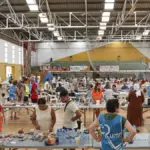


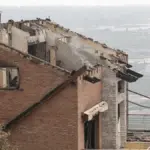


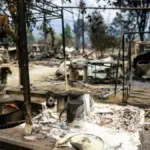

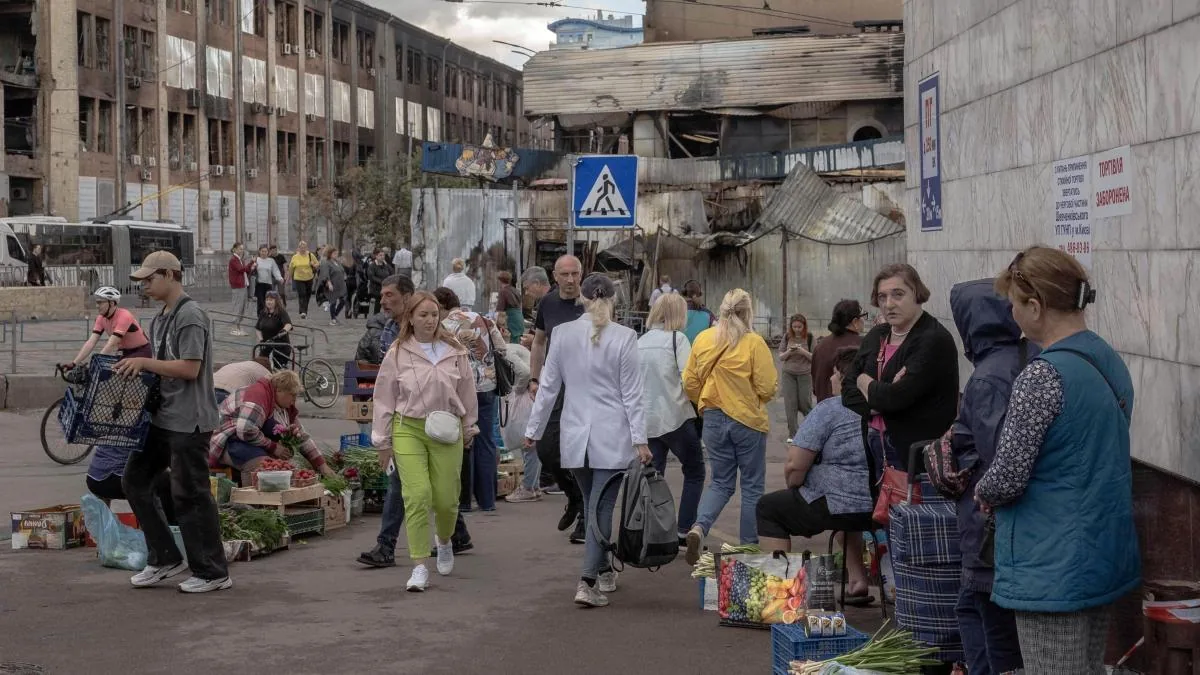
“Please sign the petition for the repair of the Lukianivskyi market,” reads the signs held by several women. Behind them lie the burnt iron and roofs of what until the early hours of last Sunday was one of Kyiv’s oldest markets, said to date back 120 years. “I have been living in fear of missiles, of losing everything, for more than four years. And now we have nothing left,” says Marina, who stands out among the other women by her yellow wool jacket. For 25 years she has had, or had, a small fruit and vegetable shop.
Read more The Revenge of the Ku Klux Klan
But the missiles with which Russia attacked this part of the city – perhaps the most hit sector of Kyiv since the start of the large-scale Russian invasion – reached and set fire not only to the market but also to the houses along the entire street, a shopping center, and the apartment blocks opposite where a large banner hangs. The banner shows a woman with a sword as a symbol of freedom rising from among burning buildings and battles: “#Freedomwar,” it reads.
Four years into the war
The bombing of Lukianivskyi is considered the largest attack on Kyiv
Ironically, this banner is one of the few things left intact from what is considered the largest attack on Kyiv, which has now been battered by missiles and drones for more than four years. No other European capital has been attacked with such intensity and for so long since World War II.
Several burnt-out cars still remain on the sidewalks and many of the broken glass panes of the metro station of the same name. The explosions were so strong that those sheltering deep in the metro felt the ground crack. Today everything is covered with wooden slats, like many other windows in the district and the rest of Kyiv. Many other neighborhoods, some in the heart of the city like the historic Podil, were also hit, leaving dozens injured, three dead, hundreds of homes and businesses affected, streets full of debris, and the population full of uncertainty.
“I haven’t slept since then, emotions overwhelm me,” confesses Marina, who lives near the market and who, from one of the corridors of her house, felt the missiles falling in this sector where the facilities of what was historically the Artem factory are also located, one of the country’s most important state defense industry companies, whose facade was also damaged.
Also read
“Every time the alarms sounded at night, I immediately thought the missiles were going to fall here and destroy everything, as happened,” says Katia, another woman in the group, who admits that the fear is even greater when the alarms sound during the day. Then, everyone runs to hide in shelters, mainly in the metro. They are aware that the danger is constant in this sector, which today stands as a memory of the destruction caused by this war.
But the worst part has come now that they have lost their source of income and doubt they will be able to recover their shop in the future. Both women admit they take tranquilizers to reduce anxiety, but they also say that, in a way, they have learned to live with the fear. “One of my colleagues also lost her house and her car. Ours is little compared to hers,” adds Marina, for whom her greatest therapy is being on the street, together with her colleagues, during the day. The hard part, she insists, comes at night. And more so now that Russia threatens to intensify attacks on Kyiv.
Marina and Katia have lost their source of income and doubt they will recover it
“I won’t leave Kyiv, but I do have a suitcase ready in case I have to run to the shelter,” says Marina. So far she avoids it because it is damp and uncomfortable. Katia, for her part, admits she is afraid of what might happen in the future, “but we have to keep living.” She has a 12-year-old child and has to fight for him, she says.
Read more Iceland looks to the EU again
A neighborhood in constant bustle
The metro doors open constantly. The flow of people does not stop despite the constant possibility of a new attack. Inside, sitting on an aluminum bench, is Alina, 60 years old, who runs the only magazine kiosk. She has worked in this sector for five years, shortly before the large-scale invasion began, and has witnessed each of the attacks on Lukianivskyi. On one occasion, the impact blew the station doors off; on another, it caused flooding. At the McDonald’s on the side of the building, the first of this chain to open in Kyiv, they say repairs have been made six times.
But they keep serving hamburgers, just like the thousands of women and men who keep coming here every morning. Some to work and others to shop, although there are barely any stores left. The ladies who sell vegetables from their gardens and flowers on the sidewalks have also returned, contrasting with the charred buildings. Lukianivskyi looks like a black spot in a city where the sun shines these days. “We have no choice but to keep living. We have children to educate, rent to pay,” says Alina, who admits she has been very affected in recent days.
I won’t leave Kyiv, but I do have a suitcase ready in case I have to run to the shelter
Marina
Had a shop in the destroyed market
She knows dozens of women who work in the market and the shopping center, of which only the concrete structure remains, and who now have nothing left, “it’s a tragedy, but we also know that those who suffer the most are the soldiers on the front,” adds Alina, who lives on the other side of the city where missiles also arrive. Every time she hears explosions at night, she gets under the blankets and prays, she admits.
André, 18 years old, lives nearby and does run to hide in the metro at night. He combines his engineering studies with delivery work on the outskirts to earn some money. “I’m not ashamed to admit I’m afraid of missiles,” he says, and to calm his anxiety, he tries to exercise in the parks, which are filling up again with the arrival of spring. So are the terraces of the cafes. Kyiv has learned not to stop despite the physical but especially psychological wounds left by the war.
Also read
André also admits that these days he finds it hard to concentrate, feels tired. He is anxious because although he has set himself the goal of enjoying every day he is alive, he is always thinking about when the next attack will be. In winter, he says, the anguish came from the cold and lack of light; now he worries about losing everything. Especially his loved ones.
Back in front of the market, the women continue collecting signatures. “I fear we won’t get our jobs back, no one seems interested in the market. It’s like living in constant agony,” concludes Katia in front of a burnt market that is another symbol of the harshness of this European war.
Read more A generation without a home