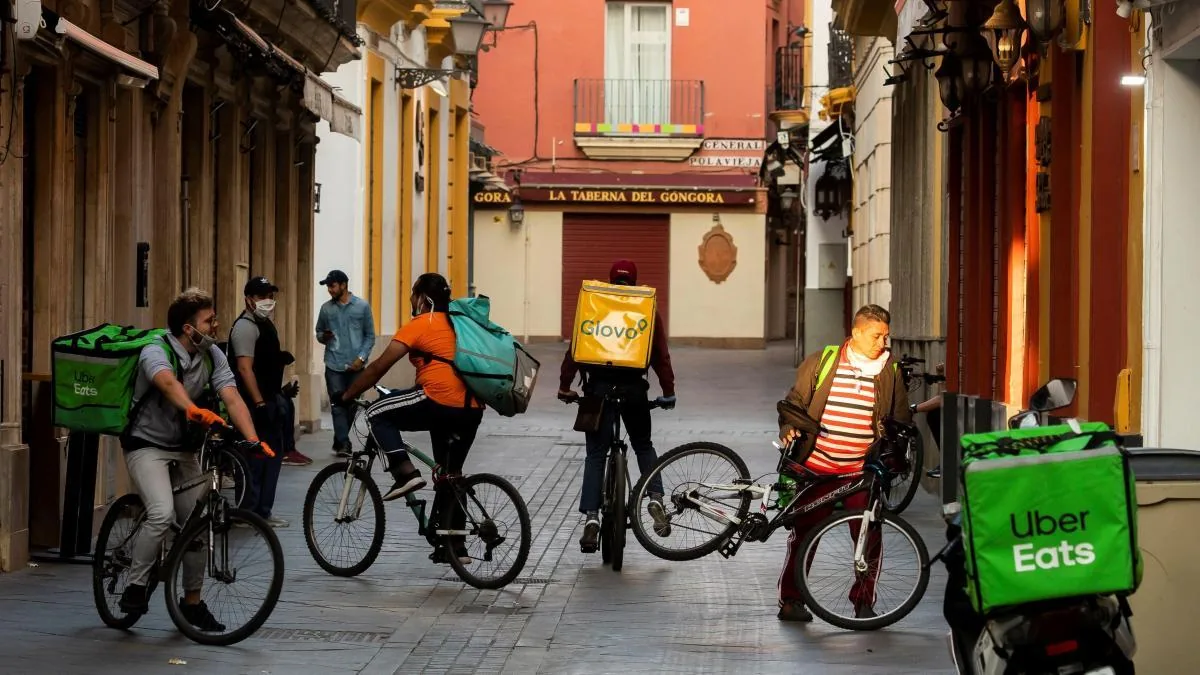
Delivery drivers, whether by motorcycle or bicycle, are already part of the urban landscape in large European cities. In Paris, they are especially visible at night, adding more chaos and danger to traffic. Their working conditions are controversial, to the point that on Wednesday four associations filed a complaint with the Public Prosecutor’s Office of the French capital against the Uber Eats and Deliveroo platforms for human trafficking, an accusation of unprecedented seriousness, and for labor exploitation.
Read more Lamine Yamal is out for the remainder of the League but his World Cup participation is not at risk
The newspaper Le Parisien, which dedicated its front page and two inside pages to the topic this Thursday, was the first to reveal the news, later corroborated by other media. The complaining associations are the House of Delivery Drivers of Bordeaux, the House of Delivery Drivers of Paris, and two other groups, Amal and Ciel, which show solidarity with these collectives.
Estimates speak of between 70,000 and 100,000 delivery drivers throughout France. According to a study by the NGO Doctors of the World (MdM), 98% of people dedicated to this tough task on the asphalt were born abroad and 64% do not have their papers in order. They work an average of 63 hours per week and earn a gross monthly salary of 1,480 euros. That is equivalent to less than 6 gross euros per hour.
According to the complainants, companies take advantage of the situation of vulnerability to impose very harsh conditions. They especially complain about not being paid for waiting hours. In the case of delivery drivers who lack a residence and work permit, they are forced to rent the identity of others, which further reduces their income.
Read more Brawl at Ábalos’s trial: “This Public Prosecutor’s Office understands nothing and is incredulous”
A lawyer for the associations, Thibault Laforcade, told the AFP agency that “the economic model (of delivery platforms) relies on the exploitation of a very precarious immigrant workforce, under undignified conditions, for subsistence income.” Thibault insisted that there is also “algorithmic discrimination,” as the automatic system that decides delivery assignments and their fees is very opaque.
The American platform Uber Eats and the British Deliveroo denied the accusations, according to Le Parisien. The former maintained that its delivery drivers connect to work an average of 26 hours per week and their income increased by 5% compared to 2024. Deliveroo claimed to be one of the highest-paying platforms in the sector. After the complaint, Uber Eats issued a statement denying any basis for the complaint. Deliveroo expressed total rejection “of any comparison of our model with a situation of exploitation or human trafficking.”
Read more Free Aragon from the “imposition of Catalan”, among the 117 measures of the PP and Vox pact