The requirements of Made in Europe rise to the skies. The European Commission wants to shield the community satellite space for European companies and exclude foreign competitors in an attempt to promote the strategic autonomy of the bloc. And this means putting a brake on the giants of this sector from the United States such as Elon Musk’s Starlink or Jeff Bezos’ Project Kuiper: the Commission’s proposal is to reserve at least two-thirds of the European mobile satellite spectrum for European companies.
Read more Russia allows the Central Bank and other institutions their own anti-drone defense
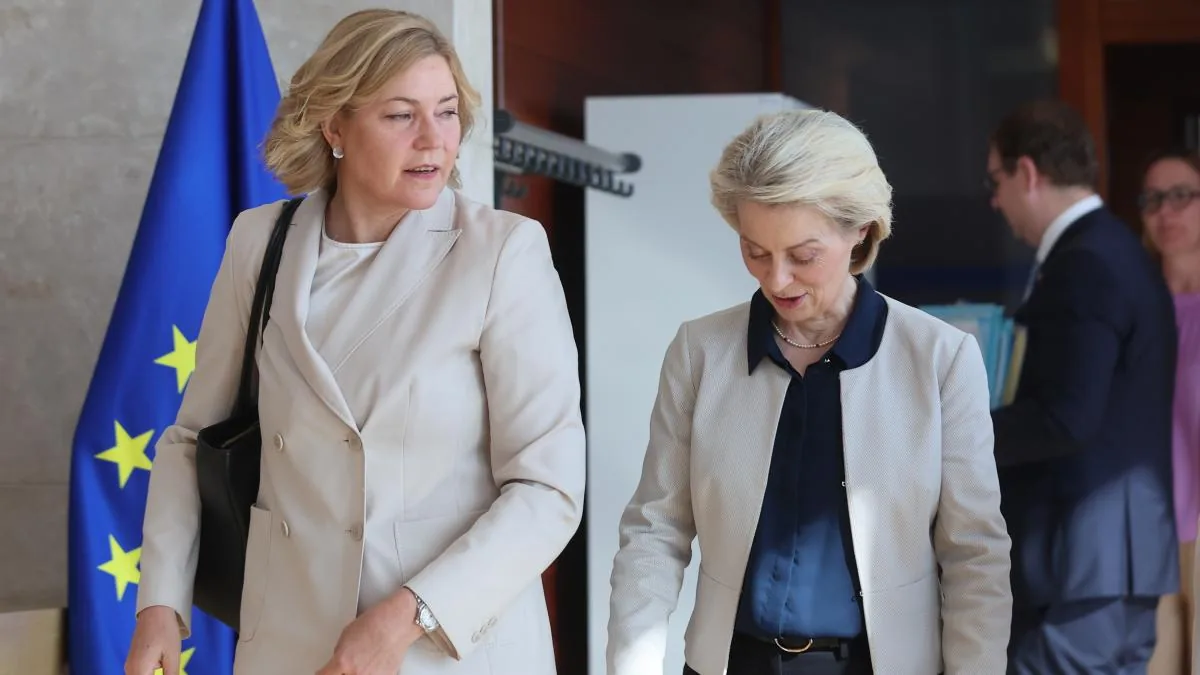
“We must always be attentive to all our technologies, especially our digital infrastructure and our critical infrastructure, so we must also have some own capacity,” said the European Commission’s Vice President for Technological Sovereignty, Henna Virkkunen, at a press conference in Brussels.
In which Hispasat is involved
The Commission seeks for these operators to integrate into the European satellite constellation IRIS2
The popular Finn has acknowledged that they make this decision taking into account the “global geopolitical context.” That is, a continuous struggle between the technological giants of the United States and European regulations, and without a doubt this new idea from the European Commission will not be welcomed on the other side of the Atlantic. Meanwhile, the United States is moving further away from Europe, with its intentions to reduce its military presence on the continent to focus on other theaters of global operations.
Something important, since with these new criteria mobile satellite services for government and military communications would be reserved for Europeans. Europe assumes that in the new global reality space is also a strategic domain and, therefore, control of its communication networks should remain in European hands, limiting the advance of Silicon Valley’s space monopolies.
All this is framed within the renewal of contracts of the American companies Viasat and EchoStar, whose licenses will expire in May 2027 and it will be the moment when Brussels can choose new mobile satellite service providers to take over under the new criteria. The Commission’s idea is to extend these contracts to gain time to reach an agreement with the rest of the community institutions.
Read more Israel assures it will carry out the «emigration project» in Gaza
Then, Brussels wants to create a new unified authorization system to ensure that these critical communication infrastructures do not depend on foreign powers. The idea is to divide this space into three equal parts. The first, reserved exclusively for companies of European ownership for exclusively governmental use, that is, for critical communications, security, and military use.
Here the rules are strict: the eligibility conditions for this segment are a direct message to the big US tech companies: to manage this system, the company must be a legal entity established in the EU, controlled exclusively by the Union, its Member States, or its nationals, and cannot be subject to control by a third country for security reasons. Additionally, the Commission seeks for these operators to integrate into the European satellite constellation IRIS2, a European project in which Hispasat participates and which should be operational by 2030.
Strategic allies
Brussels opens the door to countries like the United Kingdom or Norway
The second section will also be exclusively reserved for community companies, but in this case for commercial use, that is, innovative startups that want to develop their potential in this market to promote supplier diversity and avoid dependence on third countries. And only in the third will US companies be able to participate, as it will be open to both “EU and non-EU companies.”
Until now, companies like Starlink could take advantage of the regulatory fragmentation of 27 different national models to expand, but with the single authorization system at the Union level, if it goes ahead, it will be the European Commission that regulates who can enter this market. It is open to neighboring countries of the Union with similar values and defense cooperation, such as the United Kingdom and Norway, which will be able to access licenses reserved for Europeans. That is, provided they harmonize their rules to ensure compliance with community legislation.
Read more Alexia Putellas: “Yesterday I felt a huge emptiness and today I am full of love”