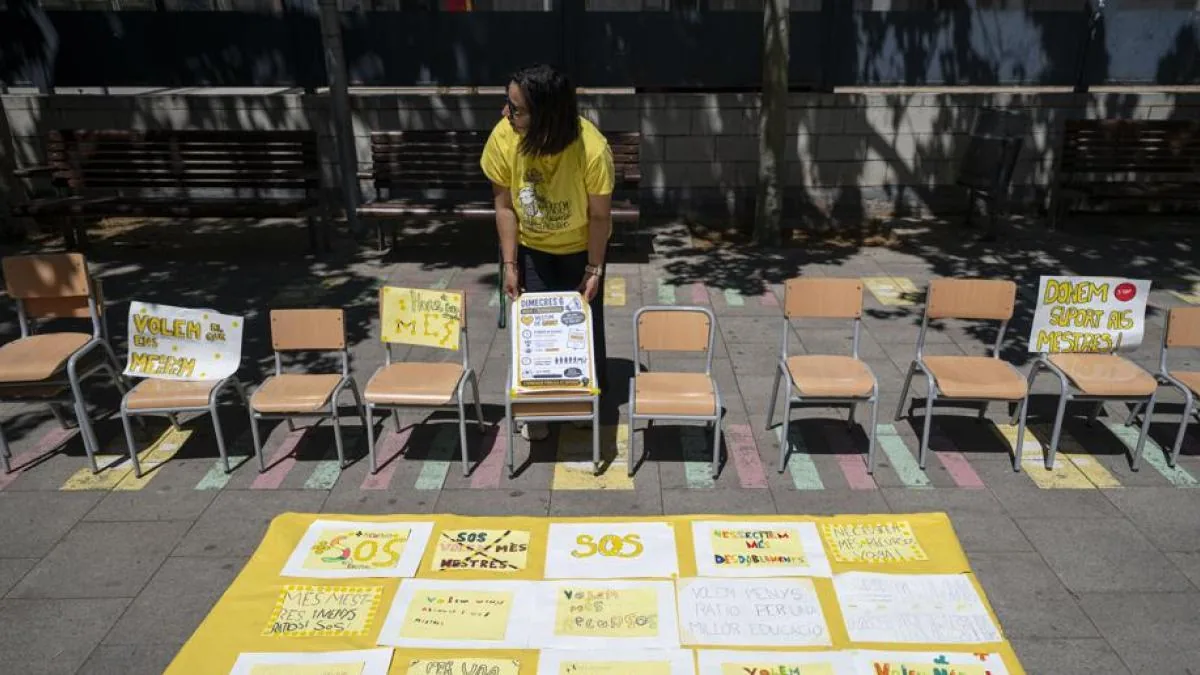
Reducing the number of students per classroom, one of the main demands of the teaching staff, will cost more than 5 billion euros per year and, however, will have a “limited” impact on student learning, according to a study by EsadeEPol. This conclusion contradicts the almost unanimous demand of the teaching staff and has led the Administration to draft new regulations.
Read more The autonomous communities halt tax cuts, except Madrid
The Government has drafted a bill currently under parliamentary process that proposes gradually reducing from 25 students per class in primary to 22 and from 30 in secondary education (ESO) to 25, considering that each student with special educational needs (due to disability or poverty) counts double. There is an exception in highly pressured areas that can exceed the ratio by 10%.
The planned ratio reduction will imply a cost of 5.169 billion annually by 2031, when fully implemented
The measure will be progressively deployed until 2031. During this period, a significant acceleration in the demographic decline is expected. Therefore, a great paradox occurs: while classes lose students, the number of teachers increases.
The EsadeEcPol study on school ratios questions the effectiveness of lowering ratios and concludes that a general regulation is very costly and of limited effectiveness. It adds that administrations could take advantage of periods of lower birth rates to design educational policies better suited to strengthening the system’s weak points. “On average, when demographics fall, hiring more teachers makes no sense, it is very expensive and ineffective, except for those schools with more vulnerable students,” explains Lucas Gortázar, author, along with Professor José Montalbán from Stockholm University, of the report on the economic impact of the new school ratio law.
Five fewer students per class is associated with a 1.25% improvement in performance, a statistically irrelevant effect
According to this study, the planned ratio reduction will involve an adaptation cost of 6.549 billion, including the construction of new classrooms and hiring more teachers. This must be offset by the demographic decline, fewer children in schools, which amounts to 1.380 billion. The final net cost is 5.169 billion. Gortázar explains that it is a high cost that benefits classrooms in urban areas more, many of which are composed of students from higher socioeconomic profiles.
In Catalonia, one of the autonomous communities most affected along with Madrid and Andalusia, the cost will be 1.177 billion euros annually when the measure is fully in force. This represents 22% more than the current education budget. Catalonia has a high number of students, ratios above those established by the measure, and a high proportion of students with special needs (who count double).
The authors point out that the Ministry of Education itself emphasizes in the bill’s explanatory statement that there is no available evidence on the direct impact of this measure on learning outcomes but “reducing the workload of teachers has a positive effect on their well-being and personal satisfaction.”
Read more Barcelona tries to put the kings of illegal pensions in jail
The report cites a study by Montalbán, one of the EsadeEcPol researchers, which states that lowering ratios has a minimal effect on student learning or repetition rates. Five fewer students per class is associated with a 1.25% improvement in performance, a statistically irrelevant effect. However, it does impact teacher satisfaction with their work, the reduction of disruptive students in the classroom, and the well-being of families who spend less on private tutoring.
The study applauds that a student with a disability or in poverty counts as two
The benefits of lowering ratios are greater in schools with a higher number of students with special educational needs, where they are already common. The study acknowledges that counting a student with a disability or in poverty as two is one of the most justified parts of the bill because these students require more personalized attention.
In any case, it assumes that co-teaching or occasional classroom support could avoid splitting classes, saving on construction and teaching costs.
The report encourages investing where it is most needed. Gortázar proposes “attracting the best teachers to these schools and paying them better, splitting classes at critical times, intensive tutoring, or remedial classes.” Also establishing an educational MIR (residency) that trains newly graduated teachers in schools.
“We should take advantage of the demographic window opening in the coming years as a lever to invest where evidence shows the educational return is greatest, that is, in students of lower socioeconomic status,” he concludes.
The bill, which has passed the approval of the State School Council and has been presented to the Sectoral Education Conference, includes an economic memorandum that does not detail its cost. This will be borne by the autonomous governments. It will soon be voted on in the Congress of Deputies.
Read more The energy shock from the Iranian conflict weakens the manufacturing sector